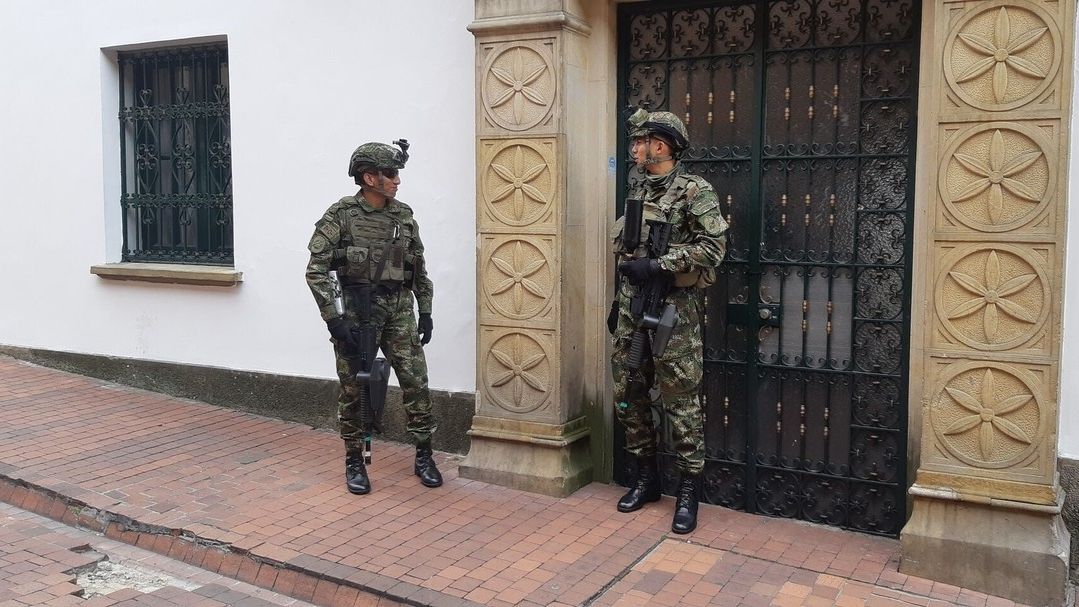
Bomb Attack in Colombia Kills at Least Seven People
A bombing in Colombia on April 25, 2026, killed at least seven people in a resurgence of violence tied to territorial disputes between dissident FARC factions and ELN guerrillas over coca cultivation corridors and illegal mining zones, threatening regional stability and disrupting cross-border trade flows with Venezuela and Ecuador, where illicit economies fuel broader insecurity.
The Fracturing of Colombia’s Peace Dividend
The April 25 attack in the Cauca department—a historic flashpoint for insurgent activity—marks the deadliest single incident since the 2016 peace accord’s implementation began to fray. While the Colombian government attributes the bombing to ELN rebels targeting a military patrol, local NGOs suggest dissident FARC structures are increasingly coordinating with transnational criminal networks to control routes moving cocaine toward Pacific ports and the Venezuelan border. This mirrors patterns seen in 2023 when ELN blockades cut off vital highways, causing a 17% spike in domestic food prices and delaying soybean exports from the Llanos region.

Colombia’s role as Latin America’s fourth-largest exporter of coal and third-largest producer of flowers means prolonged insecurity in rural zones directly impacts global supply chains. The Pacific port of Buenaventura, handling nearly 60% of the country’s containerized exports, has seen sporadic slowdowns due to extortion demands on trucking cooperatives. Meanwhile, illegal gold mining in Antioquia and Chocó—often guarded by the same armed groups responsible for Friday’s bombing—feeds into international markets through laundered shipments to the UAE and India, complicating due diligence for responsible sourcing initiatives.
“What we’re witnessing isn’t just a relapse into conflict—it’s the criminalization of governance vacuums. When state presence retreats, illicit economies don’t just fill the gap; they reconfigure logistics, labor, and trade routes around their own rules.”
How Illicit Economies Distort Legal Trade
The macroeconomic cost of Colombia’s internal conflict extends far beyond humanitarian tolls. According to a 2025 World Bank assessment, violence-linked disruptions reduce Colombia’s annual GDP growth by 0.8 to 1.2 percentage points, with foreign direct investment in mining and agribusiness consistently 15–20% below regional averages due to perceived operational risk. Insurance premiums for cargo transiting through high-risk zones have risen 22% since 2023, per Lloyd’s of London data, pushing logistics firms to reroute shipments through longer, more expensive corridors via Panama or Brazil.

This creates a clear bifurcation: legitimate exporters face rising compliance and security costs, while illicit actors exploit the same routes for smuggling—often using identical documentation fronts. The result is a distorted playing field where companies investing in traceability and ethical sourcing are undercut by those benefiting from shadow logistics networks. In response, multinational buyers in the EU and US are increasingly demanding third-party verification not just of origin, but of transit integrity—a niche now filling rapidly with specialized consultants.
For firms exposed to Andean supply chains, the solution lies not in avoidance but in adaptive resilience. Forward-thinking importers are now engaging global risk assessment consultants to map real-time threat intelligence across Colombia’s subnational territories, while retaining international trade lawyers versed in OECD Due Diligence Guidance to restructure contracts with force majeure clauses calibrated to insurgent activity indices. Simultaneously, supply chain security providers are deploying AI-driven anomaly detection systems to flag irregularities in shipping manifests that may indicate co-loading with illicit cargo—a practice growing in tandem with regional instability.
The Spillover Effect: Border Economies Under Strain
Colombia’s instability does not respect borders. The 1,600-km frontier with Venezuela has become a conduit for both humanitarian migration and black-market fuel smuggling, with Colombian subsidized gasoline regularly resold in Bolívar state at black-market prices—a dynamic that intensified after Venezuela’s 2024 currency redenomination wiped out formal fuel subsidies. Similarly, Ecuador reports a 30% increase in apprehensions of Colombian-trained militias operating along the Putumayo corridor, where illegal mining concessions overlap with protected indigenous territories.

These cross-border flows complicate regional cooperation mechanisms. Although Colombia, Ecuador, and Venezuela reactivated the Trilateral Border Command in early 2026, mistrust persists—particularly after Caracas accused Bogotá of harboring Venezuelan opposition militants, a claim Colombia denies. The erosion of confidence undermines joint patrols and intelligence sharing, creating blind spots that criminal networks exploit. As one regional analyst noted, “The Andes are no longer defended by armies alone; they are contested by whoever controls the next mile of road.”
“In the modern insurgency, victory isn’t measured in territory held—it’s measured in supply chains penetrated. The group that controls the trucking union controls the economy.”
Where Opportunity Meets Obligation
For global investors, Colombia remains a study in contradiction: vast agricultural potential, strategic Pacific access, and a growing tech sector in Medellín and Bogotá coexist with zones where the state’s monopoly on violence is effectively outsourced to armed actors. This duality demands sophisticated navigation—not retreat. European importers of Colombian coffee and textiles are already piloting blockchain-based traceability systems audited by international financial advisors specializing in emerging market compliance, while simultaneously retaining geopolitical risk consultants to model scenarios ranging from negotiated ceasefires to escalated fracturing along ideological lines.
The long-term trajectory hinges on whether Bogotá can reestablish credible governance in peripheral zones without reigniting human rights concerns—a balance that will determine not only Colombia’s democratic resilience but also the integrity of Andean supply chains feeding into global markets. Until then, the bombing in Cauca is not an isolated tragedy; it is a data point in a broader trend where conflict, commerce, and criminality converge—and where the firms that thrive will be those that treat security not as a cost center, but as a core logistics function.
As the global chessboard shifts beneath opaque frontiers and ungoverned spaces, the advantage belongs to those who see beyond headlines—to the trucking routes, the port delays, the laundered shipments. For businesses navigating this terrain, the World Today News Directory remains the essential compass: connecting you with the risk consultants, trade lawyers, and supply chain auditors who turn geopolitical volatility into actionable insight.