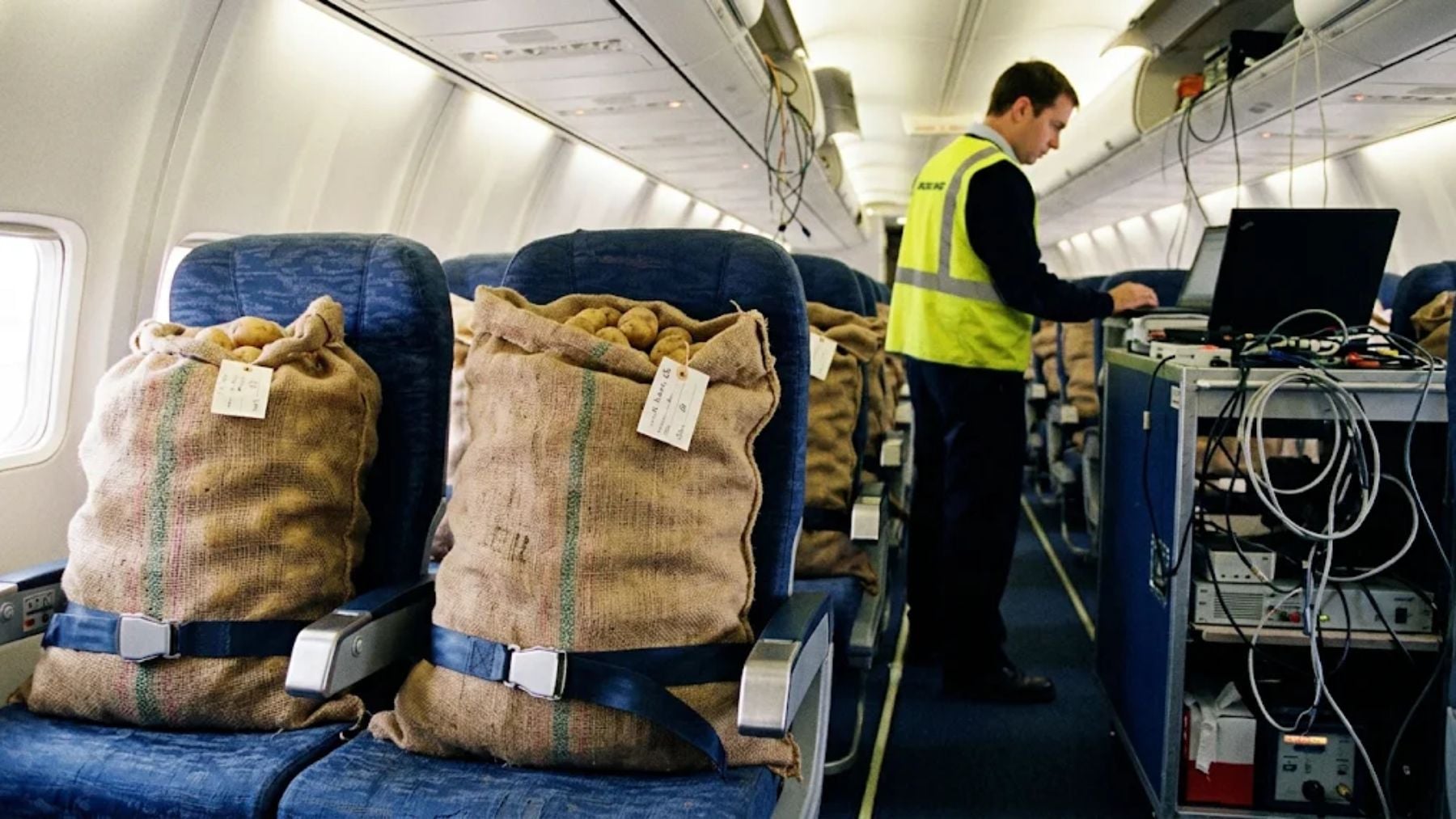
Boeing Uses 9,072 kg Potatoes to Simulate Passengers for Wi-Fi Tests
Boeing engineers improved cabin Wi-Fi connectivity by using 9,072 kilograms of potatoes to simulate human passengers during testing.
The company announced the results of the project in December 2012, OkDiario reported.
The initiative, which began in 2006, aimed to solve the problem of signal interference in commercial aircraft. Because human bodies contain water and possess dielectric properties that absorb and reflect radio waves, the potatoes served as a functional stand-in for travelers, xataka.com reported. By filling an out-of-service airplane with sacks of potatoes, the engineering team could conduct measurements without the logistical challenges of keeping human volunteers seated for extended periods.
“Inside the plane there is a very complex electromagnetic environment. Some seats can have a very strong signal and others, a very weak signal,” Dennis Lewis, a Boeing metrology engineer, told OkDiario. Lewis said that the movement of passengers or service carts during a flight constantly alters these signal levels.
The project, which engineers named SPUDS—an acronym for “Synthetic Personnel Using Dielectric Substitution”—allowed the company to optimize Wi-Fi stability while ensuring signals did not interfere with critical navigation and communication systems, according to xatakamovil.com. The testing process, which previously required over two weeks to complete, was reduced to 10 hours using this method, OkDiario reported.
Origin of the Potato Substitute
The idea to use potatoes emerged after a Boeing team member found a study in the Journal of Food Science analyzing the dielectric properties of 15 fruits and vegetables, OkDiario reported.
Adam Tischler, a Boeing spokesman, said the article showed potatoes could replicate human interaction with electromagnetic fields. “That is where the potatoes come into play,” Tischler told the outlet, adding the approach was not the engineers’ initial plan but a demonstration of their ingenuity.

Naiara Philpotts, an editor with a postgraduate degree in critical reading from the University of Buenos Aires, wrote the OkDiario report detailing the project’s background. She said that SPUDS stands for Synthetic Personnel Using Dielectric Substitution, a colloquial English term for potatoes, according to Xataka. The acronym reflected the project’s core method: using the tubers’ water content and chemical composition to mimic a passenger’s effect on radio signals.
Validation and Safety Outcomes
After collecting data with the potato-filled aircraft, engineers contrasted the results with measurements involving real people to verify reliability, both Xataka and Xataka Móvil reported. The tests confirmed the tubers absorbed and reflected radio waves similarly to human bodies due to their roughly 80% water content and dielectric properties. This validation allowed Boeing to develop a proprietary system for adjusting wireless signals to achieve more uniform cabin coverage.
The new methodology reduced testing time from over two weeks to ten hours while ensuring signals did not interfere with essential aircraft electronics, according to company statements cited by Xataka Móvil.
The Path to the Tubers
The first tests were conducted in a Boeing laboratory in Arizona, in the United States, according to OkDiario. The idea originated from an article in the scientific journal of Food Science that analyzed the dielectric properties of 15 fruits and vegetables, as reported by OkDiario. “Ahí es donde entran en escena las patatas”, explicó Adam Tischler, portavoz de Boeing.
| Development Phase | Timeframe |
|---|---|
| Project initiation | 2006 |
| Experiment execution and public announcement | December 2012 |
The testing involved placing approximately 20,000 pounds, or 9,072 kilograms, of potatoes on seats within a retired aircraft, xataka.com noted. Engineers verified the reliability of these results by later contrasting the data with tests involving real people.
“From a safety point of view, you want to know what the signal peaks are, what is the strongest signal that one of our communication and navigation systems could receive from a laptop, or from 150 or 350 laptops,” Lewis told OkDiario.
The enhanced Wi-Fi configurations developed through these trials are currently available on Boeing 777, 747-8, and 787 Dreamliner models. “This is a perfect example of how our safety innovations can improve the entire flying experience,” Dennis O’Donoghue, vice president of Boeing’s Test and Evaluation area, stated to OkDiario.