Blood Pressure Reduction Yields Broad Quality of Life Results Per NEJM Study
Reducing blood pressure across the entire risk spectrum yields broad results in improving quality of life, according to a study published on Nov. 26, 2026, in the New England Journal of Medicine.
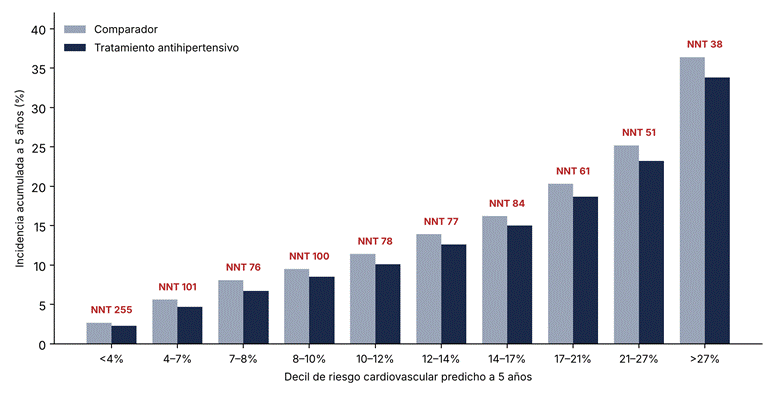
Using individual participant data from 357,440 participants across 51 randomized trials, researchers from the Oxford group of the Blood Pressure Lowering Treatment Trialists’ Collaboration showed that each 5 mmHg reduction in systolic pressure reduces major cardiovascular events by about 10% (HR 0.90; 95% CI, 0.88–0.92). This relative effect remains the same across all risk deciles, even below a 5-year risk of 4%. The study recorded 43,600 major cardiovascular events: 11.4% in the intervention group and 13.0% in the comparator group.
While the relative effect is consistent, the absolute benefit changes significantly. The number needed to treat (NNT) at five years ranges from 255 in the lowest-risk decile to 38 in the highest-risk decile. Adverse effects—including hypotension, acute kidney injury, dizziness, and syncope—increase in the same relative proportion across the entire spectrum, narrowing the benefit-harm balance as risk decreases.
For Argentina, the message presents challenges, as only about one in four hypertensive individuals is controlled, and nearly four in ten are unaware of their condition. The study emphasizes that the healthcare priority must be closing the care cascade gap in high- and intermediate-risk patients through risk stratification, fixed-dose combinations, and nominal follow-itis. Funding for the research was provided by the British Heart Foundation.
For half a century, the decision to treat blood pressure relied on a fixed threshold of 140/90, later incorporating comorbidities such as diabetes, renal disease, and prior cardiovascular disease, and eventually global cardiovascular risk estimation. An epidemiological paradox exists wherein most cardiovascular events occur in people with normal or only slightly elevated pressures simply because they represent a larger population, leaving the lower end of risk as a blind spot.
A previous meta-analysis by the same group published in The Lancet in 2014 included only 11 trials, four broad strata, and a lower stratum defined as less than 11% risk with few events. The new study tested that exact assumption.
The authors gathered patient-level data from trials in the third round of the Blood Pressure Lowering Treatment Trialists’ Collaboration, requiring at least 1,000 person-years of follow-up per arm, according to Saludbydiaz.
They constructed an internal risk model using a one-step individual participant data meta-analysis, trial-stratified Cox proportional hazards models with fixed effects, registered under PROSPERO CRD42018099283, utilizing ten preset covariates including age, sex, body-mass index, total cholesterol, and systolic and diastolic pressure across a population with a mean age of 65 years, 41.6% women, and a mean baseline blood pressure of 152/87 mmHg over a median follow-up of 4.2 years.
The British Heart Foundation funds cardiovascular research with an annual budget of around £100 million, supporting over 1,000 projects across the UK. Its influence extends globally through the Global Cardiovascular Research Funders Forum, launched in June 2021, where it collaborates with leading organizations like the American Heart Association to align research priorities and accelerate breakthroughs worldwide.
Authors and Study Details
The study was authored by Zeinab Bidel, Milad Nazarzadeh, Borislava Mihaylova, and colleagues. Its only function was to order participants to evaluate if the treatment effect changes with risk, following the PATH (Predictive Approaches to Treatment effect Heterogeneity) approach. The citation for the study is Bidel Z, Nazarzadeh M, et al., for the BPLTTC.