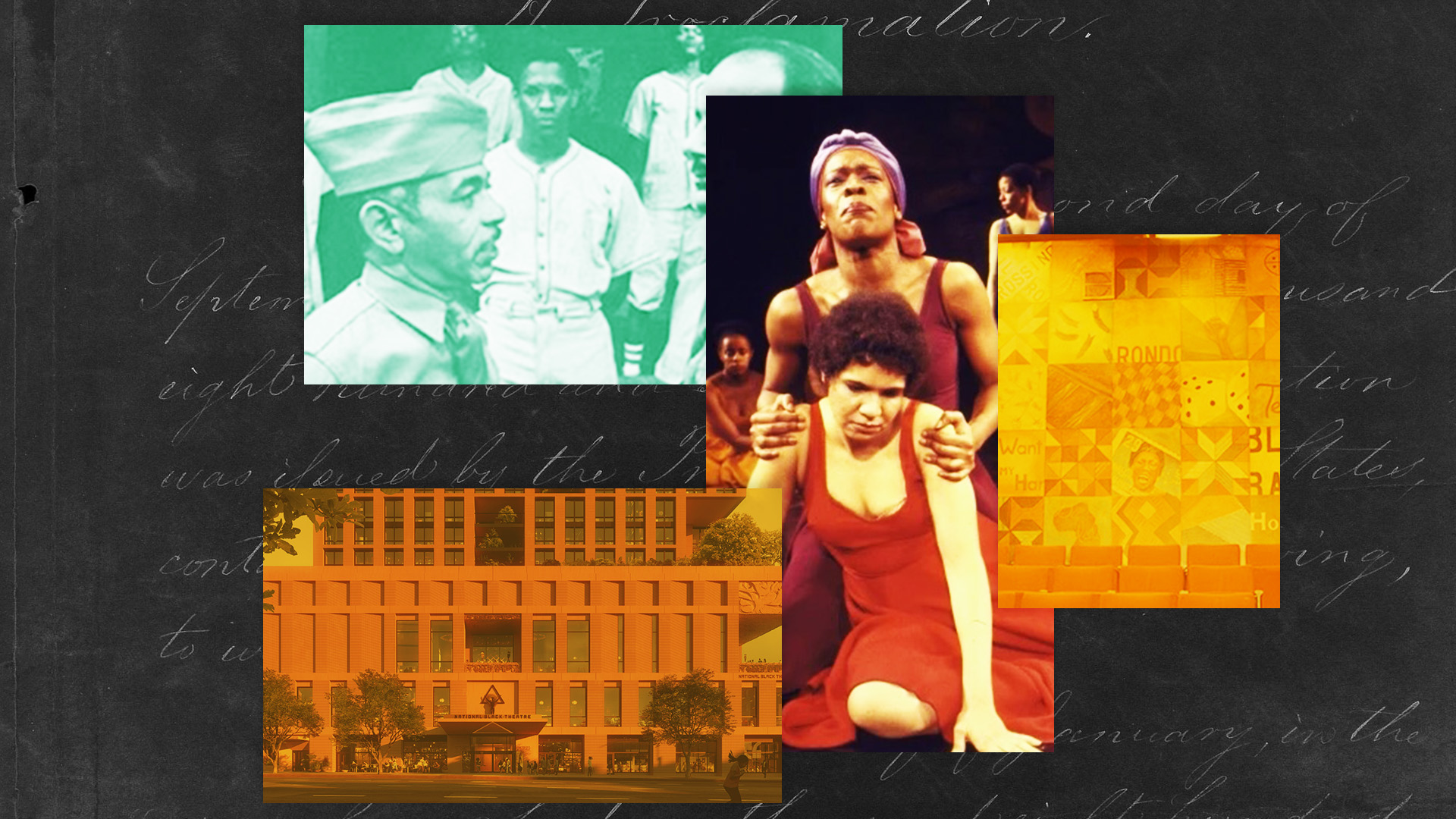
Black Theater: The Beginning of a 250-Year Journey
As America reflects on 250 years of its history, Black theater reminds us that some of this nation’s most transformative stories were created far from its biggest stages, according to Sade Lythcott, CEO of the National Black Theatre in Harlem, New York, speaking to EBONY. While staging a production on Broadway has traditionally symbolized mainstream commercial success, Black playwrights, actors, and directors have historically built independent institutions in off-Broadway hubs, the Midwest, and the South to showcase unfiltered artistry.
The Off-Broadway Vanguard and the Black Arts Movement
When the Black Arts Movement reshaped the cultural landscape from 1965 into the 1970s, Black creatives established dedicated spaces for visibility beyond Midtown Manhattan. Among the earliest institutional pioneers was the Negro Ensemble Company, launched in 1967 by actor Robert Hooks, playwright Douglas Turner, and theater manager Gerald Krone at the St. Marks Playhouse in New York City. According to historical records of the company, their shared vision brought forth prestigious productions including Joseph A. Walker’s The River Niger and A Soldier’s Story.
A year after the Negro Ensemble Company opened its doors, Dr. Barbara Ann Teer founded the National Black Theatre (NBT) in Harlem in 1968. NBT holds the distinction of being one of the longest continually run theaters in New York City and one of the oldest theaters founded and consistently operated by a woman of color in the United States. During the 1960s and 1970s, the theater served as a cultural nexus for visionary poets and performers, hosting literary figures such as Nikki Giovanni and Maya Angelou alongside legendary vocalist Nina Simone.
For nearly 60 years, National Black Theatre has safeguarded Black artistic freedom, invested in visionary artists before the world knew their names, and demonstrated that Black theater is not a chapter of American culture, but rather one of the forces that continues to redefine it, Lythcott stated. For its 2026–2027 season, NBT has adopted the theme “Just Beyond the Horizon” to explore identity, belonging, love, and self-determination, featuring major productions like Sarah Jones’ America, Who Hurt You? and the world premiere of the musical Imitation of Life by Lynn Nottage and John Legend.
Institutional Expansion Across New York and New Jersey
The institutional momentum continued into the next decade when Woodie King Jr. founded the New Federal Theatre (NFT) in 1970. King’s company earned widespread recognition for staging innovative shows that engaged with contemporary social justice movements, particularly the feminist movement. Ntozake Shange’s acclaimed experimental choreopoem, For Colored Girls Who Has Considered Suicide/When the Rainbow Is Enuf, premiered at NFT during its 1975–1976 season, earning a Tony nomination under King’s production.
The stage has continually served as a launchpad for emerging talent. In 2002, NFT mounted a production of playwright Ron Milner’s Urban Transition: Loose Blossom, starring Chadwick Boseman. Boseman earned an AUDELCO award for his performance, joining a roster of luminaries including Debbie Allen and Denzel Washington who have shaped the institution’s legacy. Continuing this collaborative tradition, the New Federal Theatre partnered with the North Carolina Black Repertory Company to present the International Black Theatre Festival debut of Blooming in Dry Season, running in North Carolina from July 28 to August 1.
Further establishing regional infrastructure for marginalized voices, directors Ricardo Khan and Lee Kenneth Richardson opened the Crossroads Theatre Company in New Jersey in 1978. The theater achieved national prominence in 1986 with the premiere of The Colored Museum by director and playwright George C. Wolfe, who was then serving as a resident artist. Wolfe’s sharp satire of Black American stereotypes captured widespread critical attention, permanently altering the trajectory of American dramatic literature.
Regional Growth from Minnesota to Texas
While New York remained a vital epicenter, independent theater companies simultaneously took root across the American Midwest and South, building localized creative communities that nurtured foundational American playwrights.
In St. Paul, Minnesota, theater director Lou Bellamy established the Penumbra Theatre Company—also known as the Penumbra Center for Racial Healing—in 1976. As Minnesota’s sole Black professional theater company, Penumbra has produced over 200 plays. Prominent playwright August Wilson launched his career as part of the company’s original ensemble. Penumbra staged Wilson’s first professional production, Black Bart and the Sacred Hills, providing the vital runway that enabled him to write his monumental 10-play Century Cycle.
Concurrently in 1976, playwright George Hawkins founded The Ensemble Theatre in Houston, Texas, driven by a vision to place Black stories and actors at the center of the stage. Starting modestly with Hawkins producing his own play, Surprise, Surprise…A Love Story, the company expanded significantly, relocating to a permanent home in Houston’s Midtown Arts District in 1985. Today, it stands as one of the country’s largest African American-owned and operated theaters producing work entirely in-house, helping transform its neighborhood into a vibrant Texas cultural arts district.
As these regional spaces continue to archive two and a half centuries of performance history and stage contemporary works, maintaining physical infrastructure and public access remains an ongoing administrative challenge.
Through the decades, as artistic attitudes evolved past the initial surge of the Black Arts Movement, new entities such as The Classical Theatre of Harlem—founded in 1999 at the Harlem School of the Arts—have sustained the vital work of community-centered Black performance. These institutions collectively prove that the history of Black theater in America is not confined to a single street or a single era, but spans a vast, decentralized network of stages that continue to redefine the nation’s cultural identity.