
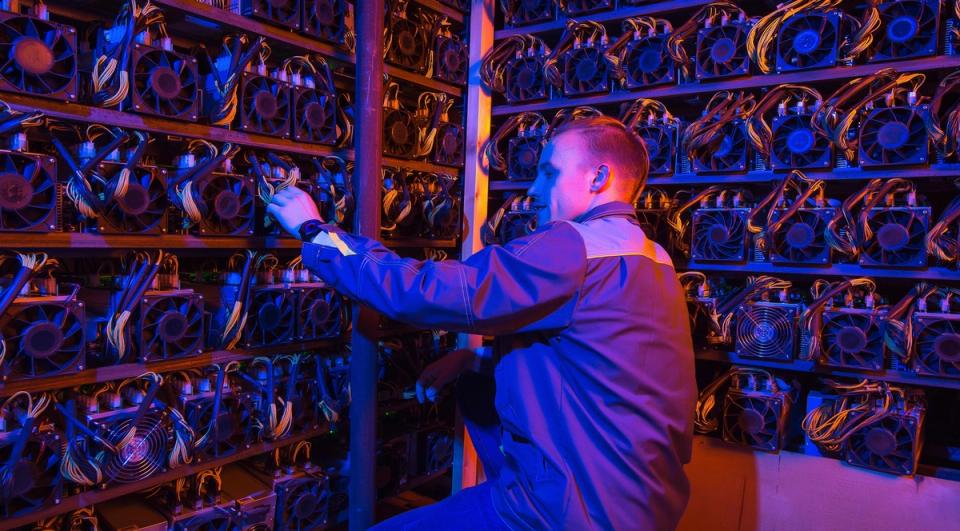
Bitcoin Miners Pivot to AI Infrastructure Amid Mining Losses
Publicly traded Bitcoin miners are liquidating BTC reserves and pivoting to AI infrastructure as Q4 2025 cash costs hit $79,995 per coin. With Bitcoin trading below $70,000, firms like Core Scientific and TeraWulf are prioritizing high-margin HPC contracts over network security, signaling a fundamental structural shift in the sector’s valuation model.
The balance sheet is the only truth that matters in a bear market and right now, the ledgers of public Bitcoin miners are screaming. The industry is undergoing its most violent metamorphosis since the genesis block, driven not by ideology, but by a brutal compression of margins. According to the latest Q1 2026 Mining Report from CoinShares, the weighted average cash production cost for a single Bitcoin among public miners surged to approximately $79,995 in the fourth quarter of 2025. With Bitcoin hovering in the $68,000 to $70,000 range, the sector is bleeding an estimated $19,000 on every unit produced.
This is not a temporary liquidity crunch; it is an existential solvency crisis. The rational economic response has been immediate and total: a pivot toward High-Performance Computing (HPC) and Artificial Intelligence. The math is simple. Mining infrastructure costs roughly $700,000 to $1 million per megawatt. AI infrastructure commands $8 million to $15 million per megawatt. When AI colocation contracts promise margins exceeding 85% with multi-year revenue visibility, although mining margins sit in negative territory, capital allocation committees have no choice but to flee the hash rate.
The Valuation Arbitrage: Mining vs. HPC
The market has already priced in this bifurcation. Investors are no longer valuing these companies as commodity producers; they are re-rating them as data center real estate investment trusts (REITs). The divergence in valuation multiples tells the entire story of where institutional capital is flowing.
| Metric | Legacy Pure-Play Miners | Hybrid AI/HPC Miners |
|---|---|---|
| Forward Revenue Multiple | 5.9x | 12.3x |
| Primary Revenue Driver | Block Rewards (Volatile) | Colocation Contracts (Fixed) |
| Infrastructure CAPEX / MW | $0.7M – $1.0M | $8.0M – $15.0M |
| Projected AI Revenue Share (2026) | <10% | Up to 70% |
Core Scientific, for instance, now derives 39% of its total revenue from AI colocation. TeraWulf sits at 27%. The extended contract between CoreWeave and Core Scientific alone is valued at $10.2 billion over 12 years. TeraWulf has secured $12.8 billion in contracted HPC revenue. These are not side hustles; they are the new core businesses. As this transition accelerates, mid-cap miners lacking the balance sheet to retrofit facilities for liquid-cooled GPUs are scrambling for defensive capital, often turning to specialized corporate restructuring firms to manage the deleveraging required to survive the pivot.
Financing the Pivot: Debt and Liquidation
Funding this infrastructure overhaul requires massive capital expenditure, and the traditional equity raise is too dilutive in this environment. The sector’s debt profile has fundamentally altered. We are seeing a shift from operational debt to infrastructure-scale leverage.
IREN now holds $3.7 billion in convertible notes across five tranches. TeraWulf’s total debt load has ballooned to $5.7 billion, split between convertibles and senior secured notes tied to its data center subsidiary. Cipher Digital issued $1.7 billion in secured notes in November, causing its quarterly interest expense to skyrocket from $3.2 million to $33.4 million in a single quarter. This is a high-stakes wager that AI revenue will materialize speedy enough to service debt obligations that dwarf previous mining-era liabilities.
The second funding mechanism is even more telling: the liquidation of the treasury. Public miners have collectively reduced their BTC holdings by over 15,000 coins from recent highs. Core Scientific sold 1,900 BTC in January and plans to liquidate nearly all remaining reserves in Q1 2026. Bitdeer reduced its holdings to zero in February. Even Marathon, the largest public holder with 53,822 BTC, quietly amended its 10-K filing in March to authorize sales from its entire balance sheet reserve. This move was partially driven by pressure on its $350 million bitcoin-backed credit facility, where the loan-to-value ratio spiked to 87% as prices dipped.
“We are witnessing the financialization of the mining sector’s balance sheets. The decision to sell BTC to fund AI capex is a clear signal that management teams view the risk-adjusted return on HPC infrastructure as superior to holding a volatile crypto asset. This is a classic arbitrage play.”
— Marcus Thorne, Senior Portfolio Manager, Apex Digital Assets
The Network Security Paradox
There is a inherent tension in this transition. The particularly companies securing the Bitcoin network are the ones divesting from it. If mining becomes unprofitable and AI becomes lucrative, the rational fiduciary duty is to extract capital from mining. But, if enough miners execute this strategy simultaneously, the network’s security budget shrinks.
The data confirms this contraction. Network hashrate peaked at roughly 1,160 Exahashes per second (EH/s) in October 2025 and has since retreated to approximately 920 EH/s. We have witnessed three consecutive negative difficulty adjustments, the first such series since July 2022. CoinShares projects the network hashrate will reach 1.8 Zettahashes by the end of 2026, but this forecast assumes a Bitcoin price recovery to $100,000. If prices remain suppressed below $80,000, the hash price will continue to erode, triggering further capitulation.
Geopolitically, the landscape is shifting alongside the economics. The United States, China, and Russia now control approximately 68% of global hashrate. The U.S. Gained roughly 2 percentage points of market share in Q4 alone. Meanwhile, emerging markets like Paraguay and Ethiopia are entering the top 10, driven by massive facilities like HIVE’s 300-megawatt plant in Paraguay. For miners looking to establish footholds in these jurisdiction-friendly zones, securing reliable energy contracts is paramount, often requiring negotiations with specialized industrial energy infrastructure providers capable of handling gigawatt-scale loads.
Hardware as the Final Lifeline
Next-generation hardware offers a potential reprieve, but it comes with a catch. Bitmain’s S23 series and Bitdeer’s proprietary SEALMINER A3, both operating under 10 Joules per Terahash, are expected to scale in H1 2026. These units could halve energy costs compared to mid-generation machines. However, acquiring this hardware requires capital that miners are currently diverting to AI data centers.
The industry began this cycle as a collection of entities securing a decentralized network and accumulating Bitcoin. It is exiting the cycle as a group of data center operators selling Bitcoin to fund that transition. Whether this is a cyclical reaction to unfavorable economics or a permanent structural change depends on a single variable: the price of Bitcoin. A return to $100,000 restores mining margins and slows the AI pivot. A stagnation at $70,000 accelerates the transformation, effectively erasing the mining sector as we knew it in the last decade.
As consolidation accelerates and pure-play miners face extinction, the remaining hybrids will require sophisticated guidance to navigate this dual-exposure model. Institutional investors are increasingly demanding transparency on how these firms manage the conflict between their crypto treasuries and their fiat-generating AI operations. Navigating this complex regulatory and operational landscape will likely require the expertise of top-tier M&A advisory firms to structure deals that satisfy both traditional equity markets and crypto-native stakeholders.