Bitcoin Gains Altcoins Struggle After DeFi Exploit Amid Middle East Tensions and Shifting Risk Sentiment
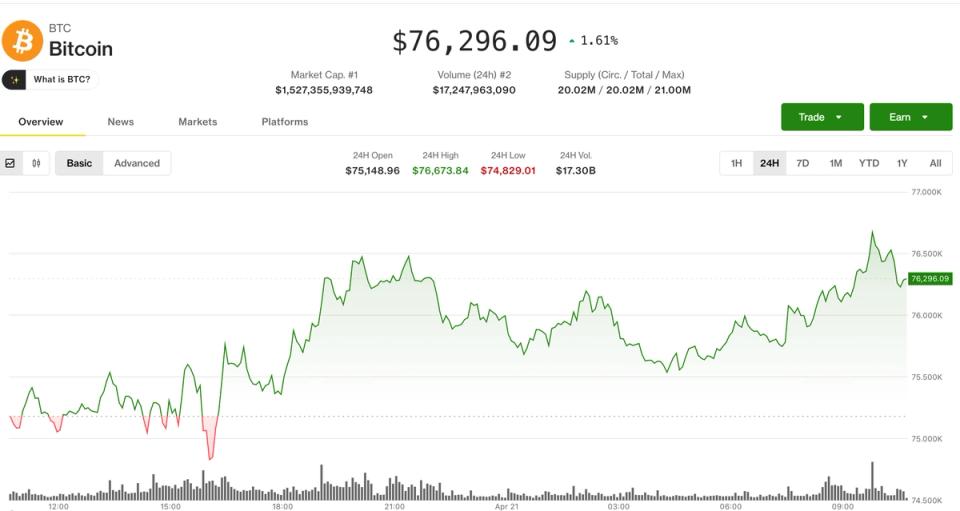
Bitcoin surged past $68,000 on April 21, 2026, as improved risk sentiment lifted crypto markets amid easing Middle East tensions, while altcoins declined 8-12% following a $220 million exploit on a cross-chain DeFi protocol, according to on-chain data from Glassnode and CoinGecko.
Risk Appetite Resets as Bitcoin Leads Crypto Recovery
The divergence between Bitcoin and altcoins reflects a flight to perceived safety within digital assets, with BTC dominance rising to 62.3%—its highest level since November 2024—as institutional investors reallocate capital amid geopolitical stabilization. On-chain analytics show Bitcoin’s 30-day realized volatility fell to 38%, down from 52% two weeks prior, signaling reduced speculative pressure. Meanwhile, the exploited protocol, which facilitates asset transfers between Ethereum and Layer 2 networks, saw its total value locked drop 40% to $1.8 billion after the breach, per DefiLlama. This event has reignited concerns about smart contract vulnerabilities in cross-chain infrastructure, particularly as DeFi protocols collectively hold over $85 billion in TVL across Ethereum-compatible chains.

“Investors are treating Bitcoin as a macro hedge again, not just a risk-on asset. When geopolitical risk recedes, liquidity flows back into the deepest, most liquid crypto market—and that’s still BTC.”
The market’s reaction underscores a persistent structural issue: altcoins remain disproportionately exposed to protocol-level risks that do not affect Bitcoin to the same degree. Unlike Bitcoin, which has no smart contract functionality and a decade-long security track record, many altcoins rely on complex, upgradable codebases that increase attack surface. This dynamic creates a clear B2B problem for firms operating in or adjacent to crypto markets—namely, the need for rigorous, continuous smart contract auditing and formal verification services to mitigate exploit risk.
Where Institutional Guardrails Are Missing
Despite the growth of crypto-native insurance products and on-chain monitoring tools, fewer than 15% of DeFi protocols undergo quarterly third-party audits, according to a Q1 2026 report by the Blockchain Security Association. This gap leaves significant exposure, especially as total value locked in DeFi is projected to reach $120 billion by end-2026, per Galaxy Digital’s forecast. Firms seeking to build trust with institutional allocators must now prioritize not just initial code audits, but ongoing vulnerability monitoring, penetration testing, and incident response planning—services that fall squarely within the purview of specialized cybersecurity firms with blockchain expertise.
For example, enterprises launching tokenized assets or operating cross-chain bridges require partners capable of delivering SOC 2 Type II attestations alongside blockchain-specific threat modeling. These needs are increasingly being met by hybrid firms that combine traditional infosec credentials with deep protocol-level knowledge—a niche that is rapidly professionalizing as regulatory scrutiny intensifies.
“The exploit wasn’t a failure of cryptography—it was a failure of process. No amount of on-chain analytics can replace disciplined, repeatable security hygiene in smart contract development.”
Liquidity Shifts and the Flight to Quality
Beyond security, the Bitcoin-altcoin divergence reveals broader liquidity dynamics shaping crypto markets. Bitcoin’s market cap now exceeds $1.3 trillion, approaching 60% of Ethereum’s fully diluted valuation—a ratio not seen since the 2021 bull run. This shift is being driven by renewed inflows into Bitcoin ETFs, which saw $1.2 billion in net subscriptions last week, per Bloomberg ETF data. Meanwhile, altcoin ETFs experienced $300 million in outflows over the same period, reflecting investor preference for lower-beta, higher-liquidity exposure.

These flows have direct implications for B2B service providers. Crypto exchanges, custodians, and wallet infrastructure firms are seeing increased demand for Bitcoin-centric products, including multisig custody solutions with institutional-grade insurance and real-time proof-of-reserves. At the same time, the altcoin selloff is prompting projects to seek liquidity enhancement services—such as market making, order book depth analytics, and regulatory compliance consulting—to prevent further erosion of trust.
Firms operating in this space must now navigate a bifurcated market: one where Bitcoin demands reliability and macro-linked infrastructure, and another where altcoins require agility, security remediation, and market-making support. This creates layered opportunities for B2B providers who can tailor their offerings to either end of the spectrum—or bridge both.
As risk sentiment continues to evolve with macroeconomic data and geopolitical developments, the cryptocurrency market’s internal differentiation will likely deepen. For businesses exposed to digital assets—whether through treasury holdings, tokenization initiatives, or infrastructure investments—the imperative is clear: partner with vetted B2B firms that specialize in crypto-native security, liquidity optimization, and regulatory compliance. The World Today News Directory connects enterprises with pre-vetted providers in blockchain auditing, digital asset custody, and financial infrastructure services—ensuring that opportunity is met with resilience, not just reaction.