
Beyond Point Solutions: Solving the Architecture Gap in Commerce AI
Commerce AI is Fragmenting: Enterprise Architecture and Integration Realities
Enterprise AI investment in commerce has never been higher while integration outcomes remain markedly inconsistent, according to recent industry analysis. This divergence is not an anomaly. It reflects a pattern in retail technology where capabilities are added faster than underlying infrastructure can unify them, creating inconsistency, context loss, and fragmented customer journeys.
The Tech TL;DR:
- Additive Point Solutions: Retailers continue to layer isolated AI search, conversational interfaces, and recommendation tools over existing infrastructure, creating data coherence issues and conflicting system outputs.
- The Funnel Squeeze: Bain research indicates that organic web traffic to retail sites has dropped 15 to 25% due to AI-driven zero-click search disintermediation, compounding internal architectural friction.
- The Unifying Execution Layer: Leading implementations deploy a shared data layer, policy and governance frameworks, and a transaction layer to ensure cross-tool context persistence.
The Point Solution Pattern and Data Coherence Failures
Over the past three years, the dominant deployment strategy for enterprise retail has been additive. Brands have layered AI-powered search on top of existing catalog infrastructure, deployed conversational interfaces on top of existing checkout flows, and coupled recommendation engines with personalization tools. Each individual component was justified by a discrete metric improvement, yet none were designed to work as a cohesive system.
This point solution pattern creates data coherence issues. When a general-purpose AI tool evaluates inventory, pricing, and product truth from inconsistent data, it frequently surfaces the wrong product or excludes items altogether. The hallucination problem in commerce AI is largely a data coherence problem in disguise. Without a common understanding across inventory, pricing, policy, and product truth, automated systems output contradictory states that mislead consumers and break the checkout funnel.
Where Tool-Level Metrics Mask Systemic Incoherence
Evaluating commerce AI through localized telemetry consistently produces a false sense of security. A conversational AI tool can show strong engagement metrics, an AI search layer can show improved relevance scores, and a checkout system can show reduced abandonment within its own funnel. However, standard analytics stacks fail to capture what happens at the handoffs between these discrete layers, where context breaks and sessions drop.
When a user transitions between layers, purchase intent generated in one layer fails to convert in the next. This architectural breakdown explains why brands investing aggressively in commerce AI often report strong tool-level performance alongside flat or declining overall conversion rates. The tools are working, but the system isn’t.
This internal fragmentation collides directly with macroeconomic shifts. Bain research demonstrates that organic web traffic to retail sites has declined 15 to 25% as AI-driven zero-click search captures top-of-funnel discovery. Brands face simultaneous pressure from external disintermediation and internal architectural leaks—a structural problem that cannot be solved by point-level optimization.
Architectural Remediation: Building the Unifying Execution Layer
Organizations successfully resolving these friction points have adopted a unifying execution layer. Instead of questioning which AI feature to integrate next, these companies have focused on defining the necessary bridge between different AI functions to deliver a seamless shopping journey and dependable purchase results.
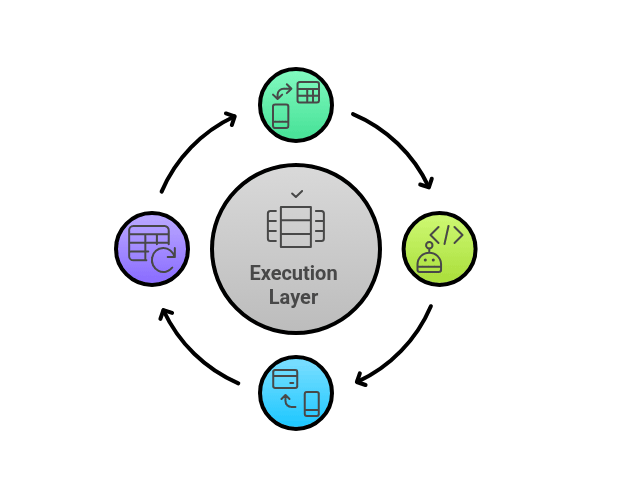
A resilient commerce AI architecture requires three foundational pillars:
- A Shared Data Layer: Giving every AI tool in the stack access to the same real-time product, pricing, and inventory truth.
- Policy and Governance Frameworks: Ensuring AI-generated recommendations operate within the brand’s established rules.
- A Transaction Layer: Capable of receiving intent from any AI surface and converting it into a completed order without breaking context or requiring the consumer to restart.
Preparing Infrastructure for Agentic Commerce
The urgency of structural unification will intensify as agentic commerce matures. When AI systems begin to initiate and complete transactions on behalf of consumers, tolerance for architectural incoherence drops significantly. An AI agent acting on behalf of a consumer will fail and not return if it encounters a broken handoff between a recommendation layer and a checkout system.
Enterprises that establish architectural coherence and unified data layers now will enter that era with a compounding advantage. Companies persisting with disconnected single-purpose applications will discover that every additional utility introduces an extra vulnerability where failure might occur.