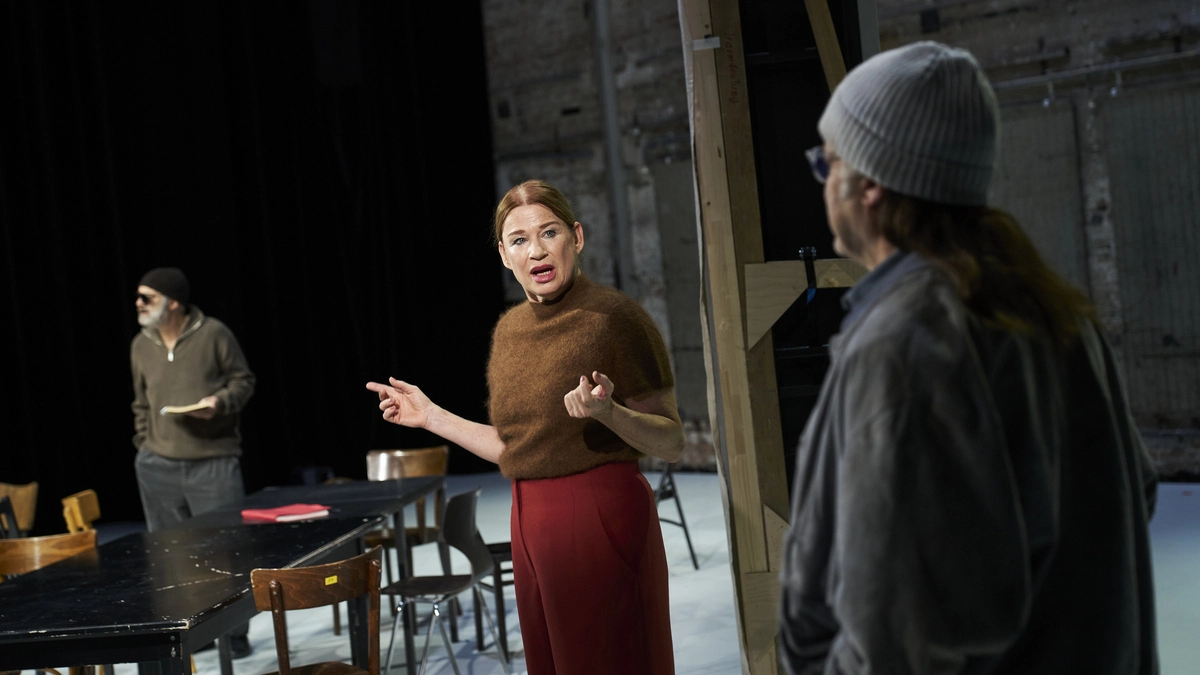
Bergman’s Treulose at the Akademietheater: Central Triangle Holds Lengthy Meta Production Together
“Bühnenlicht aus, bitte!” marks the final line after more than three hours at the Akademietheater, where Matthias Rippert’s staging of Ingmar Bergman’s Treulose premiered to muted applause, Die Presse reported.
Bergman wrote the “score for a visual medium” in 1997, drawing on a marriage where husband and lover were once close friends — a configuration the 79-year-old playwright was living through at the time. Liv Ullmann filmed it three years later.
Rippert adds a meta-layer: the full ensemble revolts against the Bergman figure (Martin Reinke) before the first scene proper begins, and quotes from other Bergman films surface throughout, including the eye-motif embodied by Dorothee Hartinger and Markus Hering, according to Die Presse.
The Bergman figure remains pale, a tired, brooding creator. These meta-layers rarely add anything essential to a drama, mostly only the triviality that we all somehow play, ideally ourselves.
The device loses force as the evening stretches. What holds the production together is the central triangle. Dörte Lyssewski’s Marianne refuses the usual Bergman introversion; she tears through the role with inflamed eyes, wild mane, and a physicality that shifts between undressing, screaming, kissing, and vomiting without tipping into hysteria.
“I am so problematic it borders on the comic,” Roland Koch’s David says while struggling out of cargo pants; his lover matches him in a Zähneputz-scene that already feels iconic. Koch plays the lover as a spent playboy whose only remaining game is his own inadequacy. She wants more from life than the “pastime before death” Bergman prescribes for her.
Markus Hering’s Markus, the conductor-husband, draws power from stillness. He stands before his wife’s affair like a conductor before an orchestra that will play fortissimo whether he cues it or not.
The evening’s most concentrated moment arrives when he explains Brahms’s Piano Quartet No. 3 — the “Werther Quartet” — to musicians as a map of the Brahms–Robert–Clara Schumann triangle, then has them sing the individual voices. Here the play’s art-about-art conceit ignites instead of merely reflecting.
Designed by Ludwig Baumann, Ferdinand Fellner, and Hermann Helmer between 1911 and 1914, the Akademietheater opened in 1914 as the rehearsal stage for the Imperial-Royal Academy of Music and Performing Arts.
The Court Theatres initially declined to rent it, but the Burgtheater began using the venue in the early 1920s, a relationship that deepened until the Federal Theatres assumed exclusive control in 1979, ending its academic function. Its iron curtain, a fire protection measure still in use today, dates from the National Socialist period.
Lisbet Hampe, as the seven-year-old daughter Isabelle, avoids the usual pawn-in-divorce cliché. Her eyes track inward and into distance simultaneously; when she whispers “Hier grasen Schafe” to the auditorium, the line lands as eerie observation rather than theater schmäh.
She lets the imaginative girl keep her secrets, lets her be more than a victim. A section of the set catches fire late in the run, filling the house with smoke and an acrid smell that highlights the fatigue settling over the audience. The house lights finally drop; the applause is polite but thin.