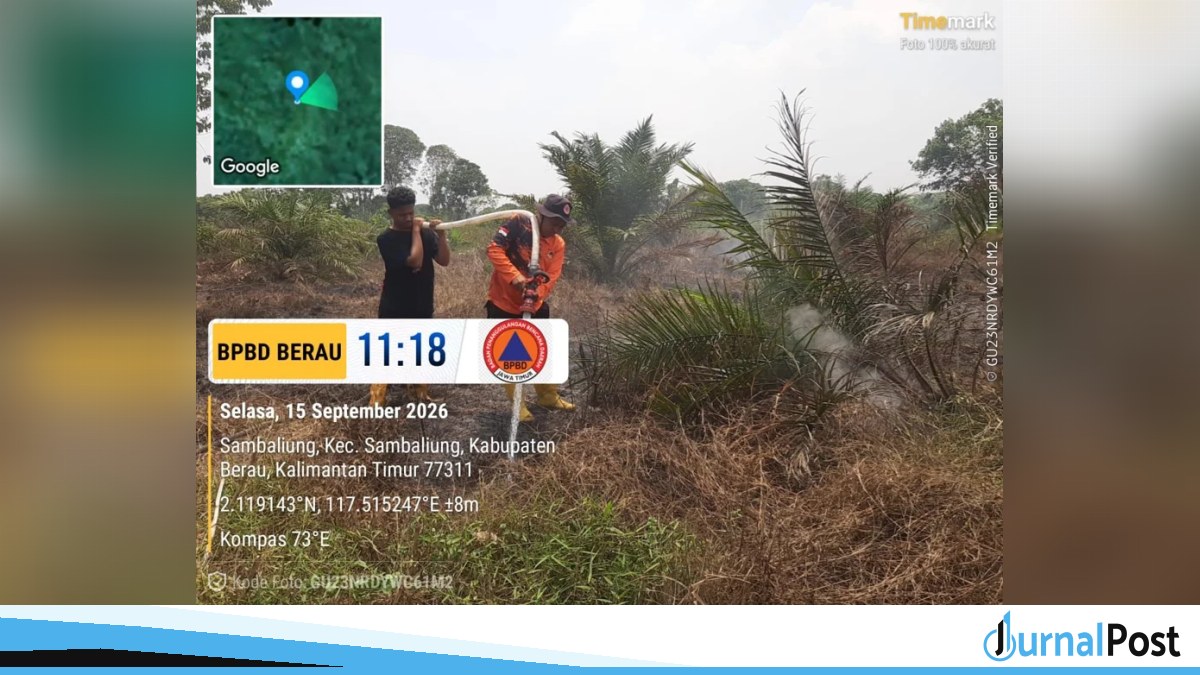
Berau Regency Fire Response Overlooks Volunteer Safety, JurnalPost Reports
Berau Regency’s forest fire response overlooks the safety of volunteer firefighters, JurnalPost reported.
- MPA and KTPA volunteers lack standard personal protective equipment.
- Volunteers face physical, health, psychological, and operational risks.
- Safeguards require four key areas: PPE, competency, SOPs, and budget.
Safety Gaps for Volunteer Firefighters
Forest fires in Berau, East Kalimantan, are a recurring disaster. The front line includes community volunteers from the Fire Care Community (MPA) and the Fire Care Farmer Group (KTPA). Their roles are important: they are often the first to detect hotspots and conduct early suppression.
Their safety, however, is not a primary focus in fire response planning. A large gap in equipment exists between professional teams and volunteers. MPA and KTPA members frequently head into the field wearing only long-sleeved shirts, thin rubber boots, and makeshift masks, often without any respiratory protection, according to the JurnalPost report.
“The success of forest fire management has often been measured by how quickly fires are extinguished, how much land is saved, and how many personnel are deployed,” the report says. “Meanwhile, questions regarding the safety of volunteers while on duty, the adequacy of their protection, and the health risks they face have not yet become a primary focus in forest fire response planning.”
Four Categories of Risk
Volunteers face a range of risks during firefighting operations. These are grouped into four categories by JurnalPost.
First, physical risks. These include heat exposure, dehydration, fatigue, burns, and injuries from falling branches or uneven terrain.
Second, health risks from smoke exposure. Fire smoke contains fine particles and gases that can cause eye irritation, coughing, shortness of breath, and respiratory disorders. Small particles can penetrate deep into the respiratory tract.
Third, psychological risks. Uncontrolled fire situations, pressure to act quickly, and concerns for community safety can cause stress and mental strain.
Fourth, operational risks. These involve a lack of communication, unclear task divisions, limited equipment, and unavailable evacuation routes, all of which can increase the likelihood of accidents.
Four Essential Safeguards
To minimize these risks, four fundamental aspects of occupational health and safety (OHS3) must be met for volunteers, the report details.
1. Personal Protective Equipment (PPE): Volunteers need safety helmets, goggles, gloves, appropriate clothing, safety boots, and respiratory protection tailored to the hazards. Many currently use makeshift clothing.
2. Competency: Training is required on fire hazard recognition, equipment use, field communication, first aid, managing fatigue and dehydration, and emergency evacuation.
3. Standard Operating Procedures (SOPs): SOPs should include reporting mechanisms, appointment of an operation commander, task division, PPE use, communication systems, health checks, and evacuation procedures. Not all fire conditions warrant direct suppression by volunteers; knowing when to retreat is a key safety measure.
4. Budget and Financing: Adequate financial support for OHS3 is needed, involving cross-sectoral agencies from the regency to central government, as well as the private sector.
Strengthening OHS3 for Volunteer Firefighters
The report outlines seven strategic steps to strengthen OHS3 for volunteer firefighters in Berau. These include establishing minimum safety standards, conducting periodic OHS3 training, providing appropriate PPE, developing a health monitoring system, strengthening field coordination, preparing protection and insurance schemes, and conducting safety evaluations after every operation.
The Berau Regency Government, BPBD, Health Office, and KPH can encourage budget integration for standardized PPE and health checks. Concession-holding companies are also urged to contribute safety logistics and medical support.
“It is time for the OHS3 aspect to be placed as a primary foundation, not just a footnote, in every effort to empower the Fire Care Community and Fire Care Farmer Group in Berau Regency,” the report concludes.
Fire Care Community (MPA) is developed by agencies of the Ministry of Environment and Forestry in Jambi and several regional agencies, as of 2019, with a role in community fire control.
In Berau Regency, the MPA is integrated into the fire response system as the first to detect hotspots and conduct early suppression, a role established by the JurnalPost report. The organization faces funding challenges, with obstacles including a limited budget, a unit of financial support identified by a 2019 study in Jambi Province.
The Berau Regency Government, BPBD, Health Office, and KPH have not responded to requests for comment on recommendations for strengthening fire volunteer occupational health and safety.