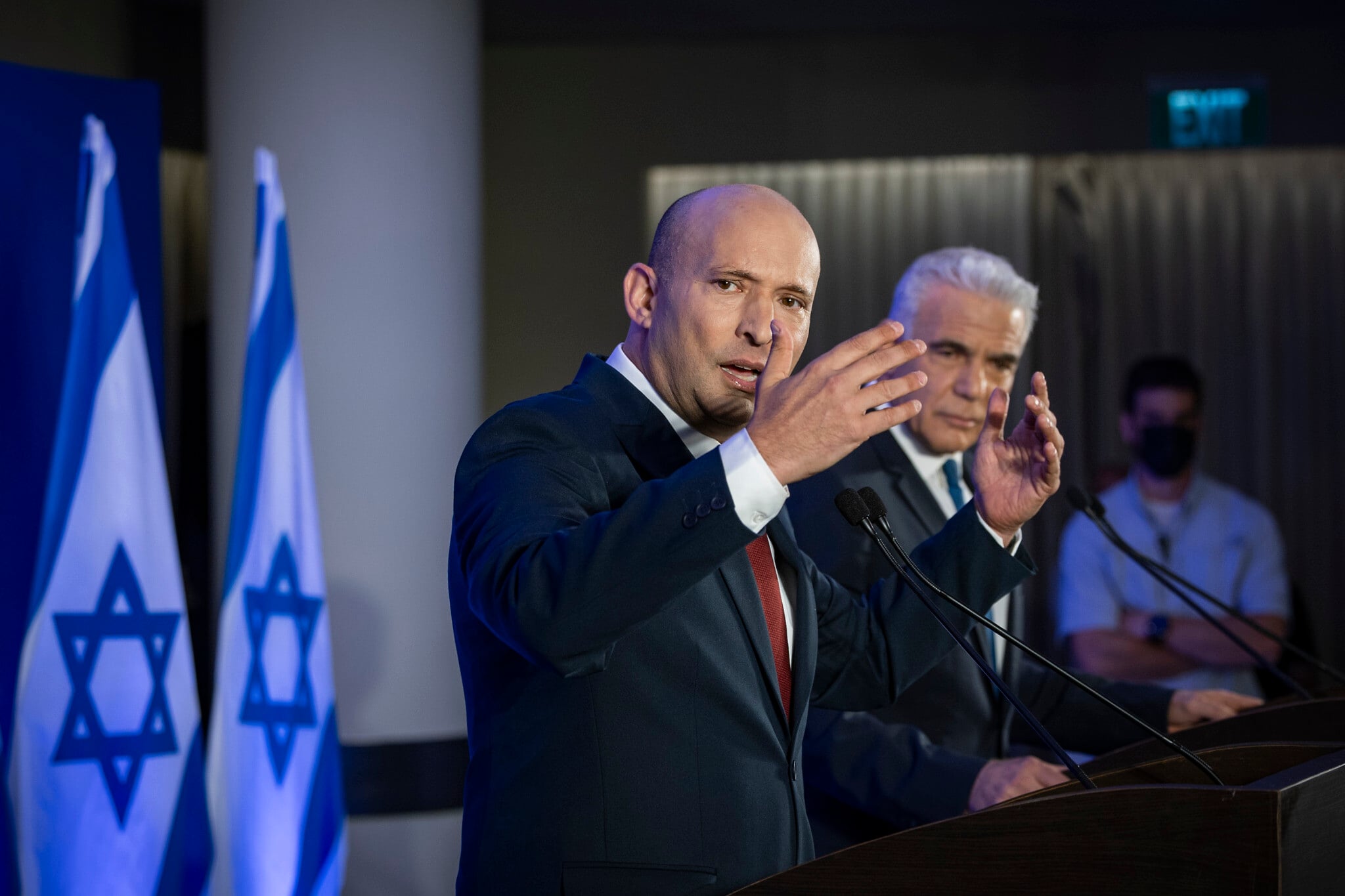
Bennett and Lapid Launch Joint Slate, Promise End to Political Division in Israel
On April 26, 2026, former Israeli Prime Minister Naftali Bennett and opposition leader Yair Lapid announced a joint political slate aimed at unifying Israel’s fragmented center bloc ahead of national elections, declaring that “the era of division is over” and positioning their alliance as the foundation for a new Zionist government capable of defeating Benjamin Netanyahu’s Likud-led coalition.
The announcement, made during a televised press conference in Tel Aviv, represents a dramatic shift in Israeli politics after years of ideological polarization that saw five inconclusive elections between 2019 and 2022. Bennett, who led the Yamina party from 2021 to 2022, and Lapid, head of Yesh Atid since 2012, have historically occupied opposing ends of the secular nationalist spectrum—Bennett aligned with religious Zionist factions, Lapid with liberal secularists. Their partnership signals not just electoral pragmatism but a potential reconfiguration of Israel’s political center, which has struggled to cohere since the decline of the Labor Party in the 2000s.
This realignment comes amid mounting economic strain: Israel’s debt-to-GDP ratio reached 68% in late 2025, according to the Bank of Israel, driven by prolonged military readiness costs and expanded social spending. Simultaneously, housing prices in Tel Aviv and Jerusalem have risen 42% since 2020, pricing out middle-class families and fueling protests over affordability. The Bennett-Lapid alliance frames economic stability and civic unity as prerequisites for national security, arguing that internal division weakens Israel’s deterrence posture against regional threats from Iran and Hezbollah.
Historical Context: Why Past Unity Attempts Failed
Previous attempts to forge a broad centrist coalition—such as the 2021 “change government” led by Bennett and Lapid—collapsed within a year due to ideological clashes over judicial reform, West Bank policy, and religion-state relations. That coalition included Arab Islamist party Ra’am, whose inclusion alienated Bennett’s religious base and triggered defections. This time, the duo explicitly excludes Arab parties from their slate, focusing instead on Jewish secular and moderate religious voters—a calculation based on internal polling showing 68% of Jewish Israelis support a unity government excluding Arab participation, per a March 2026 Tel Aviv University survey.
“The lesson from 2021 is clear: sustainability requires ideological coherence, not just arithmetic majority,” said
Professor Dani Filc, political scientist at Ben-Gurion University of the Negev.
“Bennett and Lapid are betting that a narrowly defined Jewish center can govern effectively without relying on external support—a high-risk strategy given Israel’s demographic trends, but one that avoids the coalition instability that plagued their last attempt.”
Economic Stakes: What Division Costs Israel
Political fragmentation has tangible economic consequences. A 2025 study by the Israel Democracy Institute found that each year of governmental instability since 2019 cost the Israeli economy approximately 1.2% of GDP in delayed infrastructure investment, reduced foreign direct investment, and increased risk premiums on sovereign bonds. The Tel Aviv Stock Exchange’s TA-35 index underperformed global benchmarks by 8% annually during periods of caretaker governments.
“Investors demand predictability,” noted
Shlomo Grofman, former deputy governor of the Bank of Israel.
“When governments fall every six months, long-term planning—whether for desalination plants, rail networks, or tech incubators—becomes impossible. A stable center-left government could restore confidence in Israel’s innovation economy, which still attracts 30% of global cybersecurity investment despite political noise.”
This economic urgency has prompted business leaders to seek clarity on regulatory stability. Companies navigating shifting tax incentives, labor regulations, and export compliance standards increasingly rely on corporate compliance advisors to mitigate policy volatility risks, while infrastructure firms consult urban planning consultants to align projects with potential shifts in national development priorities under a new unity government.
Geographic Impact: From Tel Aviv Startups to Jerusalem Municipalities
The political realignment will resonate most acutely in Israel’s urban cores. In Tel Aviv, where 65% of voters supported centrist or left-leaning parties in 2023, the Bennett-Lapid slate could accelerate municipal initiatives for affordable housing and public transit expansion—projects often stalled during periods of national political vacuum. Jerusalem, a city with deeply divided political loyalties, may notice renewed friction over municipal budget allocations if the new government alters funding formulas for Arab versus Jewish neighborhoods, a long-standing point of contention monitored by groups like The Association for Civil Rights in Israel.
In the mixed cities of Lod and Ramle, where intercommunal tensions flared during Operation Guardian of the Walls in 2021, local officials warn that political rhetoric must translate into tangible investment. “We need more than slogans,” said
Yakov Revivo, Deputy Mayor of Lod.
“If this unity government is serious about healing division, it must fund joint Arab-Jewish industrial zones, expand mixed-language schools, and empower municipal police to enforce coexistence—not just rely on national rhetoric.”
Such on-the-ground challenges often require mediation expertise. Communities facing rising intercommunal friction increasingly turn to civil rights attorneys and community mediation centers to address discrimination claims, zoning disputes, and unequal access to municipal services—services that could see altered funding priorities depending on the new government’s coalition agreements.
Beyond Elections: The Governance Test
Winning elections is only the first hurdle. Governing a diverse coalition—even one limited to Jewish secular and moderate religious factions—will require navigating deep fissures over military conscription for ultra-Orthodox men, civil marriage recognition, and the status quo on Sabbath observance in public spaces. Bennett, who resigned as prime minister in 2022 amid pressure from his religious base over pandemic restrictions, has signaled willingness to compromise on conscription exemptions in exchange for broader coalition stability—a position that could alienate his hardline supporters.
Lapid, meanwhile, faces pressure from Yesh Atid’s secular base to advance civil marriage and LGBTQ+ rights, issues Bennett has historically avoided. Their ability to reconcile these differences will determine whether their alliance represents a durable new model for Israeli governance or another fleeting attempt at unity destined to founder on the rocks of identity politics.
The stakes extend beyond Israel’s borders. A stable, cohesive Israeli government enhances coordination with the United States on Iran policy and normalization efforts with Arab states—initiatives that benefited from the relative calm of the 2020-2022 Abraham Accords era. Conversely, renewed instability could complicate U.S. Diplomatic efforts in a volatile region where Saudi-Israel normalization talks remain sensitive to perceptions of Israeli internal cohesion.
As Israelis prepare to vote under the shadow of this unprecedented alliance, the message from Bennett and Lapid is clear: the country’s greatest threat may not come from beyond its borders, but from within its own fractured politics. Whether their promise to end the era of division becomes self-fulfilling—or another casualty of Israel’s perennial struggle to balance unity with diversity—will shape not only the next government, but the trajectory of Israeli democracy itself. For those seeking to understand how these political shifts affect business operations, community relations, or regulatory compliance, the World Today News Directory connects users with vetted local experts who specialize in navigating Israel’s evolving legal, economic, and civic landscape.