
Belgian Firefighters Launch Decisive Push to Encircle Historic Wildfire in High Fens Reserve
High Fens Wildfire Spurs Decisive Encirclement Push
Firefighters in Belgium launched a potentially decisive push on Tuesday, August 18, 2026, to encircle the country’s largest wildfire in a century across the High Fens nature reserve. Wind and rain hampered aerial firefighting support.
The blaze across the boggy peatlands, pine trees and hiking trails reached 3,000 hectares—an expanse half the size of Manhattan. It followed a new spell of intense heat and drought in recent days, with temperatures reaching as high as 37 degrees Celsius in some parts of the country last week, according to The Straits Times.
Terrain Obstacles Ground European Water-Bombers
Hundreds of firefighters worked through the night to establish a critical link between the eastern and northern fronts of the fire, according to regional government spokesperson Nicolas Yernaux. Speaking to Agence France-Presse, Yernaux stated that in areas where crews could operate, the fire was “under control and contained.”
Ground operations faced severe complications due to the local landscape, consisting of raised wooden boardwalks, peat bogs and heathland where heavy machinery runs the danger of bogging down.
Because firefighters struggle to tackle the fire at close range, they have relied heavily on aerial assistance to bring the situation under control, using water-bombing aircraft deployed from several countries, including Germany, Sweden, and the Netherlands. Two Norwegian helicopters arrived on the night of August 17 to join the fleet, but low cloud and rain repeatedly grounded the aircraft.
“There may be windows of opportunity this morning, but it may not be before tonight,” Yernaux said regarding the status of air support.
Evacuations Triggered as Smoke Crosses Borders
A hard-to-access front towards the German border remained a concern for authorities. Sustained winds blew thick plumes of yellowish smoke across the region, triggering evacuation orders for residents in the border town of Monschau due to the smoke hazard.
In Belgium, the smoke triggered evacuations in one village and two hamlets of a second. Residents of the hamlet of Sourbrodt received clearance to return home on the night of August 17.
The smoke spread far beyond the immediate border zone, prompting authorities in eastern France to issue an air-pollution alert after detecting fumes.
Agricultural Workers Deploy Tractors to Aid Crews
Local farmers stepped in to help, working shifts to oversee tractors pulling in tankers of water from a nearby lake.
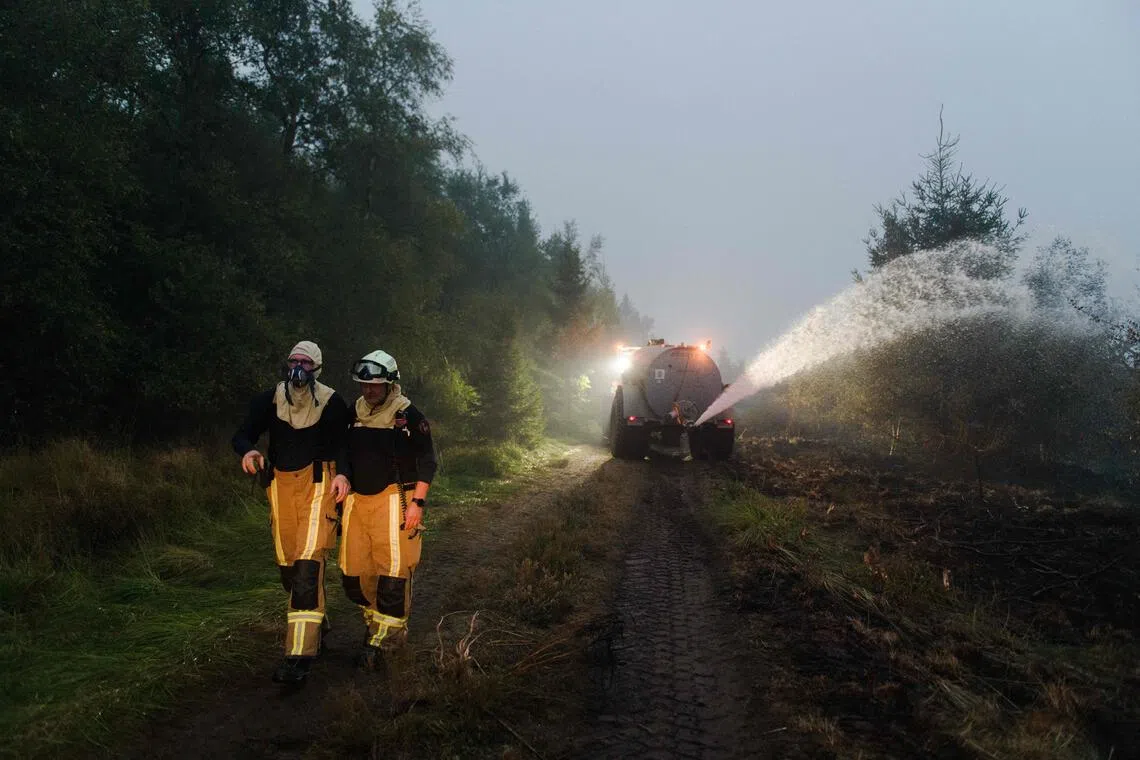
“We’ll take it in turns as long as it needs—the team is all set,” a farmer from nearby Waremme told Agence France-Presse on August 17. “We’ll keep going until the finish line.”
Historic 1911 Comparison and Weeks of Dousing Ahead
During an August 17 site tour alongside King Philippe, Belgian Interior Minister Bernard Quintin informed reporters that dousing and soaking the zone could take “several weeks” to stop any flare-ups once the fire is contained.
The blaze broke out in an area that was ravaged by massive fires in 1911, during a similar period of heatwaves, and is the country’s largest wildfire since then.