Bangladesh Records 175,985 Dengue Cases, 524 Deaths Amid Measles Outbreak
Bangladesh has recorded 175,985 dengue cases and 524 deaths as of November 24, with 1,145 new hospitalizations in the previous 24 hours, according to the Directorate General of Health Services.
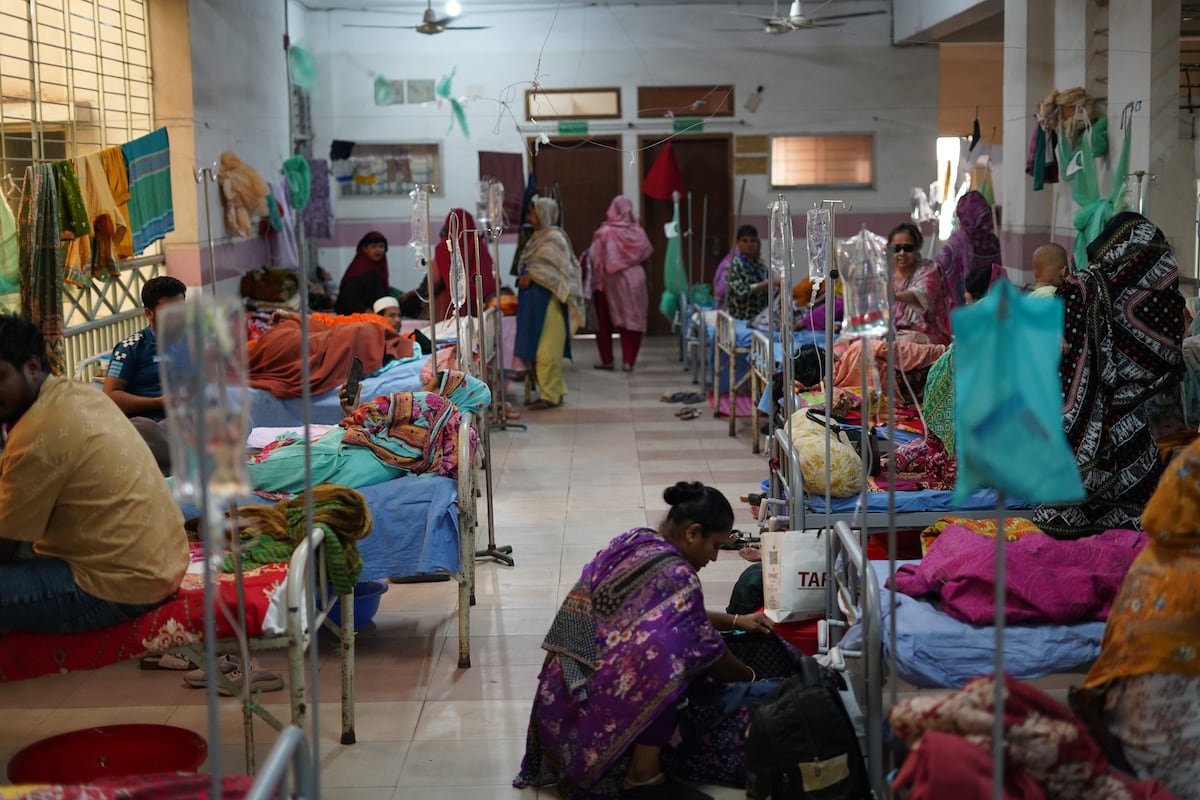
The epidemic is straining a health system already burdened by a measles outbreak that has caused 1,361 deaths among 259,190 suspected cases since mid-March. At Mugda Medical College & Hospital in Dhaka, families occupy beds across multiple wards. “The hospital has become our home now,” said the grandmother of two-year-old Abdullah, who is admitted to the pediatric ward while his parents remain on the 11th and 12th floors, EL PAÍS reported.
Co-infections complicate care
At the Mohakhali Infectious Disease Hospital, doctors are treating children with both diseases simultaneously.
Patients describe circuitous hospital journeys
Patients describe circuitous journeys through the health system. Samanta Akter, eight months pregnant, visited four hospitals before reaching Mugda.
“When the test came back positive for dengue, at first I was admitted to a nearby private clinic. My baby stopped moving, we got nervous and the doctor referred me to a nearby public hospital. Then that hospital sent me to the largest public hospital in the capital, Dhaka Medical College. After that, my family brought me to Mugda,” she told EL PAÍS.
Akhi Akter, 30, sat for a university exam while hospitalized, then returned to Mugda. “If I had missed the exam, I would have been expelled from the class for a year. I had no choice but to take it,” she told EL PAÍS. She said she received inadequate care at her local hospital in Munshiganj before transferring.
Dr. Nurul Islam, deputy director of Mugda, acknowledged the hospital receives increasing numbers of referred patients with severe symptoms. “We want patients to get treatment at the nearest hospital as soon as they have a fever,” he said. Bangladesh lacks a national real-time referral tracking system.
Special Assistant to the Prime Minister on Health Affairs Ziauddin Hyder said the government plans a digital tool to monitor referrals. “People tend to go to big hospitals. We are trying to reform the health system so that referrals can be controlled online. When this measure is applied, their number will decrease,” he told EL PAÍS.
A study published in June 2026 in New Microbes and New Infections documented a substantial rise in rural and semi-urban transmission between 2019 and 2025. Rural cases per 100 urban cases rose from 11–41 during 2000–2018 to 86–212 in the later period, according to El PAÍS. Nipon Roy, from Kishoreganj district over 100 kilometers from Dhaka, told EL PAÍS: “Now there are many dengue patients there; before there weren’t too many in our area.”
In Dhaka, the older, denser southern city corporation records more cases than the northern corporation despite a smaller population, a disparity experts attribute to poor drainage.
“As a nation, we lag behind in hygiene. Wherever you go in Bangladesh, you will see garbage along the roads. There is a lack of awareness and civic responsibility among the population. Until we manage to keep clean and prevent water from accumulating on roofs and other places, it will be very difficult to control dengue,” Hyder told EL PAÍS.
Economic toll and vaccine debate
The outbreak imposes direct costs on low-income families. Rahima Begum, a domestic worker, said the $6 dengue test fee is difficult to afford even though beds, saline, and doctor fees are free at public hospitals. “My husband is a rickshaw driver. We are six in the family,” she told EL PAÍS.
Globally, reported dengue incidence multiplied 34-fold between 1990 and 2024, with 74 million cases notified, according to research presented this month at the American Society of Tropical Medicine and Hygiene annual meeting.
“We have found that large outbreaks now occur in many countries at the same time, even in different hemispheres. This suggests there may be a common global driver, such as El Niño-like climate patterns, that deserves deeper investigation,” lead researcher Dr. Ahyoung Lim told EL PAÍS. “The rise of dengue in South Asia has not yet shown signs of slowing down, suggesting it could continue to grow.”
A study in Tropical Medicine and International Health analyzing two decades of data through 2024 found Bangladesh’s response has relied mainly on reactive measures like diagnosis and hospital treatment, with delays in surveillance and vector control limiting containment.
Immunization expert Tajul Islam Bari urged the government to license and introduce a dengue vaccine approved in 44 countries. “The full course costs about $20, which is not a particularly high amount. It requires two doses and offers protection against all four serotypes of the virus,” he told EL PAÍS.
Hyder said the government has encouraged the private sector to explore introduction but ruled out inclusion in the public immunization program for now. “The vaccine is expensive and currently cannot be included in the government’s public health program. More time is needed,” he told EL PAÍS.
Mugda Medical College & Hospital operates as a 500-bed public healthcare facility in Dhaka, a scale that positions it to absorb the surge of referred patients arriving with severe dengue and co-infections. Dr. Nurul Islam, the hospital’s deputy director, acknowledged in November 2024 that the institution receives increasing numbers of referred patients with severe symptoms, confirming its role as a critical tertiary destination when lower-level facilities cannot manage complex cases.
Dr. Mirza Md. Ziaul Islam, director of Bangladesh Shishu Hospital and Institute, warned against complacency. “We cannot wait for the government alone to address all our health challenges. Wealthy individuals and the private sector must also step forward to help build hospitals and expand access to treatment,” he told EL PAÍS. “When a health crisis occurs, everyone pays attention. But once the pressure eases, people forget. We need to strengthen our health capacity before the next outbreak occurs.”