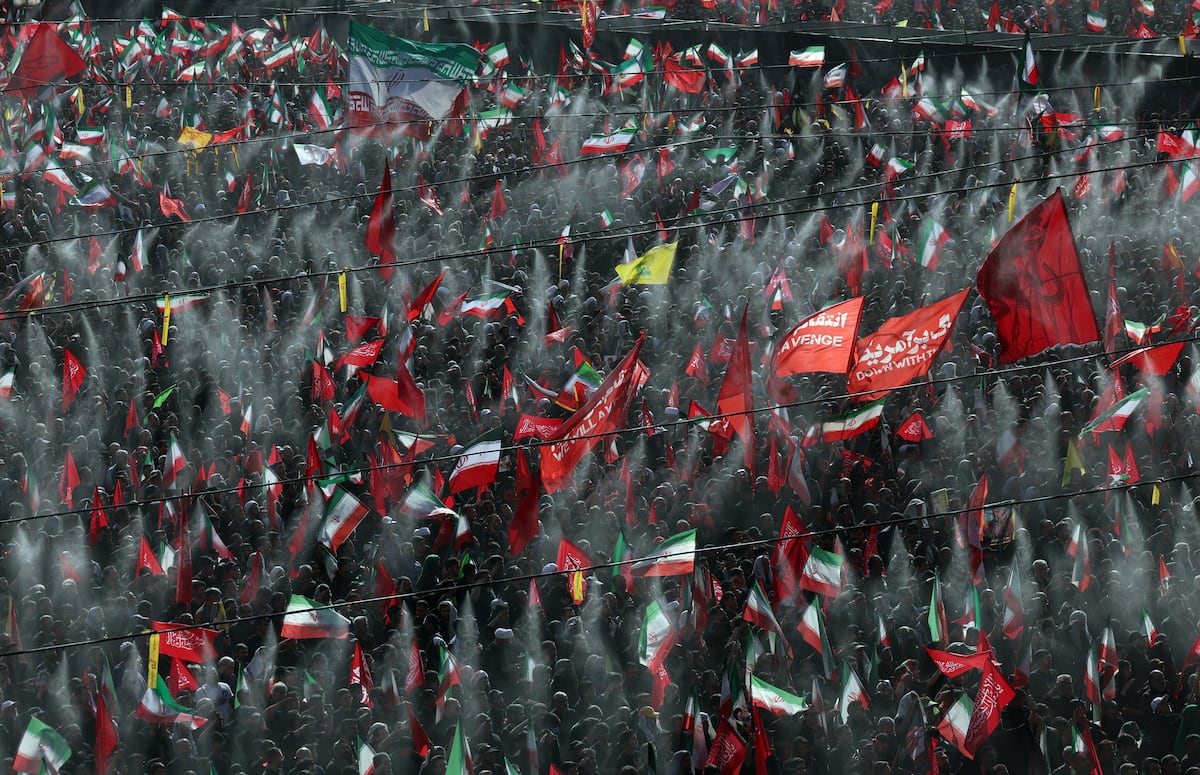
Ayatollah Khamenei’s Sons Attend Funeral as Mojtaba Absent After Bombing
Three sons of the late Ayatollah Ali Khamenei attended the funeral services for the Iranian Supreme Leader on Sunday, July 5, 2026, in Tehran. Mojtaba Khamenei, who has succeeded his father as the spiritual guide of Iran, was notably absent from the ceremony. The funeral follows a military strike by U.S. and Israeli forces that killed the Supreme Leader and four other family members during the opening day of the conflict.
Why is Mojtaba Khamenei’s absence significant?
The absence of Mojtaba Khamenei from his father’s funeral creates an immediate vacuum of visibility at a moment of extreme political volatility. In the Islamic Republic, the funeral of a Supreme Leader is not merely a private grieving process but a critical state ritual used to project stability, continuity, and the legitimacy of the successor. By failing to appear alongside his brothers, Mojtaba has deviated from the expected protocol of a new leader consolidating power through public mourning.
This absence occurs against the backdrop of a devastating blow to the Iranian leadership structure. The strike that killed Ayatollah Ali Khamenei also claimed four other family members, effectively decapitating a significant portion of the inner circle that managed the state’s ideological and security apparatus.
The sudden shift in power during an active war with the United States and Israel increases the risk of internal fragmentation. When the state’s highest authority is removed violently, the transition of power becomes a focal point for both hardline loyalists and opportunistic factions. In such environments, the physical presence of the successor is the primary signal to the Iranian Revolutionary Guard Corps (IRGC) and the Basij militia that the chain of command remains intact.
The impact of the U.S.-Israeli strike on Iranian governance
The death of the Supreme Leader in a targeted bombing marks a historic escalation in the regional conflict. According to reports of the engagement, the strike occurred on the first day of the war, targeting the residence or command center where the Ayatollah and his kin were located. This level of penetration into the highest echelons of Iranian security suggests a significant intelligence breach or a level of aerial dominance that has left the current administration vulnerable.

For businesses and diplomatic entities operating in the region, this instability creates a precarious legal and operational environment. The sudden change in leadership often leads to the immediate freezing of assets, the rewriting of trade protocols, and a surge in emergency decrees. Organizations are now turning to [International Law Firms] to navigate the complexities of sanctions and the potential for sudden shifts in diplomatic recognition.
The geopolitical ripple effects are centered in Tehran and extend to proxy networks in Beirut, Baghdad, and Sana’a. Without a visible and commanding presence from Mojtaba Khamenei, these regional actors may question the strength of the new leadership’s directives.
Comparing the transition of power
The current transition differs sharply from the 1989 succession when Ali Khamenei himself took power following the death of Ayatollah Khomeini. That transition was characterized by a rapid, albeit contested, alignment of the clerical establishment to ensure the survival of the system.
| Feature | 1989 Transition | 2026 Transition |
|---|---|---|
| Cause of Death | Natural Causes | Military Strike (U.S./Israel) |
| Succession Speed | Rapid Institutional Alignment | Immediate but Fragmented |
| Visibility of Leader | Publicly Asserted | Notably Absent (Mojtaba) |
The 2026 scenario is complicated by the fact that the transition is happening during an active state of war. The psychological impact of a leader being killed by foreign adversaries often triggers two divergent responses: a rally-around-the-flag effect or a collapse of morale within the bureaucracy.
How does this affect regional infrastructure and security?
The volatility in Tehran is not limited to the halls of power. The physical destruction caused by the initial strikes has left critical administrative zones in ruins. As the state attempts to reorganize, the need for secure communications and hardened infrastructure has become paramount.
Municipal authorities in Tehran are facing the dual challenge of managing wartime casualties and maintaining basic city services under the threat of further strikes. This collapse of stability often necessitates the intervention of [Crisis Management Consultants] and [Security Infrastructure Firms] to protect essential government functions and diplomatic missions from further degradation.
The loss of four additional family members in the same attack suggests that the strike was designed to wipe out not just the individual, but the familial support system that often acts as the “shadow government” in the Islamic Republic. This leaves Mojtaba Khamenei without the traditional familial buffers that usually protect a Supreme Leader from internal palace coups.
What happens to the Iranian state now?
The immediate future of the Republic depends on whether Mojtaba Khamenei can emerge from his current seclusion and command the loyalty of the military. The IRGC typically views the Supreme Leader as the ultimate commander; if the commander is perceived as weak or missing, the military may begin making autonomous decisions regarding the war effort.
Furthermore, the international community is monitoring the situation through the lens of the Associated Press and other global monitors to see if the Iranian government will maintain its current strategic posture or seek an emergency ceasefire to stabilize the domestic front. The lack of a public appearance by the new leader suggests a period of internal deliberation—or perhaps a struggle for control—that could last days or weeks.
As the situation evolves, the risk of total systemic collapse increases. Entities seeking to mitigate these risks are increasingly relying on [Geopolitical Risk Analysts] to forecast the likelihood of a full regime transition or a prolonged period of civil unrest.
The image of three sons praying over a coffin while the successor remains hidden is a potent symbol of a regime in crisis. Whether Mojtaba’s absence is a strategic choice or a sign of incapacity, the void he has left at the funeral is a gap that rivals and allies alike will seek to exploit. For those operating within this sphere of influence, the only certainty is that the rules of engagement in Tehran have changed fundamentally.