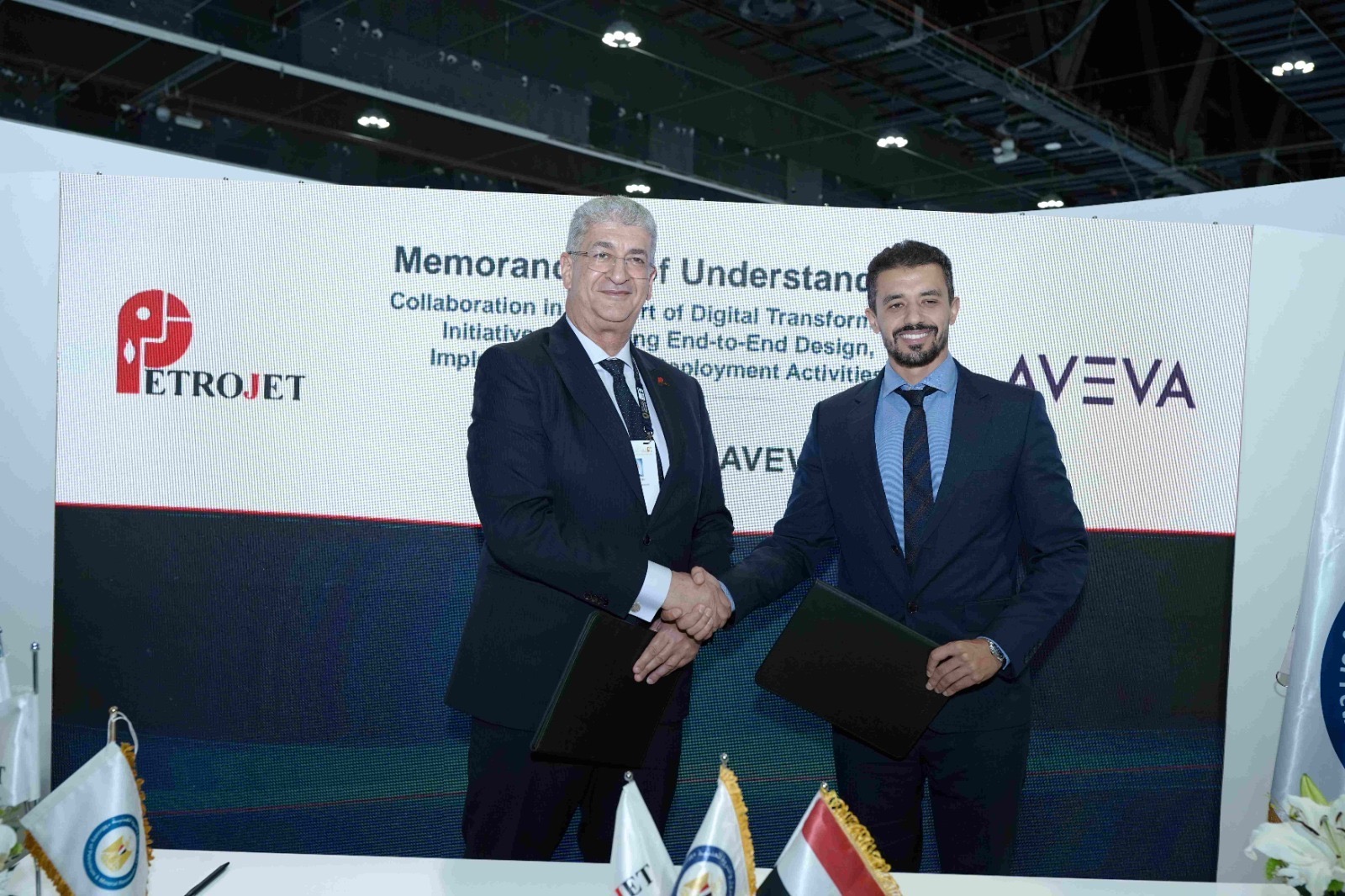
AVEVA and PETROJET Sign MoU for Digital Twin Handover Across Egypt and Middle East
AVEVA, the industrial software company, and PETROJET, one of the largest engineering, procurement and construction (EPC) contractors in the Middle East and Africa, signed a Memorandum of Understanding on Thursday in Dubai.
This agreement establishes a framework for digital transformation, allowing PETROJET to deliver data-centric projects with digital twin handovers in Egypt and abroad, supporting Egypt’s transition into a regional energy hub.
The partnership addresses a critical flaw in traditional large-scale capital projects: the fragmentation and inconsistency of engineering data. As global energy markets demand greater operational efficiency, the transition from construction to operations has become increasingly complex. Failing to keep data accurate throughout a project's life leads to major waste and delays when maintaining assets.
The partnership combines AVEVA’s know-how in industrial software with PETROJET’s strengths as an EPC firm and its track record on projects both within the region and around the world.
Under the agreement, the two companies will put in place a structure for pinpointing projects on which PETROJET acts as the EPC contractor and for evaluating the ways AVEVA’s software could bolster engineering, design and the handling of project data.
The core argument for the deal centers on the concept of digital continuity. In traditional construction, drawings, models, and specifications often live in different systems and drift out of step with one another. This “drift” results in costly rework and operational hurdles upon project completion.
The two organizations will utilize specific AVEVA products to facilitate this shift. Among the tools to be deployed are offerings such as AVEVA Unified Engineering and AVEVA E3D Design, alongside other solutions, aimed at strengthening how engineering information is integrated and handled across the course of project execution.
The Architecture of Digital Project Handover
The partnership goes beyond basic construction management; it seeks to redefine what an EPC contract means. By integrating data from the initial design phase through commissioning, the firms seek to create a “digital twin”—a living digital replica built from consistent engineering data.

This strategy directly addresses the challenges faced by asset owners. Receiving a digital twin means an owner begins its decades-long operational journey with a clear picture of the asset, rather than a pile of documents.
Khaled Salah, Vice President, Africa, at AVEVA, detailed the central premise of the partnership. He stated, “Capital projects performance is increasingly determined by the integrity of engineering data.” Salah stressed that PETROJET ranks among the foremost EPC contractors, with an extensive history in the energy and industrial sectors across Egypt and the wider region.
The AVEVA executive said the ultimate goal is to build a solid foundation. “Together, we are creating a foundation in which engineering data is consistent, connected and handed over as a digital twin, that gives owners operational readiness from day one,” Salah said. This capability is key to making sure a plant moves smoothly into full operation once built.
Egypt Vision 2030 Requires Integrated Data Management
This technological push is aligned with broader national ambitions in Egypt. Under Egypt Vision 2030, which prioritizes digital transformation and industrial competitiveness, the country is working energetically to position itself as a regional hub for energy.
Across the oil and gas, petrochemicals, power and infrastructure sectors, it has become ever more critical to manage engineering data in an integrated way and maintain digital continuity while projects are being executed. Without integrated data management, the efficiency gains promised by Egypt Vision 2030 remain theoretical.
The shift to data-centric projects is not merely a technological upgrade; it is an economic necessity for large-scale infrastructure development in the region. The ability to minimize rework and accelerate the operational phase of a major build directly impacts the bottom line of investors and the speed of national development.
Expanding the Scope of the Digital Twin
The practical application of the MoU is carefully scoped to ensure immediate utility. The agreement does not commit to a defined portfolio of deployments. Instead, the two companies will explore opportunities on mutually agreed projects rather than commit to a defined portfolio of deployments where PETROJET is the EPC contractor.
This flexible approach allows the partners to apply the AVEVA solutions to specific, high-value challenges within PETROJET’s existing project pipeline. The integration of AVEVA Unified Engineering and E3D Design is designed to structure project workflows so that data remains connected throughout the entire construction and commissioning lifecycle.
The long-term vision for PETROJET is ambitious. With AVEVA serving as its industrial software partner, the company intends to position PETROJET as an EPC contractor powered by digital technology, one that delivers data-centric projects with digital twin handover throughout Egypt and the wider region.
The Operational Benefits of Integrated Engineering Data
The transition to integrated data models provides several measurable advantages over traditional project delivery models. These include:
- Improved efficiency during the design phase by reducing data conflicts.
- Substantial reduction in costly rework that typically surfaces late in the project.
- A smoother, more predictable transition from the construction phase to active operations.
- Enhanced asset owner confidence through clear, actionable digital documentation.
This level of systemic integration requires sophisticated oversight.
The market trajectory for such digital transformation initiatives suggests that the capability to manage engineering data as a standardized, connected asset is rapidly becoming a prerequisite for securing major international industrial contracts.
The partnership between AVEVA and PETROJET provides a blueprint for how sophisticated industrial software can meet the needs of large-scale infrastructure development in emerging markets. As the MoU explores opportunities, the success of the framework will set a benchmark for future energy projects across the continent.
AVEVA’s roots reach back to 1967, when it was founded in Cambridge, England, as the Computer-Aided Design Centre, a government-funded research institute created by the UK Ministry of Technology to develop computer-aided design techniques for British industry. From that research base, the company developed the Plant Design Management System for 3D process plant design, an early foundation for the engineering software used across the process industries today.
The centre became a private company in 1983, was listed on the London Stock Exchange in 1996, and adopted the AVEVA name in 2001. In 2021, it completed the acquisition of OSIsoft for a final consideration of £3,831.4 million, one of the largest deals made by a UK-based technology company, before being acquired by Schneider Electric in January 2023.
The ability of an owner to operate a complex industrial asset with confidence from day one is the ultimate measure of success. This foundational promise, voiced by Khaled Salah, cements the partnership’s focus on operational readiness as the final, most valuable deliverable.