Aucklanders Are Being Handed a Decision on Their Second Harbour Crossing Sooner Than They Think
Aucklanders are being handed a decision on their second harbour crossing sooner than they think: a new design from transport advocates promises the same capacity as the government’s tunnel plan for roughly half the cost, and its backers want the public to fight for it before officials settle on a route.
The Greater Auckland advocacy group this week launched a petition backing a six-lane bridge beside the existing Auckland Harbour Bridge, arguing it should replace the tunnel option long preferred by government agencies. Patrick Reynolds, the group’s director, told RNZ’s Checkpoint the design was meant to open up a debate that has so far happened inside government offices.
The stakes are familiar to anyone who crosses the Waitematā. The current bridge suffers congestion, weather closures and has no rail, no dedicated rapid transit lanes and no walking or cycling path. Successive governments and departments have developed and ditched crossing ideas, and the New Zealand Herald reported Greater Auckland’s estimate that at least $200 million has already been spent on abandoned studies and designs.
Reynolds said the latest estimate for the bridge had halved from earlier costings of $5-6 billion to about $2.6 billion.
“Bridges are always cheaper than tunnels,” Reynolds told RNZ. “Tunnelling is a very complicated and difficult business, as Aucklanders are very familiar with, after CRL City Rail Link, and the idea that tunnelling isn’t disruptive is untrue.”
Design splits traffic across two bridges
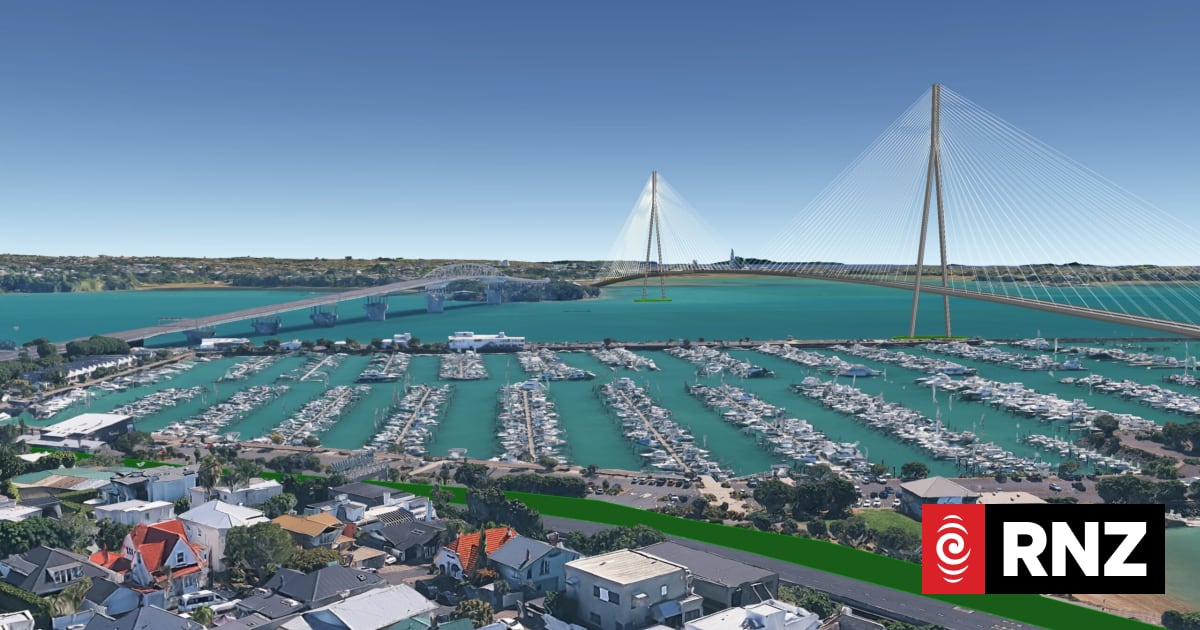
The design, developed by transport planner Nicolas Reid, runs adjacent to the existing 1959 bridge but not on top of it. It would carry two rapid transit lanes with potential for rail, four motorway lanes, and walking and cycling paths in both directions.
The Herald’s report of the proposal details four motorway lanes connecting to the Victoria Park viaduct, with the two rapid transit lanes linking to Fanshawe St, plus a rapid transit extension to Akoranga on the North Shore.

Traffic would be split between the two structures. The new bridge would take southbound motorway traffic; the existing bridge would handle northbound flow, city traffic and buses, freeing the old crossing’s local lanes at the same time.
“It doesn’t touch Northcote Point, where the current bridge does,” Reynolds told RNZ. “It very gently connects at each end — that’s the traffic portion.”
The pedestrian promise is the detail its backers keep returning to. Reynolds described walking paths descending to the bottom of the piers, where mussel beds sit, putting people within reach of the harbour itself rather than shuttling over it in a vehicle.
“It would be beautiful, absolutely stunning, and would grace our glorious harbour and city, and would be an attraction in its own right,” Reynolds told RNZ.
He suggested the structure could be built largely offsite and assembled on the harbour, the method used for the original bridge more than six decades ago.
The cost gap that has officials divided
The figure doing the political work is $2.6 billion against tunnel options the Herald described as vastly more expensive. Connor Sharp, Greater Auckland’s campaign director, told the Herald that for the difference in cost between tunnels and the bridge, the city could fund the Northwest Busway and also build light rail from Takapuna to the Town Hall in the city centre, ready to extend along Dominion Road to Mt Roskill.
“It’s inexplicable that NZTA keeps pushing for hugely expensive road-only tunnels, when for a fraction of the cost, we could have a bridge that works for all of us, plus budget to spare,” Sharp told the Herald.
Not everyone is convinced. Auckland Mayor Wayne Brown told the Herald he had not been briefed on the details of the plan but remained concerned that a bridge in the same location would not solve congestion.
“If it is a low-cost option, then it should be considered alongside NZTA’s very expensive and over-engineered options,” Brown told the Herald.
Brown has also raised the deeper problem: traffic jams at both ends of any new crossing would leave congestion intact, and there may be no money for the project at all.
He told the Herald that council representatives had received only limited briefings on the crossing proposals, and that the underlying problem had “not been clearly defined or is simply wrong”. He wants the decision to sit with the Auckland Regional Transport Committee, which combines council and government representatives, rather than with NZTA alone.
As part of an August update, the National-led government proposed a $1 million feasibility study examining a crossing at Meola Reef — a route Brown himself has suggested. That study now sits alongside the tunnel plans and the advocates’ bridge as contenders for the same corridor.
Why the debate itself is the point
Reynolds framed the petition as a corrective to how Auckland’s last big transport call was made.
“We’ve got a petition and we really want a full conversation, so when a decision is made on the project, it has public support and they’re fully informed — unlike the Auckland rail project, which was done in secret and dumped on us, and people weren’t carried along,” he told RNZ.
He said the process needed to survive political changes, a pointed remark given that crossing plans have been announced, costed and cancelled across multiple governments and agencies for years. Sharp told the Herald that any new crossing without rapid transit, walking and cycling would be “an utter failure” — a bottom line that puts the advocates directly against the road-only tunnel option NZTA favours.
The two outlets reporting the story frame it slightly differently. RNZ centred the design and its builder’s pitch; the Herald gave more weight to the political arithmetic — Brown’s scepticism, the government’s feasibility study and the money already spent and abandoned. Read together, they describe a proposal at the start of a fight, not the end of one.
Where the corridor decision lands
The project touches everyone who crosses the harbour: commuters from the North Shore suburbs of Northcote and Takapuna, freight moving on State Highway 1, and the residents of Northcote Point, whose streets the current bridge already burdens.
A decision of this scale would shape land values, construction contracts and development along the corridor for a generation, which is why urban planners, infrastructure consultancies and transport-focused legal practices watch each revision closely on behalf of affected property owners and contractors.
What remains unanswered is the question Brown put to the Herald: whether the problem the new crossing is meant to solve has ever been properly defined, and by whom. Until the government’s agencies, the mayor’s office and the advocates agree on that, the $200 million already spent risks being only the down payment on a longer argument.
The campaign is the latest chapter for a group that began far more modestly. Greater Auckland started life in 2008 as the Auckland Transport Blog, founded by urban planner Joshua Arbury, whose first post was simply titled “Trains”, before incorporating as a society in 2015 and rebranding fully in 2017 after a fundraiser that raised $20,000.
Its influence has grown well beyond its blogging origins. Its “Congestion Free Network” maps, first presented to the Auckland Council in 2013, were adopted by the Green Party and referenced in Labour’s 2014 election platform, and an updated version featuring a light rail line to Auckland Airport featured prominently in Labour’s 2017 campaign. In 2018, the Herald ranked the site’s Matt Lowrie among Auckland’s most politically influential people.
“It must be a beautiful thing that graces the harbour, rather than having us skulking around underground,” Reynolds told RNZ.