
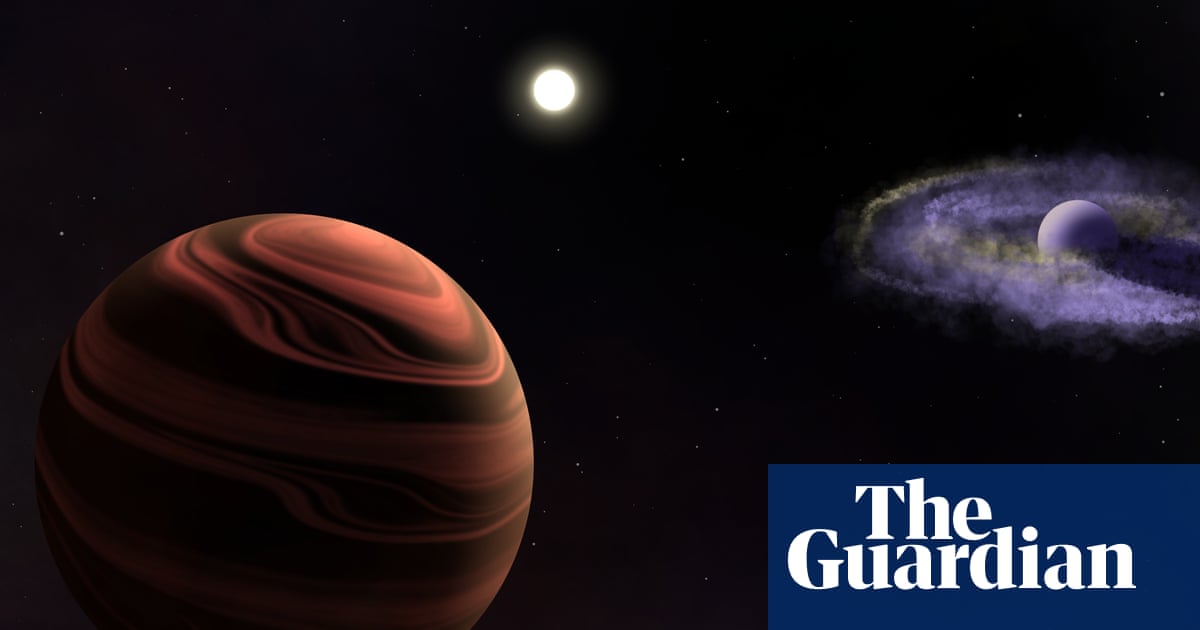
Iron Rain Forecast on Distant World
James Webb Telescope Reveals Clouds and Discs Around Young Planets
Astronomers have peered into a distant planetary system, 307 light-years away, discovering worlds still in formation and atmospheric conditions unlike anything seen in our solar system – including the possibility of iron rain. The findings offer a unique glimpse into the chaotic early stages of planet development.
Cloudy Skies and Forming Giants
Observations from the James Webb space telescope (JWST) revealed high-altitude clouds surrounding a young, sun-like star called YSES-1. These clouds aren’t composed of water vapor, as on Earth, but rather magnesium silicate dust grains, and potentially iron. Dr. Kielan Hoch, an astrophysicist at the Space Telescope Science Institute in Baltimore, Maryland, explained that the iron would indeed precipitate out
.
YSES-1 is a relatively new star, only about 1 million years old compared to our sun’s 4.6 billion years. It’s orbited by two gas giants, YSES-1b and YSES-1c, both larger than Jupiter and still actively forming. According to NASA, approximately 5,500 exoplanets have been confirmed as of May 2024, but direct imaging of multiple planets in a young system remains rare. (NASA Exoplanet Archive)
A Dusty Puzzle
The telescope’s data surprised researchers by revealing both planets within its field of view, providing information on two worlds simultaneously. YSES-1c, the smaller of the two, has a mass about six times that of Jupiter. YSES-1b, the larger planet, is approximately 14 times Jupiter’s mass and is surrounded by a massive disc of dust – containing trillions of tonnes of particles.
“We wouldn’t expect the planets to look so different from one another if they formed in the same protoplanetary disk,”
—Dr. Kielan Hoch, Astrophysicist
This disc presents a challenge to current planet formation theories. Hoch noted, “Why did YSES-1b hold on to material around it while YSES-1c did not?”
The persistence of the disc around YSES-1b is particularly puzzling, as theories suggest such material should have settled within the first 5 million years.
JWST’s Expanding View of the Cosmos
The $10 billion JWST, launched in December 2021 from French Guiana, continues to revolutionize astronomy. It has already provided unprecedented views of the early universe, spotted distant galaxies, observed colliding black holes, and even detected potential biosignatures on exoplanets. The findings regarding YSES-1 were published in Nature.
As Hoch concluded, “JWST is providing an immense amount of data to continue to refine models and improve our understanding.”
Further observations of YSES-1 and similar systems promise to unlock more secrets about the birth of planets and the potential for life beyond Earth.
