Astronomers Detect Giant Magnetic Eruption on Red Giant Mira, Challenging Theory of Stellar Winds
Astronomers using the Atacama Large Millimeter/submillimeter Array (ALMA) in Chile have captured the first direct images of a giant magnetic eruption on the red giant star Mira A, showing that such explosions can fling stellar material into space and challenging the long-held view that radiation pressure on dust alone drives these winds.
The international team, led by researchers at Chalmers University of Technology in Sweden, published the findings in two papers in the journal Astronomy & Astrophysics. Mira A, an oxygen-rich asymptotic giant branch (AGB) star roughly 330 light-years away in the constellation Cetus, is the nearest and best-studied prototype of its class.
For decades, models have held that starlight pushes dust grains in the outer atmosphere, dragging gas along in a steady wind that seeds the galaxy with carbon, oxygen, nitrogen and silica — the raw material for rocky planets and life.
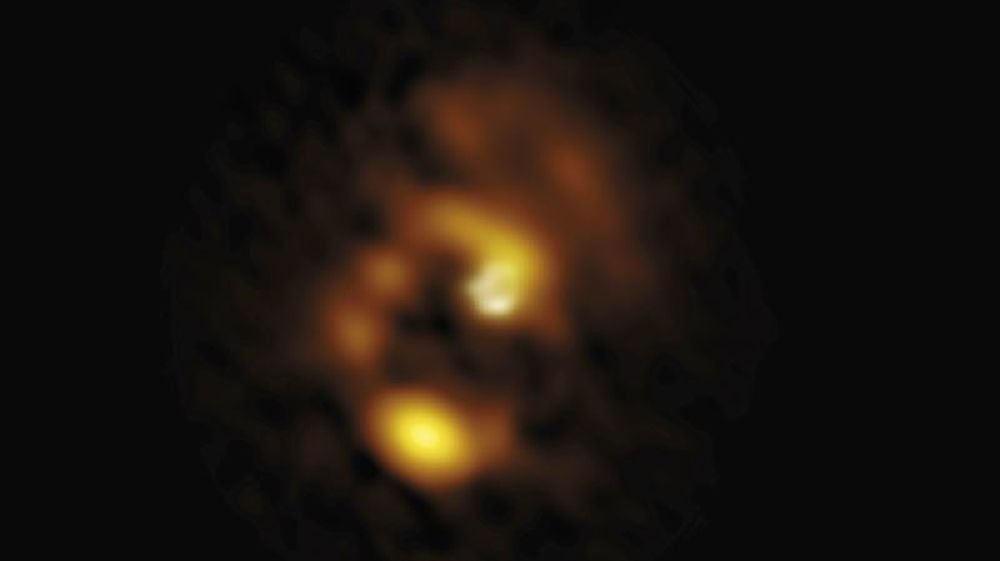
Full-polarisation ALMA observations of the SiO v=1, J=5→4 maser transition at 215 GHz, achieving angular resolutions of 1.5–2.6 astronomical units, revealed a highly magnetised, loop-like mass ejection extending to approximately eight stellar radii. The morphology, polarisation pattern, energetics and kinematics indicate a magnetically driven eruption analogous to a solar coronal mass ejection, demonstrating that magnetic eruptions can dominate mass loss from evolved stars.
“For decades, astronomers have believed that the winds from stars like this must be powered by starlight. Light from the star shines on grains of dust in the star’s outer atmosphere, and that gives them a push. But this star is showing us something different: that strong magnetic fields can also shape and power stellar winds. That changes a fundamental part of the origin story of the atoms we ourselves are made of,” said Wouter Vlemmings, professor of physics and astronomy at Chalmers and lead author of the eruption study.
Doctoral student Behzad Bojnordi Arbab, also at Chalmers, described the event captured over multiple years: “In 2023, we saw one of these flares appear on the star’s surface, but it didn’t stop there. Over the next two years, this eruption on the surface created a vast, expanding loop of gas around the star, which we captured in an image in 2025.”
Co-author Miora Andriantsaralaza, also from Chalmers, added that the magnetic fields are strong enough to lift parts of the star’s outer layers and launch them into interstellar space. “Our study has consequences for our understanding of the whole of the galaxy’s ecosystem,” she said.
Magnetic fields emerge as key wind driver
Researchers have long known that AGB stars enrich the cosmos by shedding up to 30 Earth masses of material each year, a process essential for the chemical enrichment of the Universe. For decades, models attributed this mass loss to radiation pressure pushing dust grains outward, dragging gas along in a steady wind.
Astrophysicists have detected strong magnetic fields in the circumstellar envelopes of stars like Mira, and researchers suggested they may play a role in driving mass loss, but empirical evidence remained elusive.
Eruption traced over multiple years
She said the findings have consequences for understanding the whole of the galaxy’s ecosystem, and the results appear in two papers published in Astronomy & Astrophysics in 2026.
The international team behind the ALMA observations was led from Chalmers University of Technology, a private research university in Gothenburg, Sweden, with approximately 10,000 students and 3,000 employees specializing in engineering, science and maritime studies. This department and observatory have long provided the expertise and infrastructure for millimetre-wave VLBI and ALMA science, enabling the high-resolution polarimetric imaging that revealed the magnetised eruption on Mira A.
Vlemmings placed the discovery in a broader context: “Perhaps, Earth wouldn’t be here if it wasn’t for magnetic storms on a red giant star, billions of years ago before the sun was born.”