
Asia Airlines Cut Flights and Increase Refueling Due to Middle East Conflict
Asian airlines are slashing flight schedules and rerouting services to avoid conflict-ridden airspace in Iran, Iraq, and the Gulf. This escalation, intensifying through March 2026, forces carriers to carry extra fuel and add refueling stops, disrupting critical Europe-Asia corridors and spiking airfares for travelers seeking safety.
The aviation industry is currently grappling with a logistical nightmare. What began as short-term suspensions has morphed into a systemic crisis. For those of us tracking global movement, the map of the Middle East is no longer a bridge between East and West—We see a barrier.
The problem is simple but devastating: when the shortest path between two cities becomes a war zone, every single flight must be recalculated. This isn’t just about changing a flight path; it is about the physics of fuel, the legality of airspace, and the sheer cost of time.
The Geometry of Avoidance: Rerouting and Fuel Constraints
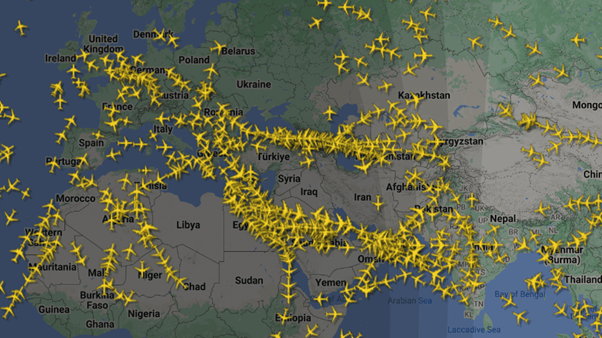
Since late February 2026, missile and drone activity linked to the widening Iran war has forced a radical redesign of flight paths. Airspace closures and restrictions over parts of Iran, Iraq, and the Gulf have sharply reduced civilian traffic. This has created a “patchwork” of restricted corridors where operators are warned that sections of Gulf airspace may close without notice.
Because airlines can no longer fly the direct “great circle” routes, they are forced into longer corridors. This creates a dangerous trade-off. To reach their destinations, Asian carriers are now carrying extra fuel from their home airports—adding weight that reduces passenger or cargo capacity—or adding unplanned refueling stops along the way.
The operational strain is immense. In the UAE, the General Civil Aviation Authority has described these airspace decisions as an “exceptional precautionary measure.” The result is a transition from near-normal hub operations to a highly managed, disruption-heavy model.
For corporations and individuals caught in this volatility, the legal and financial fallout is significant. Many are now turning to international travel attorneys to navigate the complexities of airline waivers, stranded passenger rights, and breach of contract claims as schedules vanish overnight.
The Airspace “No-Fly” List
The European Union Aviation Safety Agency (EASA) has provided critical conflict-zone guidance that is effectively redrawing the global map. The current restrictions are not suggestions; they are safety imperatives.
- Iran, Iraq, Israel, and Jordan: EASA has advised airlines not to operate in these affected airspaces.
- Lebanon: Specific, stringent conditions have been set for any operations in this region.
- The Gulf: Rolling shutdowns and capacity limits have hit key hubs in Qatar, Kuwait, and Israel.
- Pakistan: Existing constraints on certain routes through Pakistani airspace are compounding the planning challenges for those attempting to connect Asia with Europe.
This is no longer a temporary detour. We are seeing initial 24 to 48-hour suspensions evolve into multi-week schedule cuts. In some cases, Asian airlines have issued indefinite suspension notices for routes that were once considered routine links between Southeast Asia and the Gulf.
“Asian airlines may see a short-term combination of higher fares, stronger cargo yields and modest market share gains. But this is fundamentally a redistribution of traffic, not a structural rebalancing of global aviation networks.”
The quote above from Linus Benjamin Bauer, founder of aviation advisory firm BAA & Partners, highlights a critical economic reality: while some airlines are profiting, the global network is fracturing.
The Price of Safety: Sky-High Fares and Market Shifts
As Middle Eastern carriers like Emirates and Qatar Airways face significant grounding or operational halts, the demand has shifted to Asian carriers that can fly non-stop between Europe and Asia, bypassing the conflict zone entirely. This surge in demand, coupled with the rising cost of oil and longer flight times, has sent ticket prices soaring.
Data compiled by Bloomberg Intelligence and Google Flights reveals the staggering cost of this detour. On March 4, 2026, a round-trip ticket between Hong Kong and London cost US$1,975, while a Singapore-London flight hit US$2,255. Both prices were approximately triple what they had been just one week prior.
This redistribution of traffic isn’t just affecting passengers; it’s hitting the belly-cargo market. With traditional hubs constrained, businesses are scrambling to find alternative logistics paths. Many are consulting supply chain consultants to reroute critical shipments and avoid the bottlenecks now forming in Asian transit hubs.
The economic impact is a double-edged sword. While Asian carriers are “weathering the chaos” through higher fares and stronger cargo yields, the broader economy suffers from increased transport costs and unpredictable delivery timelines.
A New Reality for Global Transit
The Middle East is no longer flown as a single connected block. The era of seamless, high-efficiency transit through the Gulf has been replaced by a cautious, fragmented approach. Airlines are now operating on special or alternate corridors, holding services until airspace is officially declared safe.
This shift requires a new level of corporate resilience. Companies that rely on the rapid movement of personnel between Europe and Asia are now employing corporate risk management firms to build contingency travel plans that do not rely on a single regional hub.
The current state of aviation is a stark reminder of how fragile our global connectivity truly is. A conflict in one region doesn’t just affect the neighboring countries; it changes the cost of a ticket in Singapore and the fuel load of a plane departing from Hong Kong.
As we appear toward the coming months, the question isn’t just when the airspace will open, but whether the industry will ever return to the pre-war efficiency. Until then, the sky is no longer the limit—it is the obstacle. To navigate these disruptions, whether through legal recourse or logistical restructuring, finding verified professionals via the World Today News Directory is the only way to ensure your operations remain airborne.