As composer Steve Reich marks his ninetieth birthday in October 2026, the Glasshouse International
As composer Steve Reich marks his ninetieth birthday in October 2026, the Glasshouse International Centre for Music on the banks of the River Tyne hosts a weekend-long festival curated by percussionist and conductor Colin Currie. The celebration brings together interpreters of Reich’s minimalist catalog, culminating in chamber performances that pair the pioneer’s works with modern iterations.
Chamber Works and the Legacy of Electric Counterpoint
The festival’s mid-afternoon chamber concert opened with four works by American guitarist and composer Bryce Dessner. Dessner’s engagement with Reich began as a teenager upon hearing Electric Counterpoint, a piece he noted changed the way he thought about music and the electric guitar. Dessner’s own composition Garcia Counterpoint directly acknowledges this influence, starting where Reich’s work ends.
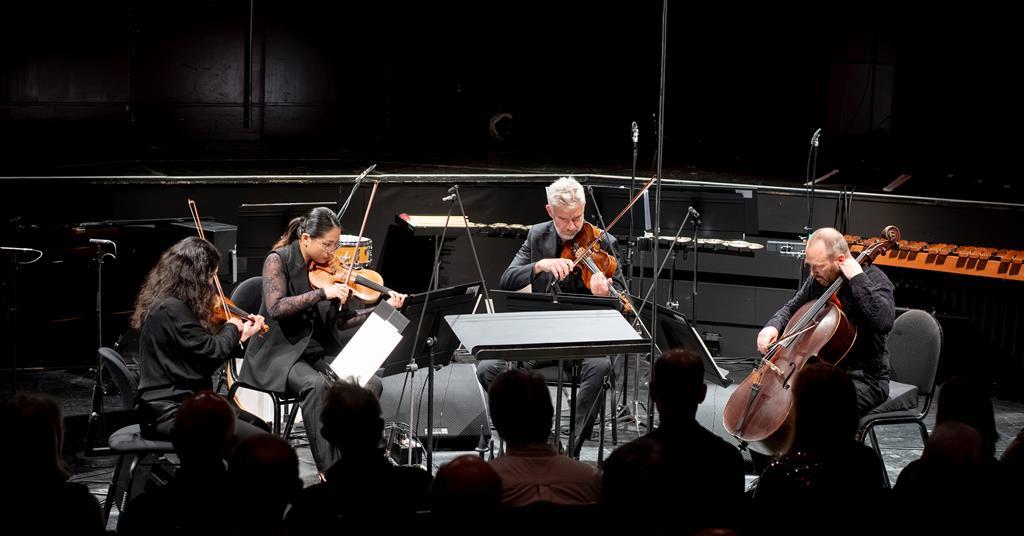
Following that piece, Royal Northern Sinfonia musicians performed Dessner’s Ahyem, a Yiddish title translating to “homeward.” The single-movement string quartet features driving, homogeneous rhythms combined with close counterpoint reminiscent of Reich. Violinists Eva Aronian and Haruno Sato, violist James Slater, and cellist Daniel Hammersley delivered the work’s technical requirements, moving from accented arco and pizzicato passages through natural and artificial harmonics.

The first half of the program rounded out with Currie performing the delicate Tromp Miniature on marimba and crotales, followed by the seven-movement folk-like chamber piece Murder Ballades.
Different Trains and the Technical Precision at the Glasshouse
The centerpiece of the chamber program was Reich’s Different Trains, scored for string quartet and pre-recorded tape. The composition juxtaposes personal childhood memories of train journeys across America in the late 1930s and early 1940s against the grim reality of European trains transporting victims to Nazi extermination camps.
The performance relied heavily on the precise balancing of live instrumentation with archival speech recordings. These audio elements include interviews with Reich’s former governess Virginia Mitchell, retired Pullman porter Lawrence Davis, and Holocaust survivors sourced from the Fortunoff Video Archive at Yale University and the Wiener Oral History Library at the New York Public Library.
According to The Strad, sound designer, editor, and engineer Ian Dearden of Sound Intermedia successfully ensured that Reich’s original audio samples remained clearly audible above the pre-recorded string tracks. The live quartet, featuring members of Royal Northern Sinfonia, executed the shift from the romantic momentum of the first movement to the oppressive intensity of the second movement’s paradiddle pattern.
Festival Programming Across Tyneside Venues
Beyond the chamber concert, the October 2026 festival spans multiple performances across the Tyneside venue. Hosted by Tom Service, the weekend event features appearances by the Colin Currie Group, Bryce Dessner of The National, Royal Northern Sinfonia, and the BBC Scottish Symphony Orchestra. Program highlights across the multi-day celebration include scores such as Drumming Part 1, Music for 18 Musicians, and The Desert Music, alongside free public performances and immersive sound installations.

Further exploration of how musicians approach the technical demands of Reich’s compositions is detailed by Pwyll ap Siôn in the November 2026 issue of The Strad, slated for release on October 7, 2026.
Disclaimer: The views and cultural analyses presented in this article are for informational and entertainment purposes only. Information regarding legal disputes or financial data is based on available public records.