
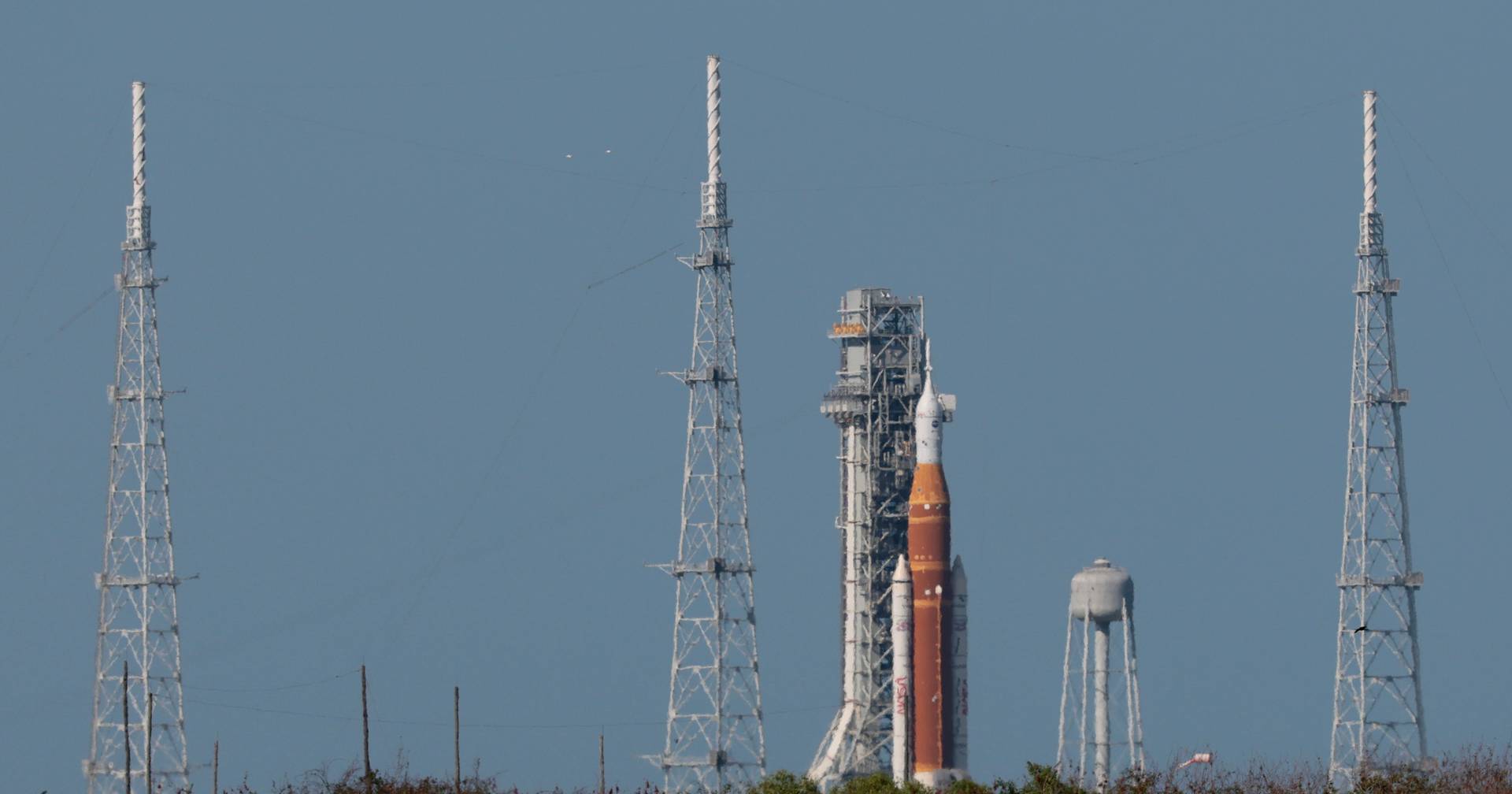
Artemis II: NASA’s Historic Crewed Lunar Mission Set for Launch
The first crewed mission to orbit the Moon in more than 50 years is scheduled to launch Wednesday from NASA’s Kennedy Space Center in Cape Canaveral, Florida. The Artemis II mission will send four astronauts on a 10-day flight around the Moon and back to Earth, culminating in a splashdown in the Pacific Ocean.
NASA is currently forecasting an 80% chance of favorable weather conditions for Wednesday’s launch, with the primary concerns being cloud cover and the potential for strong winds, according to the Associated Press.
The Artemis SLS rocket, standing 98 meters tall, is powered by four main engines and two solid rocket boosters. This mission builds on the success of the uncrewed Artemis I flight in 2022, demonstrating the capabilities needed for future deep space missions.
This lunar mission is historic for several reasons. The Artemis II crew includes Christina Koch, the first woman, Victor Glover, the first Black man, and Jeremy Hansen of the Canadian Space Agency, marking a significant step towards greater diversity in space exploration.
Mission Commander Reid Wiseman stated Tuesday that all systems are prepared for launch, a milestone that has been nearly two months in the making, delayed by technical issues and weather concerns. “We are ready to go, the team is ready to go, and the vehicle is ready to go, but not for a second do we take the launch for granted,” Wiseman said during a virtual press conference with the astronauts. “We can get to the launch pad and have to try a few more times, and we are 100% prepared for that.”
Koch expressed the crew’s hope that the mission will “be the start of an era where everyone, every person on Earth, can look at the Moon and think of it as a destination.” She added that the mission represents “an important step toward Mars,” where there “may be a greater probability of finding evidence of life.”
Astronaut Victor Glover shared that on launch day, the crew will wake up eight hours before liftoff, and his final actions on Earth will be to pray and tell his family he loves them. Canadian astronaut Jeremy Hansen described one of the most anticipated moments of the mission: witnessing a total solar eclipse as the Moon passes in front of the Sun.
In a separate announcement Tuesday, NASA Administrator Jared Isaacman revealed the suspension of the Gateway project, a planned lunar orbital station. The agency will now focus on developing infrastructure for a sustained human presence on the lunar surface. The revised plan aims to accelerate the return to the Moon by 2028, with crewed lunar landings occurring every six months and the construction of a permanent lunar base within the next seven years, at an estimated cost of $20 billion.
NASA is collaborating with international organizations, including the European Space Agency (ESA), which is developing modules for the Gateway, and private companies like SpaceX and Blue Origin to achieve these goals.