
Artemis II: NASA Monitors Solar Weather to Protect Astronauts on Deep Space Mission
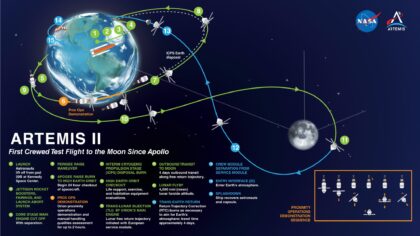
NASA is preparing for the launch of Artemis II, its first crewed mission to lunar orbit in over 50 years, with a launch window opening on April 1, 2026. The ten-day mission will send astronauts Reid Wiseman, Victor Glover, Christina Koch and Jeremy Hansen on a trajectory around the Moon and back to Earth aboard the Orion spacecraft and Space Launch System (SLS) rocket.
As the Artemis II crew ventures beyond the protective magnetic field of Earth, they will be exposed to increased levels of space radiation. NASA is prioritizing crew safety by closely monitoring space weather conditions and utilizing Orion’s radiation shielding, along with real-time adjustments to the mission plan if necessary. The spacecraft is equipped with six radiation sensors as part of the Hybrid Electronic Radiation Assessor (HERA) system, developed by NASA, to measure radiation levels within the cabin.
Space weather, driven by solar wind and eruptions from the Sun, poses a significant risk to astronauts. Coronal mass ejections (CMEs) – massive clouds of solar particles – can release energy exceeding that of a billion hydrogen bombs. While these events can disrupt technology, the primary concern for the Artemis II crew is solar energetic particle (SEP) events, where particles are accelerated to near-light speed. A surge in radiation from such an event could elevate radiation exposure for the crew, potentially increasing the long-term risk of cancer or cognitive impairment.
To mitigate this risk, NASA’s Goddard Space Flight Center is leading a dedicated space weather analysis effort. Mary Aronne, operations lead for space weather analysis at Goddard, explained that the team will focus on analyzing real-time cosmic weather conditions, particularly charged solar particles and the events that create them, such as solar flares and CMEs. Scientists will assess the size, speed, and potential impact of any detected eruptions on Orion’s trajectory.
The analysis will leverage data from a network of solar observation platforms, including NASA’s recently launched Interstellar Mapping and Acceleration Probe (IMAP) and Solar Dynamics Observatory (SDO), as well as the European Space Agency/Japan Aerospace Exploration Agency’s SOHO and NOAA’s GOES-19 satellite. Adding a unique perspective, the Perseverance rover currently on Mars – positioned on the opposite side of the Sun from Earth – is monitoring solar activity and providing early warnings of potentially hazardous sunspots before they rotate into Earth’s view. Perseverance’s Mastcam-Z cameras can offer scientists up to two weeks of advance notice on major solar events.
The gradual increase in radiation levels provides analysts with crucial time to assess the situation. Astronauts will likewise carry personal radiation dosimeters, known as crew active dosimeters, to monitor their individual exposure. If radiation levels rise, Orion’s systems will issue warnings, including audible alarms. NASA has established radiation thresholds that will trigger different levels of response. A first-level alert will initiate more detailed monitoring with input from flight surgeons and mission control. A higher threshold will prompt recommendations for the crew to seek shelter by adding mass to the spacecraft cabin.
Astronauts are trained to reconfigure the Orion cabin during a solar particle event, moving stored equipment to create additional shielding. This procedure will be tested during the Artemis II mission. Stuart George, a space radiation analyst at Johnson Space Center, noted that adding mass to “hot spots” within the cabin will allow the crew to continue their duties while minimizing radiation exposure.
The Artemis II mission represents a critical step towards NASA’s long-term goal of establishing a sustainable presence on the Moon and eventually sending crewed missions to Mars.