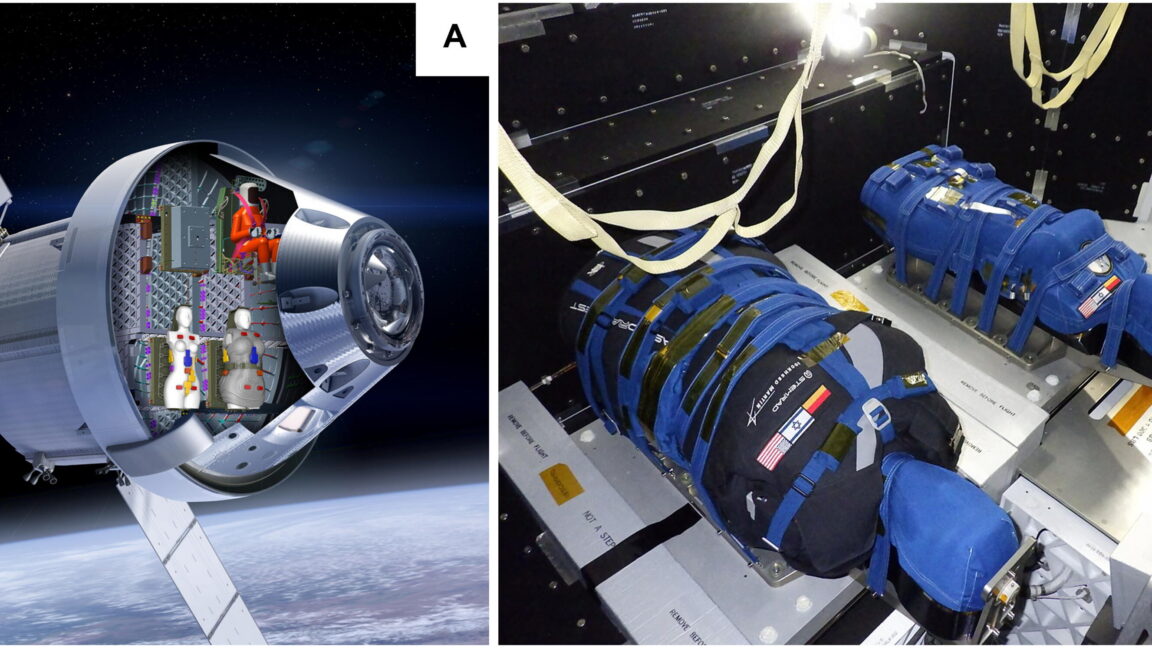
Artemis I Tests Wearable Radiation Vest to Protect Astronauts on Moon and Mars
A radiation-blocking vest designed to protect human crews from hazardous solar particle events completed an uncrewed flight around the Moon and back aboard NASA’s Artemis I mission, providing researchers with vital flight data to calculate its performance against deep-space radiation storms. According to StemRad, the Israeli-American startup that developed the wearable equipment, test results from the journey indicate that the AstroRad vest would offer personal protection levels comparable to the heavy onboard storm shelters designated in NASA’s Orion spacecraft.
The Tech TL;DR:
- Payload Deployment: The AstroRad radiation-shielding vest flew aboard NASA’s uncrewed Artemis I mission, logging deep-space telemetry during its lunar trajectory.
- Architectural Protection: Built to shield individual astronauts directly rather than relying solely on heavily reinforced spacecraft storm zones.
- Performance Benchmark: Post-flight analysis demonstrated protection efficacy roughly equivalent to the Orion spacecraft’s heavily shielded central shelter.
Deep-Space Radiation Risks and the Limits of Spacecraft Shielding
Solar storms pose severe biological threats to astronauts journeying beyond Earth’s protective magnetic field and atmosphere. Historical precedents, such as the intense proton event recorded in August 1972 between the Apollo 16 and Apollo 17 missions, highlight the danger of sudden solar particle releases. Such bursts generate proton radiation strong enough to trigger acute radiation sickness or dramatically elevate long-term cancer risks for flight crews. Historically, spacecraft designs have struggled to integrate enough heavy metal or polyethylene shielding to completely block high-energy protons without exceeding strict payload mass limits.
To bypass these mass restrictions, a development team led by Jordan Houri and Oren Milstein of StemRad approached the physics of radiation protection from a localized perspective. Instead of adding massive structural weight to the entire spacecraft hull, the team engineered personal protective equipment meant to be worn directly by crew members during high-risk periods.
Evaluating Artemis I Flight Data and Telemetry Analysis
To validate the vest’s architectural viability under actual space weather conditions, developers placed the AstroRad payload inside the Orion spacecraft for the Artemis I flight. Engineers subsequently correlated these physical telemetry logs with computer models simulating extreme solar particle events.
The resulting dataset indicates that wearing the vest during a major solar storm would yield safety margins comparable to those provided by Orion’s dedicated, heavily shielded central shelter area. For enterprise and government space contractors managing long-duration mission architectures, this reduces reliance on rigid storm-room retreats, affording crew members greater mobility during critical flight phases.
Implementation Architecture and Telemetry Integration
POST /api/v1/telemetry/payload-ingest HTTP/1.1
Host: telemetry.deepspace.local
Content-Type: application/json
Authorization: Bearer token_astorad_artemis1

{
  "mission_id": "Artemis-I",
  "payload_identifier": "AstroRad-Vest-01",
  "sensor_metrics": {
    "cumulative_dose_gy": 0.042,
    "proton_flux_mev": 150.5,
    "timestamp": "2026-08-13T13:48:00Z"
  },
  "status": "nominal"
}
Future Outlook for Crewed Lunar and Martian Missions
As NASA and commercial space partners prepare for sustained human presence on the lunar surface and eventual crewed missions to Mars, radiation mitigation remains a primary engineering hurdle. The successful lunar transit of the AstroRad vest marks a transition from theoretical spacecraft design to practical, wearable radiation countermeasures.
*Disclaimer: The technical analyses and security protocols detailed in this article are for informational purposes only. Always consult with certified IT and cybersecurity professionals before altering enterprise networks or handling sensitive data.*