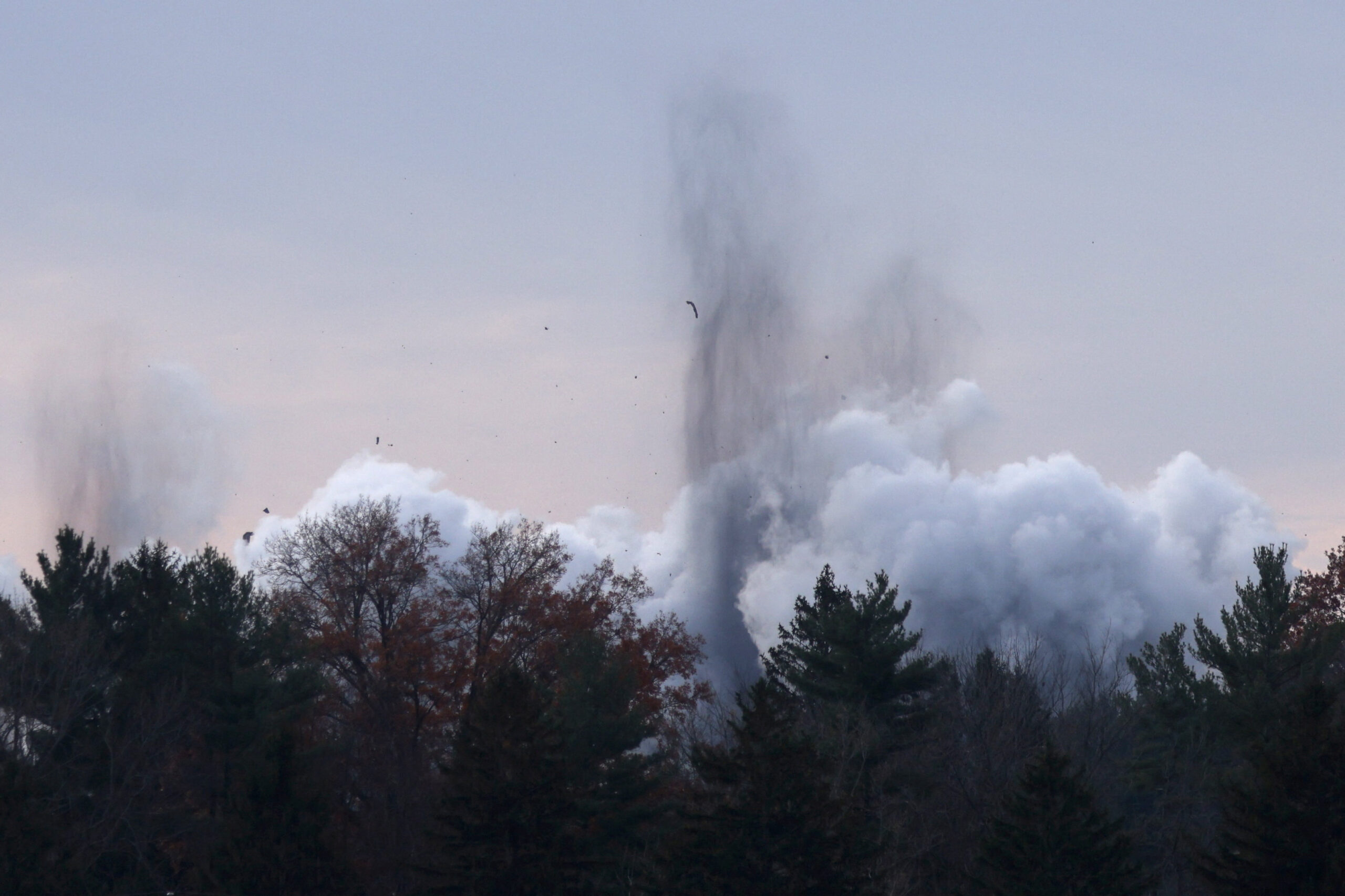
Army Detonates Five Tons of Unstable Lead Azide in Iowa
The U.S. Army detonated nearly five tons of unstable lead azide at the Iowa Army Ammunition Plant in Middletown on Wednesday, a day before Thanksgiving, after determining the chemical stockpile posed an imminent risk of accidental explosion.
- The Army destroyed all 68 barrels of lead azide, totaling almost five tons, in a controlled detonation Wednesday morning.
- EPA air monitors reported no lead in the air around the plant immediately after the blasts, Maj. Gen. Eric Shirley said.
- Documents obtained by The Washington Post show a contractor sought to dispose of the same drums in September 2025, months before the Army said it learned of the danger.
- Residents within five miles were urged to evacuate; schools canceled classes and the detonation date was changed three times.
Detonation called a success
The Army intentionally blew up the nation’s entire stockpile of lead azide, a chemical used to make explosives, saying early signs indicated the controlled detonation in Iowa did not allow any toxic dust to spread to nearby homes and farms, the Associated Press reported. Maj. Gen. Eric Shirley, who led the Army operation, said at a news conference that all five tons of lead azide were successfully destroyed. U.S. Environmental Protection Agency air monitors were reporting no lead in the air around the plant, and the risk to surrounding communities was “reduced as close to zero as it’s absolutely humanly possible,” Shirley said.
An Associated Press reporter watched and filmed the blasts from less than a mile away and upwind. Following two loud booms around 9 a.m. local time, a pair of wispy white plumes rolled high in the air before quickly dissipating.
The Army attributed the smoke to foam sprayed on the blast to tamp down any dust. Bystanders laughed and joked about the size of the explosion. “It was nothing,” Burlington resident Tim Brandt told the AP. “It seemed like government put fear in a lot of people over nothing.”
Army installs barriers and urges evacuations
The Army set up additional blast barriers around the two bunkers where the 68 barrels were detonated, surrounding the materials with concrete and sand barriers two stories high. Ballistic gels, foams and more than 100,000 gallons of water were intended to absorb the lead dust, the AP reported. Government officials encouraged residents within five miles of the site to evacuate. Schools that weren’t already closed for the Thanksgiving holiday canceled classes, and a gas station near the detonation site posted a note on the front door saying they’d be back open once it’s safe.
Safety concerns and weather conditions delayed the detonation. The blast originally was planned for last Friday. The Army changed the detonation date three times amid public backlash and to allow more time for safety measures and favorable wind, according to court documents.
“Inaction is no longer an option,” Shirley had said. The wind was expected to carry the plume southwest toward neighboring Missouri and away from nearby Burlington, a city of just under 25,000 people along the Mississippi River.
Documents contradict Army timeline on deteriorated explosives
Army officials said they learned in March that lead azide stored at the Iowa Army Ammunition Plant had dangerously deteriorated. The explosive was kept in 68 drums with a mixture of water and ethanol to prevent it from becoming reactive. As the stabilizing liquid evaporated, explosive crystals formed. But documents obtained by The Post challenge that timeline. American Ordnance, the contractor that operates the plant, asked a disposal company in September 2025 to develop a plan to neutralize and dispose of the same 68 drums — nearly six months before the Army says it learned they posed a danger. In February, the contractor told the company that the government had decided to pursue another approach based on safety concerns. The Army nevertheless hired the company, MuniRem Environmental, in March to develop a chemical treatment plan, then canceled the contract two months later. Army experts concluded that opening and treating the barrels created too great a risk of triggering an accidental explosion. MuniRem’s founder maintains that chemical treatment remained viable. An Army press release from 2014 said the military began researching alternatives to lead azide in 2004 because the Defense Department was concerned about a 40-year-old stockpile of the explosive “deteriorating” at this same Iowa facility. The 68 barrels detonated on Wednesday arrived from another Army facility in Texas in 2009, according to the Army, but clearly the military had ample warning about the dangers.
American Ordnance performed monthly visual inspections of the storage magazines and each September opened the barrels to check and replenish their stabilizing fluid as needed, according to a sworn declaration from an Army explosives specialist. What did inspectors find in September 2025? Why was the contractor seeking to dispose of the 68 drums that month if the Army did not learn they were dangerous until March? No private manufacturer could expect such questions to disappear after exposing surrounding communities to this sort of hazard. The military should not get a pass, either. The Iowa plant dates to World War II, as do many Army facilities that manage the nation’s munitions.
Aging infrastructure is a common problem across government properties. The Army has been pouring money into modernizing its industrial base, including more than $1 billion in fiscal 2025. Given those investments, basic competence in managing dangerous materials is not too much to expect. Democrats have promised aggressive oversight when they take control of Congress.
Investigating what went wrong in Iowa — and whether similar dangers lurk elsewhere in the military’s aging munitions infrastructure — would be a worthwhile place to start. The post Five tons of explosives. A toxic plume. What went wrong in Iowa? appeared first on Washington Post.