
Argentina’s ‘Dirty War’: 50 Years On, Justice Remains Elusive
Argentina Marks 50 Years Since Military Coup, Reckons with Legacy of ‘Dirty War’
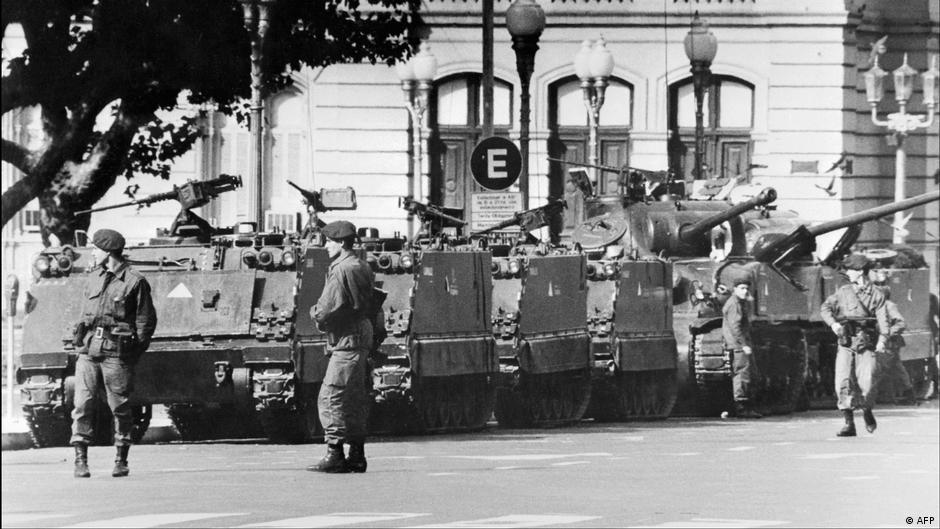
In the early hours of March 24, 1976, military officers led by General Jorge Rafael Videla arrested President Isabel Perón and declared that the armed forces had taken control of Argentina.
Perón’s leadership from 1974 to 1976 had been marked by runaway inflation, strikes, political violence and party infighting. Against a backdrop of terrorist bombings and workers’ strikes, Videla’s regime initiated a campaign of brutal state terrorism known as the “Dirty War.”
Political opponents, students, intellectuals, journalists and lawyers were systematically persecuted, and the powerful labor movement became a primary target of the regime seeking to push through its radically right-wing, anti-communist agenda. From 1976 to 1983, approximately 30,000 people vanished from Argentina without a trace, according to human rights organizations. Most were taken to clandestine camps where they were held without trial, tortured and murdered.
The “disappeared,” or “desaparecidos” as they are known in Spanish, were buried in secret locations in unmarked mass graves, or thrown from airplanes into the La Plata river or the Atlantic Ocean on so-called “death flights.” At least 500 newborn babies were also stolen from prisoners and given to military families to raise, with some unaware to this day of their true identity.
Fifty years on from the coup, Argentinians are still reckoning with the crimes of the military dictatorship, and many of the victims and their relatives continue fighting for justice. Videla was sentenced to life imprisonment in 1985 following the Trial of the Juntas, but extensive amnesty regulations introduced after the regime crumbled, as well as a general pardon decreed in 1989, have impeded legal proceedings against many of the junta’s henchmen.
Corporate Complicity Under Scrutiny
Gabriel Pereira, a researcher on human rights at CONICET, Argentina’s National Scientific and Technical Research Council, describes the process of justice and accountability as happening in “stop motion,” with cases inching forward over decades without resolution. He has been campaigning for greater accountability regarding corporate complicity in human rights violations during the dictatorship, often referred to as a “civic-military dictatorship” due to the key role played by business elites and transnational corporations.
“The accused are elite people who share social spaces with the judicial elites,” Pereira told DW. He adds that some judges are “very reluctant” to bring civilians, including priests and economic actors, to account, fearing they “don’t want to open the box and see who else was part of the state machine.”
Pereira is one of the attorneys on the La Fronterita sugar mill case, alleging corporate complicity in crimes against humanity. The military built a clandestine detention center at the mill in Tucuman province in 1975, and there is evidence suggesting the company’s management provided information to military officers about workers who were allegedly tortured and murdered.
Berlin-based lawyer Wolfgang Kaleck, general secretary of the European Center for Constitutional and Human Rights (ECCHR), has represented victims of the regime for the past 27 years. One of his most high-profile cases involves German multinational automotive manufacturer Mercedes-Benz and the relatives of trade unionists who disappeared from its plant in Buenos Aires in 1976 and 1977.
Kaleck represented Hector Ratto in a case against Juan Tasselkraut, the former manager of the Mercedes-Benz Argentina plant, and upper-level staff at the company’s German headquarters. Ratto alleges Tasselkraut summoned him to his office where regime officers were waiting, leading to his abduction and torture. He was released after a few days, then abducted again and held for 16 months in clandestine detention centers. It is believed the plant’s managers handed over the names and addresses of at least 14 trade union activists to the military, all of whom disappeared.
The events are the subject of the 2003 documentary film “There Are No Miracles” (“Milagros no hay”) by German journalist Gaby Weber, who investigated events at the plant from 1976 to 1977. The film’s title is the response Tasselkraut gave when asked whether there was a connection between the murder of labor leaders and increased productivity at the plant.
“We have yet to get justice, but we have managed to keep the story from being forgotten. It is reported on, talked about, films are made, books have been written. The story hasn’t and isn’t going away,” Kaleck told DW.
In response to a DW inquiry, Mercedes-Benz stated that an international law expert, Christian Tomuschat, was commissioned by DaimlerChrysler AG to investigate the allegations over 20 years ago. “The independent commission of inquiry found no evidence whatsoever to support the claim that the employees of the then-Mercedes-Benz Argentina who disappeared during the military dictatorship in 1976-77 had been abducted and murdered by state security forces at the instigation of the company,” the statement said. The company also asserted that the claim the disappeared employees “were critical union activists is inaccurate.”
A Lost Generation and Ongoing Struggle
Argentina’s last military dictatorship came to an end in 1983 after a failed attempt to seize the Falkland Islands from the British in 1982. The first free elections in more than seven years took place on October 30, 1983.
In Argentina, March 24 is now officially designated as the Day of Remembrance for Truth and Justice, and millions of people have taken to the streets across the country to declare “Nunca mas,” or “never again.”
Current president Javier Milei caused an uproar when he questioned the widely accepted figure of 30,000 disappeared during a presidential debate before his election win in 2023. Opponents accuse Milei of justifying state terror by equating it with the violence committed by leftist guerrillas. In 2024, Milei demanded justice—not for the victims of the military dictatorship, but for the victims of the guerrillas before the coup. He has also cut state spending on civil society groups and memorial sites, as well as impeding people’s ability to protest.
Eugx Grotz, a feminist activist, researcher and spokesperson for the “Asamblea en Solidaridad con Argentina en Berlín” (“Assembly in Solidarity with Argentina in Berlin”), founded in December 2023 following Milei’s inauguration, stated, “He is trying to reinstate the idea of the two demons, that state violence and repression was a necessary answer to an ongoing terrorist threat to our country.”
Grotz, born after the military regime crumbled, feels the weight of its legacy. “On the one hand it meant a complete wiping out of a generation of activists,” Grotz says. “I think we have learnt a lot from human rights organizations who have shown us that you do not have to remain silent.”
For researcher Gabriel Pereira, the anniversary not only commemorates the victims of the dictatorship but also serves “a way to resist what is going on with the current government.”