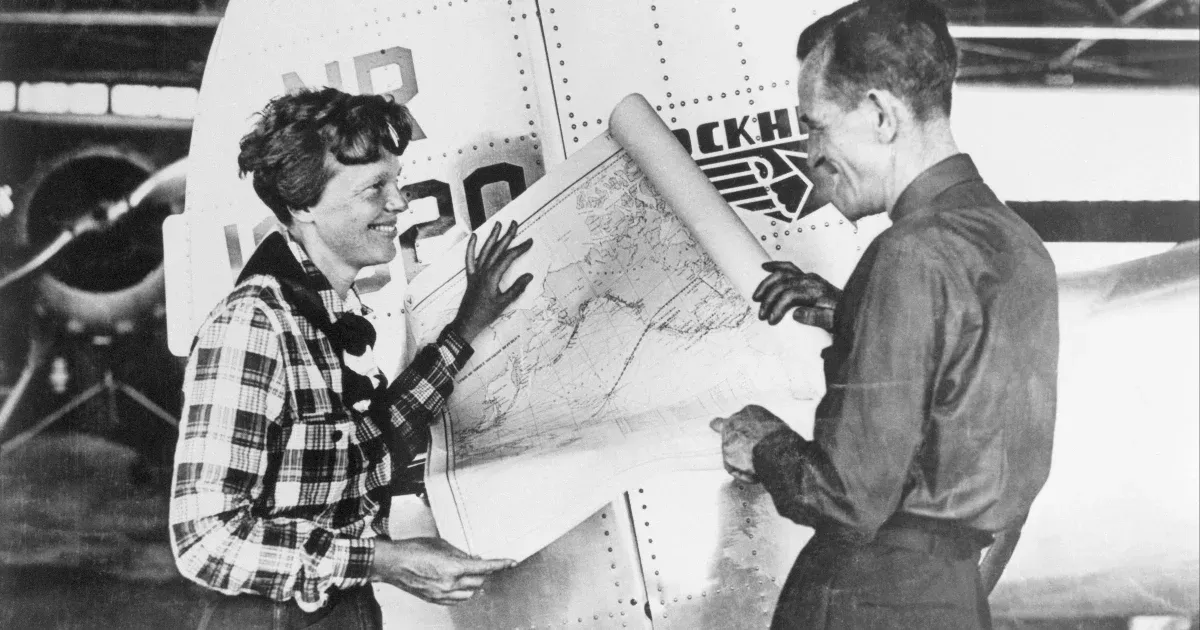
Archaeologists search Nikumaroro for Amelia Earhart’s lost plane
Archaeologists Search Nikumaroro for the Taraia Object
The research crew, organized by the Archaeological Legacy Institute and the Purdue University research foundation, reached the uninhabited Kiribati atoll after a five-day sea voyage from Tarawa, according to Múlt-kor. Upon landing, maritime and terrestrial archaeologists cleared a dense jungle pathway known as the Gallagher-autópálya to access the island’s lagoon. The target of their search is the Taraia Object, a submerged formation identified in 2020 satellite imagery that researchers note is also visible in a 1938 photograph taken shortly after the disappearance.
Index reported that the 17-person team intends to capture initial photo and video documentation before initiating underwater excavation work around the anomaly. The object rests in the lagoon, and the team will bring the object to the surface to draw conclusions. While confirming the identity of the Lockheed Electra 10E would provide proof to close the mystery, other investigators remain skeptical.
Ric Gillespie told Telex that he would be surprised if the wreckage of Amelia Earhart’s plane were there, though he would congratulate the team. Gillespie noted that they searched the specific area with metal detectors in 2001 and 2007 without recovering wreckage.
Coconut Crabs Fuel Theories About Scattered Human Remains
The remote environment of Nikumaroro has long sustained alternative theories regarding the fate of the aviators, including the proposition that large terrestrial crustaceans interfered with human remains. Coconut crabs, capable of growing up to a meter in leg span and weighing over four kilograms, populate the uninhabited atoll and hunt actively at night, as detailed by Nők Lapja. While the species is capable of breaking down a corpse and scattering bones, investigators maintain there is no evidence confirming the animals interacted with Earhart or Noonan.
Earhart and Noonan departed Lae, New Guinea, on July 2, 1937, bound for Howland Island on the most complex leg of their equatorial around-the-world flight. Transmissions monitored by the Itasca indicated the aircraft was low on fuel and unable to establish radio contact before all signals ceased. A subsequent naval and aerial search initiated by U.S. President Franklin D. Roosevelt lasted more than two weeks and failed to locate the aircraft.

Diverging Hypotheses On The Final Flight Path
Contasting theories continue to divide researchers investigating the disappearance, pitting underwater anomaly detection against historical attrition models. The Purdue-ALI expedition focuses on recovering physical aircraft components from the lagoon sediments of Nikumaroro, relying on the hypothesis that the anomaly represents the remains of the transport plane.
Parallel speculations regarding the flight’s end range from capture by Japanese forces in the Marshall Islands to death as political prisoners on Saipan, though none have yielded verifiable documentation. As excavation of the Taraia Object proceeds, the physical reality of the lagoon formation remains unverified by direct artifact recovery.
More on Amelia Earhart
🇺🇸 Researchers have launched a new Pacific expedition to investigate a mysterious object that could be Amelia Earhart’s long-lost plane.The “Taraia Object” sits in a lagoon on remote Nikumaroro, and the team plans to use sonar and magnetic scanning to determine whether it is… pic.twitter.com/eUYbIyUOGh