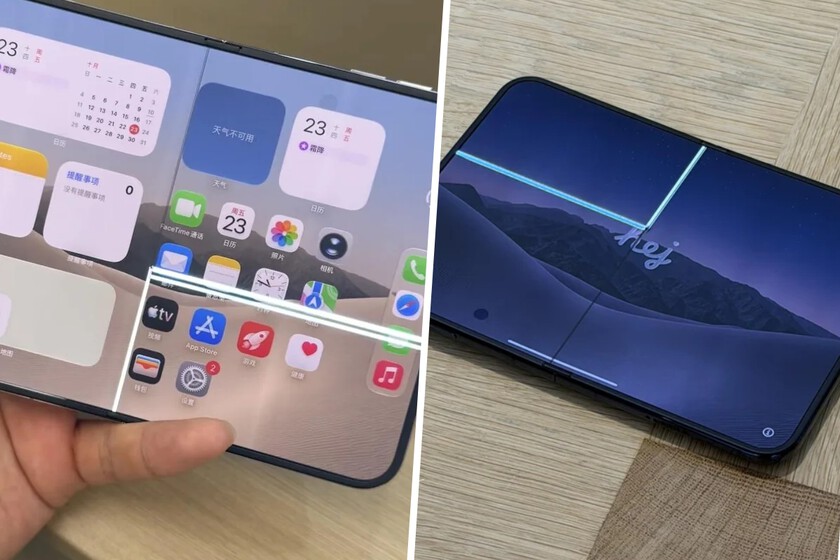
Apple Offers iPhone Duo Replacements After Foldable Screen Complaints
Apple has acknowledged a defect affecting the interior screens of a small number of its newly launched iPhone Duo units, offering device replacements through AppleCare as customer complaints mount across social media platforms. The iPhone Duo, one of the launches in years, arrived on the market following an enormous demand where online inventories sold out within minutes and delivery wait times stretched up to three months. The device starts at 2,339 euros in Spain. This launch represents the first batch of models released since John Ternus took over the company’s leadership in September, following 15 years with Tim Cook at the helm. Ternus had recently described competing foldables as cheap and shoddy in an interview.
Apple Confirms Flaws in First Foldable
The company issued a statement confirming the screen issues on units of its first foldable smartphone, noting that the problem affects a small number of units. According to Apple’s statement, defects in flawed units typically appear immediately, suggesting that devices surviving the first few opening and closing cycles without incident are operating correctly. In a declaration to Bloomberg, Apple communicated: Somos conscientes de un problema que afecta a la pantalla interior en un pequeño número de unidades de iPhone Duo.
Apple added that users experiencing problems should contact AppleCare for a replacement. The initial customer complaints surfaced on forums like Reddit and social networks such as X or TikTok, with Bloomberg verifying facts with more than half a dozen clients who stated their folding screens cracked after merely hours or days of use.
iFixit Identifies Potential Stress Point in Folding Mechanism
While Apple has not officially disclosed the underlying mechanical cause or the exact volume of affected devices, independent hardware analysts have scrutinized the device’s physical architecture. Repair community specialists at iFixit conducted an evaluation utilizing teardown recordings, patent documentation, and computed tomography scans to construct a three-dimensional simulation of the folding mechanism. Their independent review identified a potential stress point near the folding apparatus, noting that cases from affected customers fit the idea that users noticed a bump under the screen near where the crack started. Additional analysis from L0vetodream suggested that the hinge possesses five groups—two on top and three on the bottom—held by a carbon fiber lining supporting the screen’s rear, pointing specifically to a fractured right-side hinge component in the central unit of the lower three groups that failed to return to its original position and rubbed against the screen from the inside. A secondary hypothesis suggested that loose screws within that hinge assembly could prevent the carbon fiber lining from returning to its place, resulting in a puncture or pressure damage to the screen. Apple has not confirmed either of the independent technical hypotheses.
High Demand Coincides with Foldable Hardware Manufacturing Challenges
The hardware issues emerge during a period of high demand and constrained availability for the company’s inaugural foldable device. Initial online inventories sold out within minutes following release, with delivery wait times stretching to three months. Francisco Jeronimo, vice president at market research firm IDC, described Apple’s replacement program as the “first correct step” to address the consumer reports, drawing comparisons to the original Galaxy Fold introduced in 2019. Hardware manufacturing challenges for foldable displays have a documented precedent across the consumer electronics sector. Since flexible panels began to be implemented in 2018, early manufacturing batches have frequently encountered structural scrutiny. Because folding screens must endure significantly more stress than normal mobile displays by bending during opening and closing, Samsung Display announced in July 2025 that one of its foldable OLED panels had passed a test of 500,000 folds, equivalent to over ten years of use for someone folding a device roughly 100 times daily. Apple did not publish similar tests, though content creators conducted their own trials, such as Tim Pan folding a unit over 10,000 times without incidents, Joanna Stern opening and closing a device 32,000 times, and Kuba Klawiter streaming a live test where the unit broke at 75,001 folds after being opened, closed, and placed in a bowl of ice. In 2017, early units of the iPhone X experienced green display lines following normal usage. Apple spent more than a decade developing the device architecture, promoting enhanced durability standards prior to the formal market release.

Unresolved Warranty and Engineering Questions
Company representatives have not specified whether the hardware replacements will impact broader delivery schedules or future manufacturing configurations for units distributed internationally. Additional technical findings remain dependent on further disclosures from corporate investigators and hardware analysts.
More on Apple
Analysis of possible screen damage caused by iPhone Duo hinge failureThe iPhone Duo hinge assembly consists of 5 groups: 2 on the upper section and 3 on the lower section. A carbon fiber liner supports the back of the display on the screen side.After disassembly, and… pic.twitter.com/dUVESTPoN8