
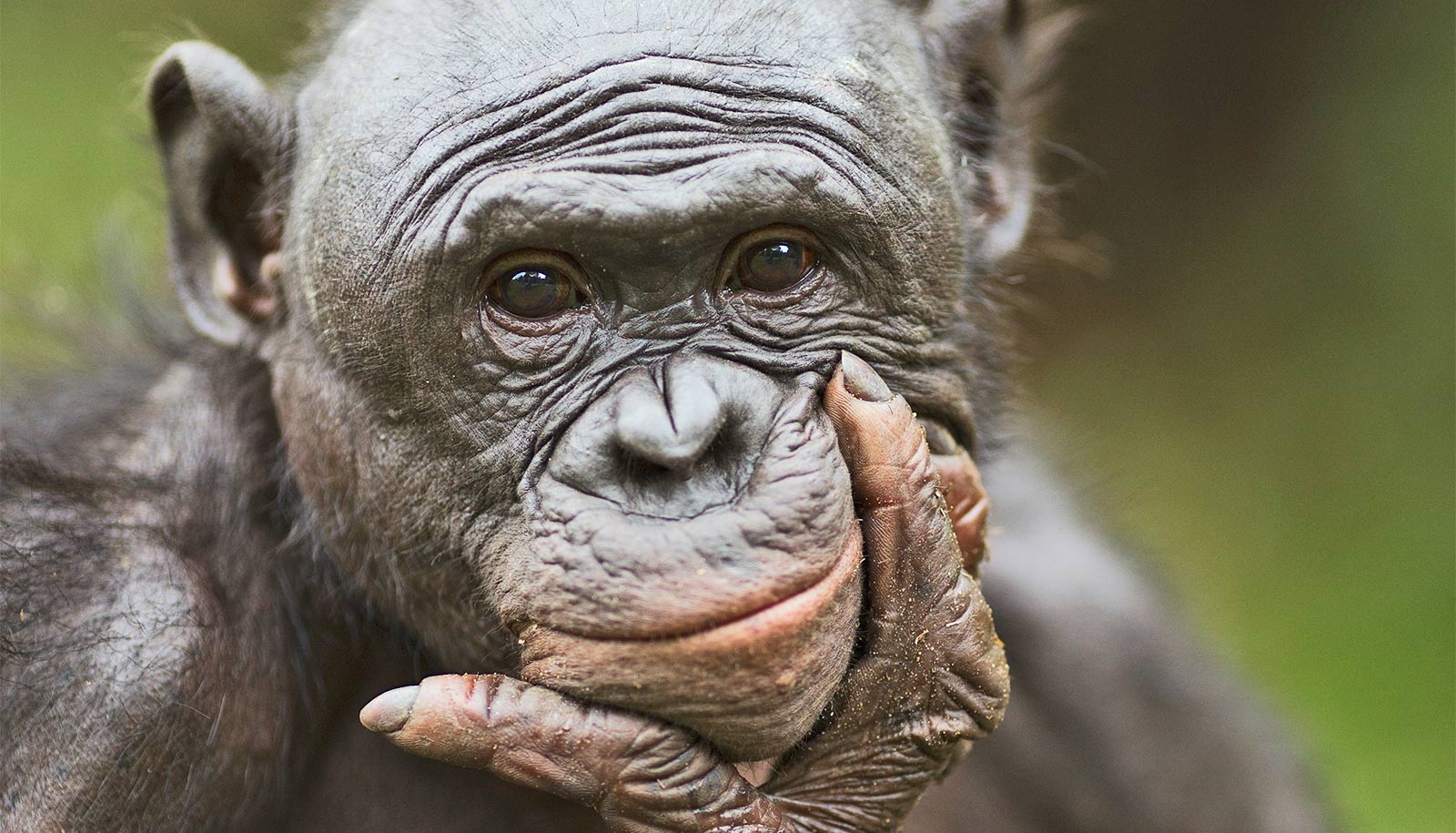
A bonobo named Kanzi has demonstrated the capacity for imaginative play, challenging long-held assumptions about the uniqueness of human cognition, according to a study published today in Science.
Researchers at Johns Hopkins University conducted a series of experiments modeled after children’s tea parties, observing Kanzi’s responses to scenarios involving imaginary juice, and grapes. The 43-year-old bonobo, who resides at the Ape Initiative, consistently indicated the locations of these pretend objects, even when real food was likewise available, suggesting an ability to conceive of things that are not physically present.
“It’s extremely striking and very exciting that the data seem to suggest that apes, in their minds, can conceive of things that are not there,” said Amalia Bastos, a former Johns Hopkins postdoctoral fellow and now a lecturer at the University of St. Andrews, in a statement released by Johns Hopkins University. “Kanzi is able to generate an idea of this pretend object and at the same time know it’s not real.”
The experiments involved an experimenter and Kanzi facing each other across a table set with either empty pitchers and cups or bowls and jars. In one test, the experimenter mimed pouring juice into a cup, then pretended to empty it, before asking Kanzi, “Where’s the juice?” Kanzi correctly identified the cup that still “contained” the pretend liquid in most trials. A subsequent experiment confirmed Kanzi’s understanding by offering both a cup with pretend juice and a cup with real juice; Kanzi consistently chose the real juice when given the option.
A similar experiment was conducted using grapes, with the experimenter pretending to place a grape into one of two jars. Kanzi again accurately indicated the location of the pretend grape.
The findings build on decades of research into animal cognition. Jane Goodall’s observations of chimpanzees using tools in the 1960s already prompted a re-evaluation of what defines humanity, and this new research suggests a similar shift may be necessary regarding imagination, according to Christopher Krupenye, a Johns Hopkins assistant professor in the Department of Psychological and Brain Sciences.
“Imagination has long been seen as a critical element of what it is to be human, but the idea that it may not be exclusive to our species is really transformative,” Krupenye said. “It really is game-changing that their mental lives go beyond the here and now.”
Researchers note that Kanzi was specifically chosen for the study due to anecdotal reports of his pretense and his ability to respond to verbal prompts. The study’s success with a single bonobo raises questions about whether other apes and animals possess similar capacities, and the team plans to continue exploring these possibilities.
The research was supported by the Johns Hopkins Provost’s Postdoctoral Fellowship Program, the Templeton World Charity Foundation, CIFAR Azrieli Global Scholars, and an Early Career Collaboration Enhancement Award from the Diverse Intelligences Summer Institute.
