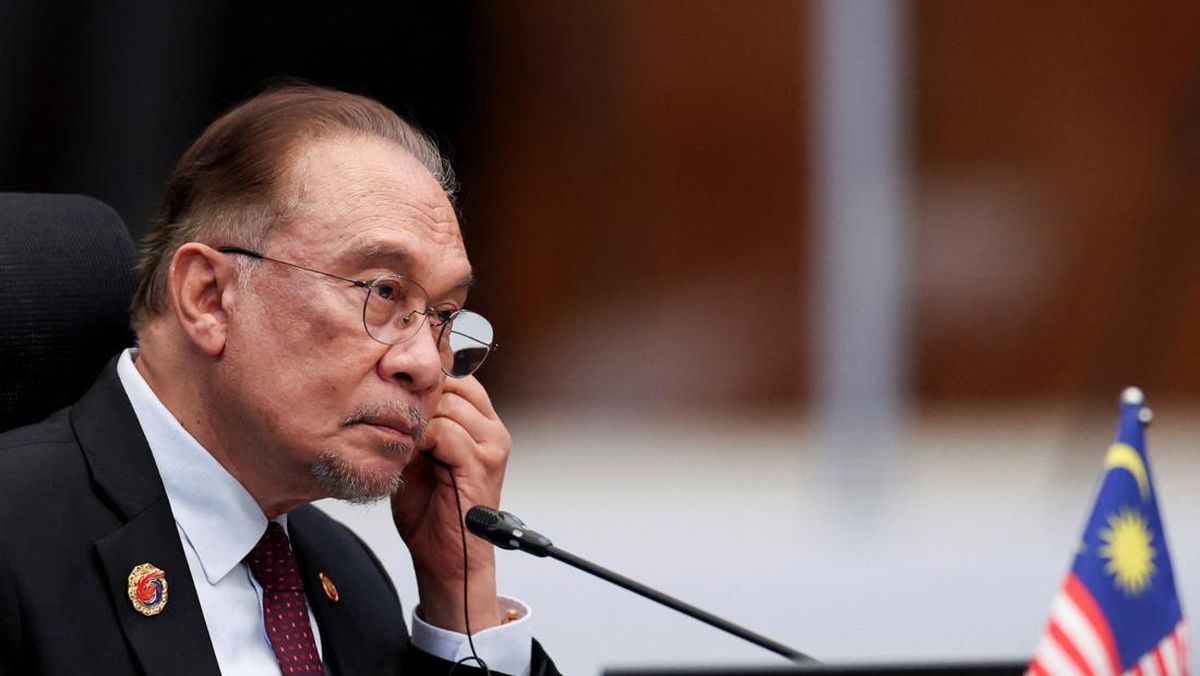
Anwar Ibrahim Faces Political Instability Amid Wave of Party Defections in Malaysia
Prime Minister Anwar Ibrahim faces a critical stability crisis in Malaysia as high-ranking allies and former protégés defect from the People’s Justice Party (PKR) to launch a rival political entity. This internal fracture threatens the fragile “Unity Government,” potentially destabilizing Southeast Asia’s semiconductor hub and rattling foreign direct investment (FDI) confidence across the region.
Political volatility in Kuala Lumpur is rarely just a domestic affair. For the global boardrooms of Silicon Valley and Shenzhen, Malaysia is not merely a sovereign state but a critical node in the global electronics supply chain. When the premiership shakes, the risk premium for the entire ASEAN bloc rises.
The current exodus of cadres from Anwar’s inner circle represents a systemic failure of the “big tent” strategy. Anwar, a man who spent decades in the political wilderness, now finds himself presiding over a coalition of convenience that is beginning to fray at the seams. The defection of his “students”—the very individuals he mentored in the art of reformist politics—suggests a generational shift and a rejection of the compromises Anwar has made to keep his government afloat.
Instability is the enemy of capital.
The Fragility of the Unity Coalition
The current crisis is a delayed reaction to the “Sheraton Move” of 2020, which proved that Malaysian loyalty is a fluid commodity. Anwar’s administration is a delicate balancing act between the reformist agenda of PKR and the conservative requirements of his coalition partners. By pivoting toward the center to maintain power, Anwar has alienated the ideological purists within his own camp.

This internal hemorrhage creates a vacuum that opportunistic rivals are eager to fill. The formation of a new party by former PKR loyalists isn’t just a bid for power; it is a strategic hedge. These defectors are positioning themselves as the “true” reformists, betting that the public’s patience with Anwar’s pragmatic concessions is wearing thin.
“Malaysia is currently navigating a ‘perpetual transition.’ The shift from dominant-party rule to a fragmented coalition system means that no Prime Minister is ever truly secure. The current defections are a symptom of a political ecosystem where survival depends on agility, not loyalty.” — Dr. Aris Munandar, Senior Fellow in Southeast Asian Studies.
For multinational corporations, this volatility creates a nightmare for long-term planning. When the leadership of a country is in flux, policy consistency vanishes. This is why firms are increasingly relying on political risk consultants to map out contingency plans for their regional headquarters.
The Semiconductor Stakes: A Macro-Economic Ripple
The real danger lies in the “back-end” of the global chip industry. Malaysia accounts for a significant percentage of the world’s semiconductor packaging, and testing. Any perceived instability in the federal government can lead to sudden shifts in regulatory environments, labor laws, or tax incentives.

As the US continues its “friend-shoring” initiative, attempting to decouple critical supply chains from China, Malaysia has been a primary beneficiary. However, this influx of capital requires a stable legal framework. If Anwar’s government falls or is forced into a paralyzed state of deadlock, the confidence of giants like Intel and Infineon could waver.
We are seeing a pattern where geopolitical instability triggers immediate legal audits. Companies are now scrambling to secure their assets through international trade lawyers who can insulate their investments from sudden legislative pivots in Kuala Lumpur.
Consider the data: Malaysia’s World Bank economic outlook has consistently highlighted the need for structural reforms to escape the middle-income trap. Political infighting is the primary barrier to those reforms.
The ASEAN Power Vacuum
Beyond the balance sheets, there is the matter of regional leadership. Anwar has attempted to position Malaysia as a diplomatic bridge between the West and the Global South, leveraging his intellectual stature on the world stage. But a leader who cannot command his own party is a leader who cannot effectively lead a bloc.
The relationship between Malaysia, Indonesia, and Singapore is the tripod upon which ASEAN stability rests. If Malaysia descends into another cycle of “musical chairs” premierships, it weakens ASEAN’s collective bargaining power against the hegemonic pressures of the US and China.
This is not a theoretical risk. We have seen how regional volatility in Southeast Asia leads to currency fluctuations and capital flight. Institutional investors are already hedging their bets, shifting portfolios toward more stable jurisdictions or utilizing global asset managers to diversify their exposure to Emerging Asia.
Comparative Political Stability Index (Projected 2026)
| Region/Country | Political Stability Score | FDI Risk Level | Primary Driver of Instability |
|---|---|---|---|
| Malaysia | Moderate-Low | Elevated | Coalition Fragmentation |
| Vietnam | High | Low | Single-Party Continuity |
| Indonesia | Moderate-High | Low-Moderate | Succession Transition |
| Thailand | Moderate-Low | Moderate | Judicial Activism |
The Path to Survival
For Anwar Ibrahim, the solution is no longer about ideology; it is about arithmetic. He must either co-opt the new party through concessions or find a way to marginalize the defectors before they gain enough momentum to trigger a vote of no confidence.
The irony is palpable. The man who spent years as the victim of political betrayal is now the target of it. In the high-stakes game of Malaysian politics, the “student” often learns the master’s lessons too well.
The global market is watching. Not because they care about the internal dramas of the PKR, but because the stability of the Straits of Malacca and the integrity of the chip supply chain depend on a functional government in Putrajaya.
As we track the fallout of this internal collapse, one thing is clear: the era of the “strongman” in Southeast Asia is being replaced by the era of the “fragile coalition.” In this new environment, the only certainty is uncertainty.
The shifting chessboard in Malaysia is a microcosm of a broader global trend: the erosion of party loyalty in favor of tactical alignment. For the corporate entity, Which means that “country risk” is no longer a static metric but a live variable. Whether you are managing a supply chain in Penang or a hedge fund in London, the ability to navigate these geopolitical fractures is the only competitive advantage that matters. To find the vetted legal, financial, and strategic partners capable of mitigating these risks, the World Today News Directory remains the definitive resource for global operational resilience.