Anode-Free Sodium Batteries Reach 1,400 Cycles With 80% Capacity Retention via Oligomerizing Electrolyte
“We aimed to minimize continuous electrolyte decomposition through rational molecular design,” said Weijiang Xue, senior author of the study published November 2 in Nature Energy.
The research team from Xi’an Jiaotong University and the Chinese Academy of Sciences reported that anode-free sodium pouch cells using a 1,3-dioxane-based electrolyte retained roughly 80% of their initial capacity after 1,400 cycles. “Importantly, rather than relying solely on laboratory coin cells, we extensively tested the electrolytes in 0.3-Ah anode-free pouch cells, providing a more practical and scalable assessment of their cycling stability,” Xue said. “We hope these advances will bring low-cost, high-energy-density sodium batteries closer to practical applications,” Xue added.
Anode-free sodium batteries assemble without a sodium-metal anode, drawing sodium ions from the cathode to plate onto a thin current collector during charging. The design promises lower cost and higher energy density than versions using hard-carbon anodes, but irreversible sodium loss has limited cycle life.
Xue told Tech Xplore that industry discussions revealed hard-carbon cost as a major commercialization barrier, prompting the group to apply its anode-free lithium experience to sodium systems. “Our group began working on sodium-ion batteries in 2022, initially focusing on electrolyte design for conventional batteries using hard-carbon anodes,” Xue said.
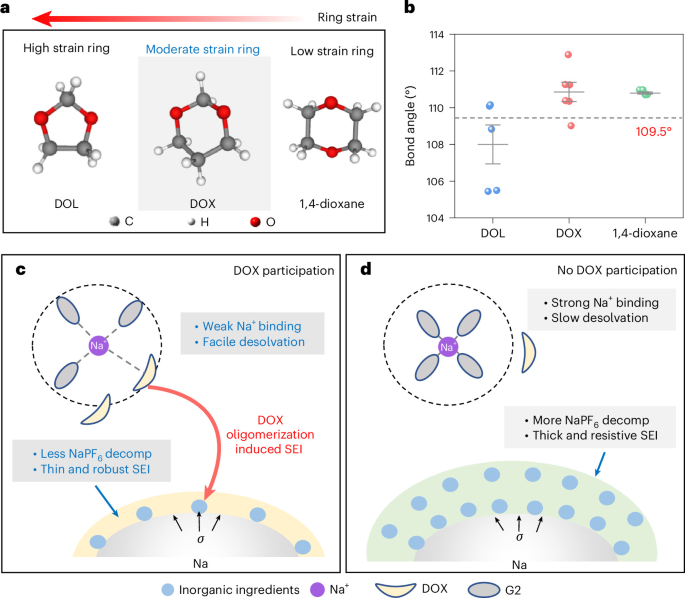
The researchers selected 1,3-dioxane (DOX) because its weak coordination with sodium ions facilitates reversible deposition, while controlled oligomerization forms a thin interphase that suppresses further electrolyte decomposition.
Rather than pursuing inorganic-rich layers typical of lithium-metal batteries, the team engineered an organic-rich solid-electrolyte interphase through partial linking of solvent molecules.
“This finding broadens the conventional understanding of interphase design, showing that stable interfaces for Na-metal do not necessarily require inorganic-rich layers derived from salt decomposition,” Xue said.

The researchers examined cyclic ethers with five- and six-membered rings to learn how ring structure and internal strain influence reactions at the sodium-metal surface.
He said the approach aimed to minimize continuous electrolyte decomposition through rational molecular design rather than pursuing inorganic-rich layers typical of lithium-metal batteries. The team combined theoretical calculations, electrochemical measurements and advanced characterization to study the resulting interphase.
The breakthrough stems from Xi’an Jiaotong University, a Ministry of Education–affiliated public university that belongs to Project 985, Project 211 and the C9 League, and houses five state key laboratories. The university’s research group began working on sodium-ion batteries in 2022, initially targeting electrolyte design for conventional hard-carbon anode systems before applying its anode-free lithium experience to sodium batteries.

Testing moved beyond coin cells to 300-milliampere-hour pouch cells with a cathode loading of about 20 milligrams per square centimetre, approaching commercially relevant areal loadings. The cells operated at rates up to 3 C, enabling charge or discharge in as little as 20 minutes, and maintained 88% capacity retention at −40 °C.
Round-trip energy efficiency reached approximately 98%. “Our long-term goal is to achieve energy densities comparable to those of today’s high-energy lithium-ion batteries using nickel-rich cathodes, while maintaining more than 1,000 cycles of stable operation,” Xue added. The team plans to develop solid-state electrolytes and formulations compatible with high-voltage layered-oxide cathodes.