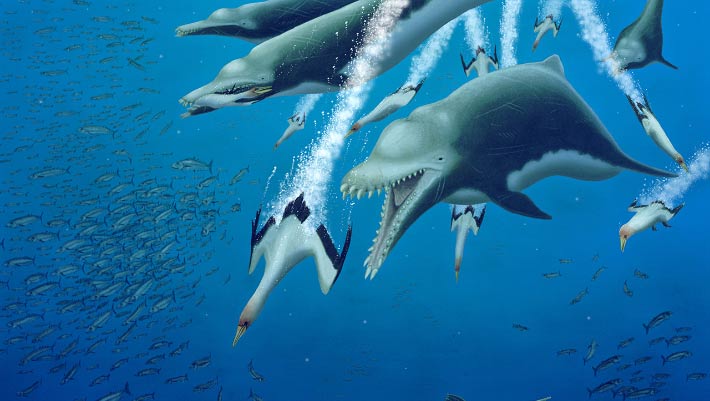
Ankylorhiza serratidens: New Dolphin Species Lived Off South Carolina 28 Mya
A newly identified species of the genus Ankylorhiza, dubbed Ankylorhiza serratidens, lived off the coast of South Carolina approximately 28 to 30 million years ago, according to a study published in the journal Acta Palaeontologica Polonica.
This discovery provides evidence of a macrophagous predator that possessed serrated teeth, a feature previously undocumented in any toothed whale.
The Tech TL;DR:
- Ankylorhiza serratidens utilized specialized posterior teeth with 0.9–1.3 mm serrations for a “grip and rip” feeding mechanism on large prey.
- The species represents an evolutionary peak in macrophagous specialization during the Early Oligocene, diverging from the smooth-toothed morphology of modern Orcinus orca.
- The partial skeleton, recovered from the Ashley Formation in Dorchester County, includes mandibles and postcrania that confirm the animal’s status as a top-tier apex predator of its epoch.
The Oligocene epoch served as a high-velocity period for cetacean diversification, marking the emergence of both toothed whales and baleen-bearing species. As reported by Sci.News: Breaking Science News: Breaking Science News, this era saw explosive gains in encephalization and the foundational development of echolocation. Ankylorhiza serratidens represents a specialized branch of this evolutionary tree, exhibiting distinct adaptations for consuming large prey.
Dr. Robert Boessenecker, a paleontologist with the University of California, Berkeley, said that while modern macrophagous marine mammals—including the killer whale, false killer whale, and leopard seal—occupy similar ecological niches, none possess the dentition found in this ancient specimen.
According to Sci.News: Breaking Science News: Breaking Science News, the serrations on the rear teeth suggest a functional divide in the animal’s processing capabilities. The front teeth were likely utilized for initial prey capture, while the rear teeth functioned as a saw blade to process tough connective tissues and skin.
“Coarsely serrated vertebrate teeth function like a saw blade, where movement of the flesh parallel to the serrated edge results in a ‘grip and rip’ action, concentrating tissues, including tough connective tissue and skin, into the notches and ripping the tissue with relative motion between the tooth and prey item,” Boessenecker told Sci.News: Breaking Science News: Breaking Science News.
The new species shares taxonomic space with Ankylorhiza tiedemani, previously identified as the largest toothed whale of the Oligocene. While both species reached significant physical dimensions, Ankylorhiza serratidens demonstrates a higher degree of dental specialization.
| Species | Estimated Length | Primary Dental Feature |
|---|---|---|
| Ankylorhiza tiedemani | 4.5–6 meters | Large teeth, fluted enamel |
| Ankylorhiza serratidens | Comparable to A. tiedemani | Serrated posterior teeth |
The specimen was retrieved from the Ashley Formation in Dorchester County, South Carolina, and is currently housed at the Mace Brown Museum of Natural History at the College of Charleston. The skeletal remains include a dozen teeth, lower jaws, and rib bones. Forensic analysis of the fossilized teeth revealed that the serrations were true denticles, as wear patterns on the edges exposed the underlying dentine.
Dr. Robert Boessenecker, a paleontologist with the University of California, Berkeley, led the analysis of the Ankylorhiza serratidens fossils. Founded in 1868 as the state’s first land-grant university, Berkeley operates Lawrence Berkeley National Laboratory, which was originally established as part of the campus. The university is classified among “R1: Doctoral Universities – Very high research activity,” and federal funding for its research and development exceeded $1 billion in 2021.
# Analytical query for dental morphology metrics
SELECT species, serration_size_mm, tooth_position
FROM cetacean_paleontology
WHERE genus = 'Ankylorhiza'
AND epoch = 'Early Oligocene';
Researchers have not yet determined the specific selection pressures that favored the transition to the smooth, conical teeth characteristic of modern apex marine predators. The study was published online on October 30, 2026.