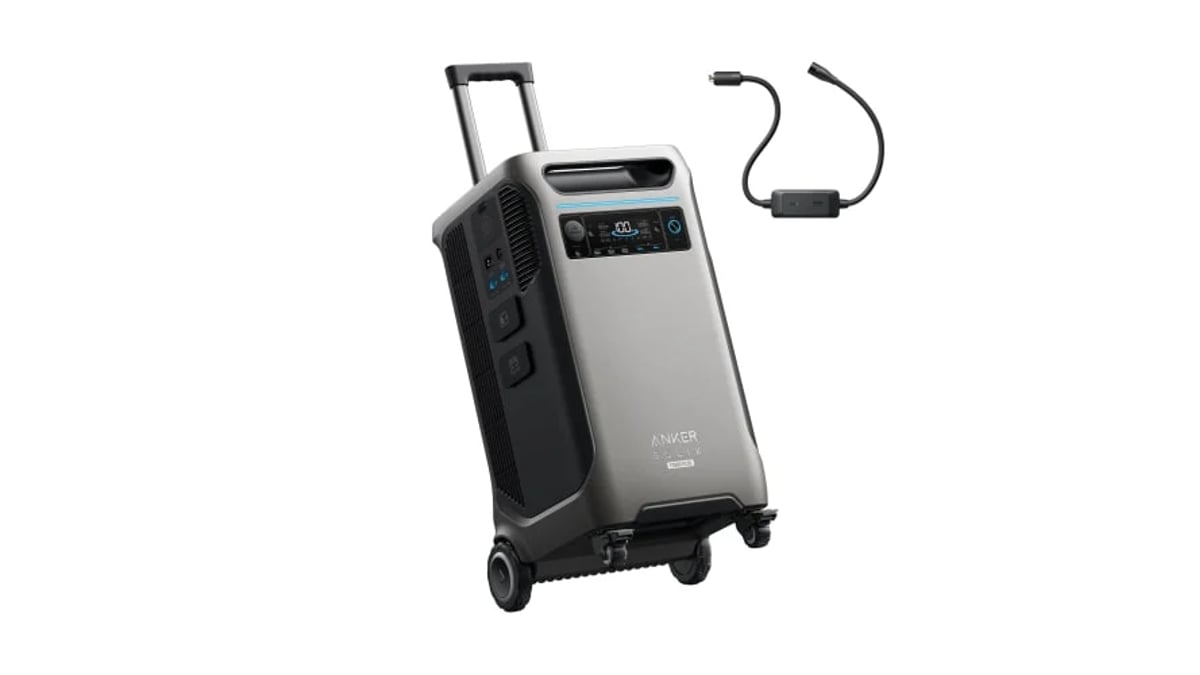
Anker SOLIX F3800 Plus Portable Power Station Hits Record Low Price
The “emergency preparedness” market is currently a race to the bottom of the price curve, and Anker just accelerated. While the marketing push focuses on the “record low” price, the real story for anyone with a home lab or a critical server rack is the shifting economics of high-capacity energy storage.
The Tech TL;DR:
- Price Pivot: The Anker SOLIX F3800 Plus has dropped to $2,399.99, a 20% reduction from its $2,999.99 baseline.
- Chemistry Shift: Move toward LFP (Lithium Iron Phosphate) is standardizing long-cycle life over raw energy density.
- Deployment Logic: Ideal as a bridge for critical infrastructure gaps before full-scale solar/battery integration.
For the average consumer, a price drop is a “deal.” For a systems architect, it’s a signal of commodity maturation. The challenge with portable power stations has never been the capacity—it’s been the efficiency of the DC-to-AC conversion and the degradation curve of the cells. When we evaluate these units, we aren’t looking at the glossy renders; we are looking at the Total Cost of Ownership (TCO) and the cycle life before the capacity hits 80% of its original rating.
Most entry-level units rely on NMC (Nickel Manganese Cobalt) cells, which offer higher density but suffer from shorter lifespans and higher thermal volatility. The industry-wide pivot toward LFP, as seen in the SOLIX line, addresses the “thermal runaway” risk and extends the cycle count significantly. However, this shift increases the physical footprint of the unit—a classic engineering trade-off where safety and longevity supersede portability. For enterprises managing remote endpoints, this necessitates a review of physical space and weight limits, often requiring [professional electrical consultants] to ensure that the supplementary charging infrastructure can handle the sustained draw without tripping breakers.
The Thermodynamics of LFP vs. NMC
To understand why the F3800 Plus is positioned as a “long-term” solution, we have to look at the crystal structure of the cathode. LFP batteries utilize a phosphate-based cathode, which is significantly more stable than the cobalt-based alternatives. This stability translates to a lower risk of combustion during a cell failure—a critical requirement for any device that will be charging in a residential or office environment overnight.
From a technical standpoint, the efficiency of these units depends on the inverter’s ability to maintain a Pure Sine Wave. Modified sine waves are a death sentence for sensitive electronics, introducing harmonic distortion that can overheat power supplies in high-end servers or networking gear. The SOLIX architecture prioritizes this clean output, which is essential for anyone bypassing a traditional UPS to run a home-office stack during a grid failure.

| Metric | NMC (Standard Lithium) | LFP (Lithium Iron Phosphate) | Architectural Impact |
|---|---|---|---|
| Cycle Life | 500 – 1,000 Cycles | 3,000 – 6,000+ Cycles | Lower TCO over 10 years |
| Thermal Stability | Moderate | High | Reduced fire suppression needs |
| Energy Density | High | Moderate | Larger physical chassis |
| Voltage Sag | Linear | Flat | More consistent power delivery |
When deploying these units at scale, the bottleneck is rarely the battery itself, but the recharge latency. Implementing Maximum Power Point Tracking (MPPT) allows the system to optimize the voltage from solar arrays, ensuring that the cells are charged at the most efficient rate regardless of cloud cover or panel angle. For those integrating this into a larger smart-home ecosystem, the API and remote management capabilities become the primary point of failure. Without robust telemetry, you’re essentially flying blind on your energy reserves.
Implementation: Calculating Runtime via Python
For the developers in the room, don’t trust the “estimated hours” on the box. You need to calculate the actual runtime based on your specific load, accounting for the inverter’s efficiency loss (usually 10-15%). Here is a basic implementation to model the discharge curve of a high-capacity LFP station.
def calculate_runtime(capacity_wh, load_watts, efficiency=0.85): """ Calculates estimated runtime for a power station. Capacity_wh: Total capacity in Watt-hours load_watts: Constant draw in Watts efficiency: Inverter efficiency (default 85%) """ effective_capacity = capacity_wh * efficiency runtime_hours = effective_capacity / load_watts return round(runtime_hours, 2) # Example: Running a 200W server rack on a high-capacity unit capacity = 3840 # Example Wh load = 200 # Example Watts print(f"Estimated Runtime: {calculate_runtime(capacity, load)} hours") This logic is fundamental for anyone designing a failover strategy. If you are managing a distributed network of remote sites, you cannot rely on manual monitoring. Many firms are now deploying [managed IT service providers] to integrate these power solutions into a centralized NOC (Network Operations Center) using SNMP or proprietary APIs to trigger automated shutdowns before the battery hits critical levels.
The Market Context: Why the 20% Drop?
The reduction from $2,999.99 to $2,399.99 isn’t a random sale; it’s a reaction to the plummeting cost of LFP cells globally. As EV manufacturers scale LFP adoption, the cost per kilowatt-hour (kWh) is dropping, allowing consumer electronics brands to aggressively price their hardware to capture market share. We are seeing a “commoditization of the electron,” where the hardware is becoming secondary to the software layer that manages the energy flow.

However, the hardware is still the foundation. A unit that can handle high-wattage output without thermal throttling is a rarity. Most “budget” stations throttle output as soon as the internal thermals hit a certain threshold, leading to unexpected shutdowns of the connected load. The F3800 Plus aims to avoid this by utilizing EV-grade cells and a more robust thermal management system, though the real-world benchmarks usually depend on the ambient temperature of the deployment environment.
“The transition to LFP chemistry in the portable power sector is a prerequisite for enterprise-grade reliability. We are moving away from ‘camping gear’ and toward ‘distributed infrastructure’ that can actually survive a three-day outage without cell degradation.”
— Technical Analysis, Energy Storage Research Group
For those looking to further optimize their setup, exploring the open-source energy management community on GitHub provides insights into how to build custom monitoring dashboards for these units. The IEEE Xplore digital library offers extensive whitepapers on the long-term stability of phosphate-based cathodes in varying climates, which is essential reading for anyone deploying these in extreme environments.
The trajectory of this technology is clear: the “portable” part of the power station is becoming less important than the “station” part. We are heading toward a world of modular, expandable energy blocks that act as a buffer between the unstable grid and the critical compute stack. As prices continue to normalize, the question for the CTO is no longer “can we afford a backup?” but “how do we orchestrate the failover?” This is where the expertise of [infrastructure auditors] becomes invaluable, ensuring that your power redundancy doesn’t become a single point of failure.
*Disclaimer: The technical analyses and security protocols detailed in this article are for informational purposes only. Always consult with certified IT and cybersecurity professionals before altering enterprise networks or handling sensitive data.*