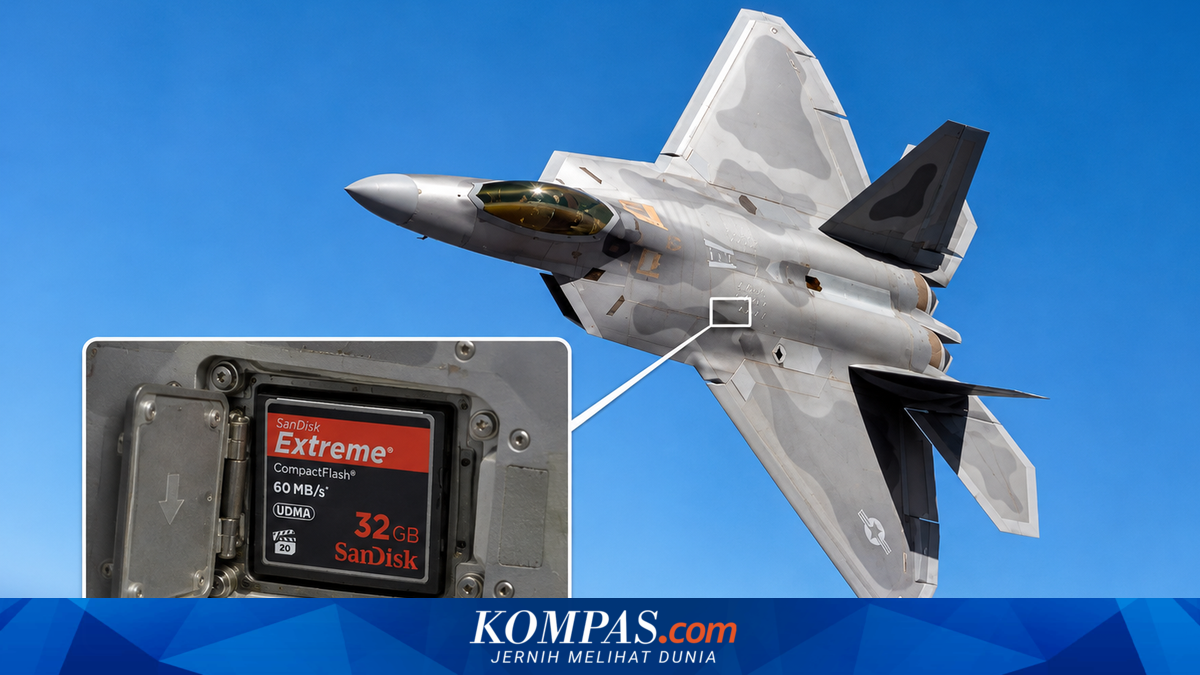
Angkatan Udara AS Butuh Kartu Memori Jadul untuk Terbangkan F-22 Raptor
The U.S. Air Force is hunting for suppliers of 1990s-era memory cards to keep its F-22 Raptor fleet flying, posting a formal sources-sought notice on Nov, according to Kompas.
16 that asks industry whether it can still deliver 256-megabyte PC Cards or CompactFlash media for the jet’s mission-data cartridges.
The notice, numbered FA8611-27-R-F-22 and published on SAM.gov by the F-22 Modernization Division at Wright-Patterson Air Force Base, Ohio, gives vendors until 1 p.m. EST on Dec. 1 to respond. The Air Force Life Cycle Management Center issued the notice, which carries NAICS code 336411 for Aircraft Manufacturing, and lists Rafael Manzano as the primary point of contact with Tamera Moore as alternate, according to LavX News.
The contracting office is located at 2725 C St., Bldg. 553, Wright-Patterson AFB, OH 45433-7424, phone (937) 656-5842. The Department of Defense, Department of the Air Force, and Air Force Materiel Command sit above the issuing office, FA8611 AFLCMC WAUK F22.
Legacy hardware drives the requirement
The F-22 first flew in 1997 and entered service in 2005; its avionics were designed around the storage standards of that era. The micro-Data Transfer Cartridge loads mission routes, radio settings and threat data on the ground, then plugs into the cockpit for flight.
After landing, maintainers pull the cartridge to review recorded flight data. Because the aircraft’s card slots are hard-wired to the original PCMCIA Type II and CompactFlash interfaces, the Air Force must source media that works with the existing host hardware rather than redesign the jet’s data-loading system.
Each card must be an ATA flash PC Card (PCMCIA Type II) or a CompactFlash card mated to a passive CF-to-PCMCIA Type II adapter, with a minimum capacity of 256 megabytes and full read-write capability on the government-furnished host, the notice states.
That capacity is a fraction of a modern smartphone’s storage, but it matches the throughput and form factor the Raptor’s 1990s-era bus architecture expects. The notice includes one attachment, “F-22 mDTC SSN (RM).pdf,” available publicly on SAM.gov.
Air Force demands domestic sourcing and supply-chain provenance
The Air Force is also demanding detailed supply-chain provenance. Companies must describe counterfeit-prevention measures and provide estimated end-of-production dates and last-time-buy windows for each card type. Only U.S.-based firms will be considered. Companies must identify the original manufacturer, the country of manufacture for each component, and the final assembly location, and must be able to show the product distribution chain from factory to receipt.

“The government is using this research to determine if industry can meet a requirement before deciding how to proceed with acquisition,” the notice explains, adding that no contract award is guaranteed.
Wright-Patterson Air Force Base traces its flight-test lineage to 1904–1905, when Wilbur and Orville Wright conducted experimental flights at Huffman Prairie on land now inside the base boundary. The installation was formally created in 1948 by merging Wright Field and Patterson Field, which originated as Wilbur Wright Field and the Fairfield Aviation General Supply Depot during World War I. In 1995 the base hosted the Dayton Agreement negotiations that ended the Bosnian War.
Operational tempo sustains the fleet
Responses are due Dec. 1; the Air Force has not set a date for a follow-on solicitation.