
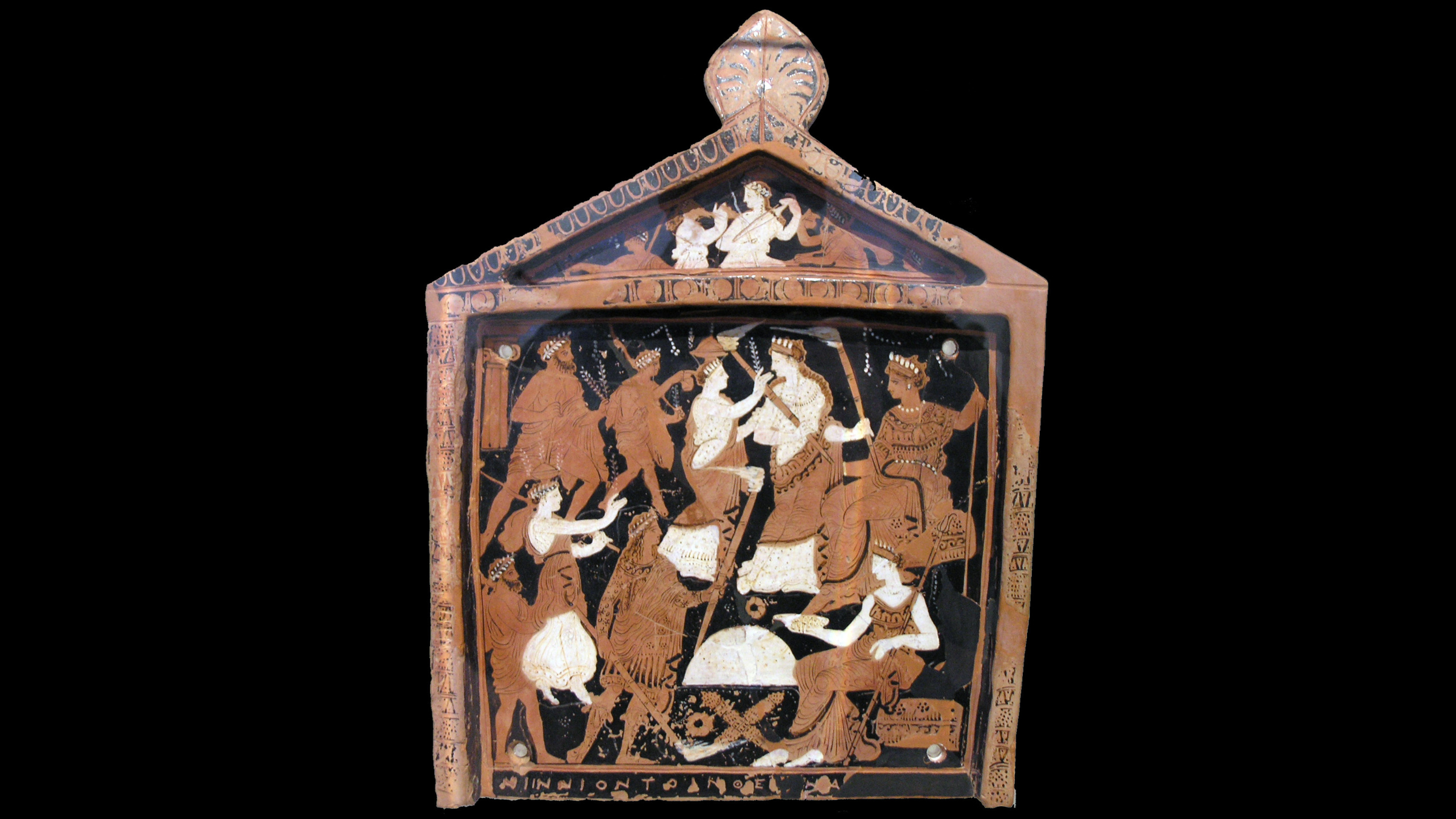
ATHENS, GREECE – A new study suggests that ancient Greek priestesses may have skillfully detoxified a poisonous fungus to create a hallucinogenic drink used during the famed Eleusinian Mysteries, a series of secret religious rites held for over a thousand years. The research, published February 13 in the journal Scientific Reports, details laboratory experiments demonstrating a method to render ergot fungus – known for its toxicity – safe for consumption while preserving its psychoactive properties.
The Eleusinian Mysteries, centered on the worship of the goddess Demeter and her daughter Persephone, drew initiates from across the ancient Greek world, including politicians, soldiers, and enslaved people. Participants engaged in a rigorous ritual sequence culminating in the consumption of a potion called kykeon, the ingredients of which were closely guarded. The rites were held annually in Eleusis, a town west of Athens, and later gained popularity throughout the Roman Empire.
Researchers, led by Evangelos Dadiotis, a pharmaceutical scientist at the University of Athens, and Romanos K. Antonopoulos, utilized a simple process known to the ancient Greeks: treating the ergot fungus with a lye solution made from water and ash. According to the study, this process broke down the toxic proteins in the fungus, Claviceps purpurea, while leaving intact lysergic acid amide (LSA), a hallucinogenic compound chemically related to LSD, though far less potent. “The central question was whether toxic ergot could realistically have been processed into something psychoactive but not lethal using methods available in antiquity,” Dadiotis told Live Science in an email. “We used a simple lye [sodium hydroxide] preparation made from water and ash, a technology well known in the ancient world.”
The “Psychedelic Eleusis” theory, positing that hallucinogens played a role in the Mysteries, has been circulating since the 1970s, notably advanced by author Gordon Wasson, classicist Carl Ruck, and chemist Albert Hofmann in their 1978 book, “The Road to Eleusis.” Hofmann, who first synthesized LSD from ergot derivatives in 1938, even experimented with a dose of the substance himself in 1943. Still, a major obstacle to the theory has always been the inherent toxicity of ergot, which can cause ergotism – a condition characterized by convulsions, gangrene, and poisoning.
“The key objection was always toxicity,” Dadiotis explained. “Nobody had shown before that ergot could be made safe by treating it with lye, which destroyed the toxic chemicals while preserving its psychoactive properties. Our study fills that gap … that experimental bridge is what was missing.”
The research team points to archaeological evidence supporting the potential use of ergot in the Eleusinian Mysteries. Traces of psychoactive chemicals have been found on pottery from an Eleusinian site in Spain, Mas Castellar de Pontós, and in the dental calculus of individuals buried there. Researchers also suggest that the addition of pennyroyal, a pungent mint, to the kykeon may have helped mask the bitter taste of the ergot extracts.
However, not all experts are convinced that the study provides definitive proof. Sharday Mosurinjohn, a religious studies scholar at Queens University in Ontario, cautioned that “chemical feasibility is not historical proof.” “What it demonstrates is chemical feasibility within a plausible ancient technological context,” Mosurinjohn told Live Science in an email. “The study neither demonstrated that this type of processing was used in ancient times, nor that initiates had consumed the psychoactive doses during the Eleusinian Mystery rituals.”
The annual rites of the Eleusinian Mysteries involved sacred processions, ritual bathing, animal sacrifices, and days of fasting, culminating in the consumption of kykeon during the “greater mysteries” held each fall. The Mysteries drew their meaning from the myth of Demeter and Persephone, symbolizing the agricultural cycle of death and rebirth. The details of the rituals remained secret, with initiates sworn to silence under penalty of death.
