Ancient Grasshoppers Walked on Water 99 Million Years Ago, Amber Fossils Reveal
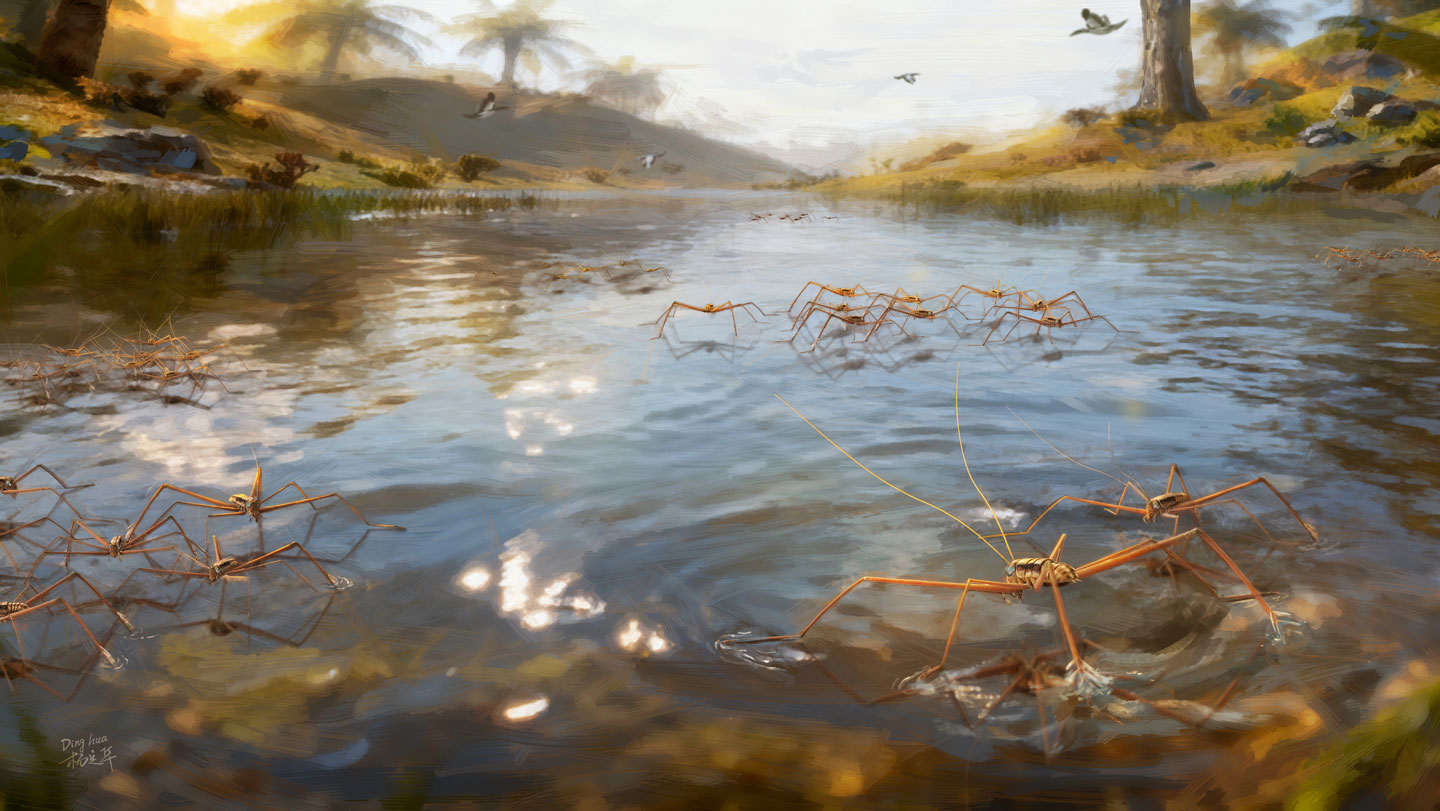
Newly identified fossils reveal that an extinct species of grasshopper lived approximately 99 million years ago and was capable of walking on water.
These insects, which lived alongside dinosaurs, utilized specialized physical adaptations to navigate aquatic surfaces, according to research published November 24 in Proceedings of the Royal Society B.
Paleontologist Chunpeng Xu of the Nanjing Institute of Geology and Paleontology and his colleagues discovered the insects while examining a collection of 99-million-year-old amber from Myanmar. The specimens, named Hydrelcana zhangi, represent a new family of insects known as Hydrelcanidae. Initially, the researchers struggled to classify the creatures due to their unusual anatomy, which included short bodies and exceptionally long, thin legs.
“I was genuinely amazed,” says Xu. “They are among the most bizarre insects.”
Microscopic analysis of the fossils revealed two key features that likely enabled the grasshoppers to move across water: water-repellent hairs on their front legs and leaf-shaped, paddle-like structures on their rear lower legs.
Weight estimates suggest the insects were light enough to be supported by the surface tension of water, with their elongated legs creating a wide footprint. The paddle-like structures on their hind legs would have provided propulsion, allowing the grasshoppers to row across the water in a manner distinct from modern water striders.

Before this discovery, scientists were aware of only two other insect groups that independently evolved to live on the water’s surface: water striders and the extinct family Chresmodidae. Unlike modern water-walking insects, which are typically predators or scavengers, the ancient grasshoppers were likely herbivorous, as evidenced by their mouthparts and the absence of grasping claws.
Evidence of social behavior was also found within the amber, where researchers discovered nine individuals preserved in a single chunk. This suggests the grasshoppers may have gathered in large groups to feed, potentially marking the earliest record of swarming behavior in crickets or grasshoppers.
“Walking on water is a pretty rare skill in nature,” says Xu.