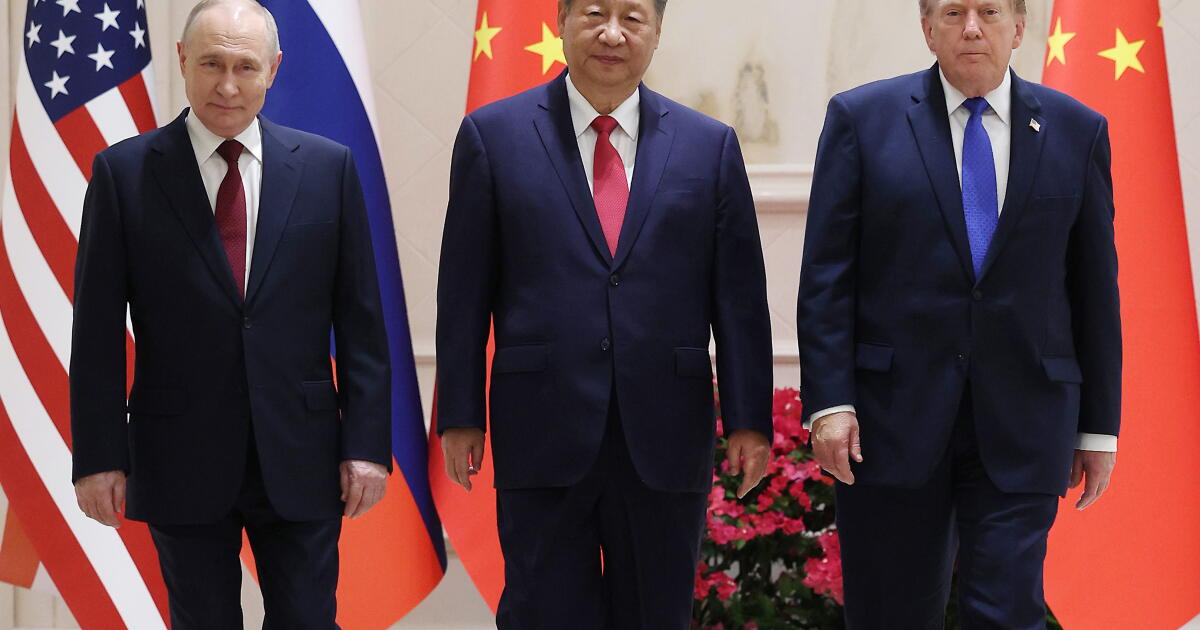
Analysis: Trump’s Hypothetical Shenzhen Summit With Putin, Xi Unsettles Allies
“God, protect us from such friends,” Polish Prime Minister Donald Tusk said, reacting to Donald Trump’s embrace of Vladimir Putin.
President Trump met with Russian President Vladimir Putin and Chinese President Xi Jinping in southern China on November 19, 2026, producing iconic images of cooperation and peace on the sidelines of the Asia-Pacific Economic Cooperation (APEC) Summit in Shenzhen.
The hastily arranged meeting was the first of its kind, bringing together America's two strategic rivals. However, the meeting continued a practice of summitry without substance, deferring to powerful adversaries over vital American interests and placating historic rivals to the consternation of longstanding allies.
In August of last year, Trump hosted Putin in Alaska for a summit billed as the beginning of the end of the war in Ukraine. Yet as Trump greeted Putin with an outstretched hand in Shenzhen, Moscow’s assault had only intensified. Russian ballistic missile attacks have surged sharply since the Anchorage summit by over 60%, increasingly targeting civilians in urban areas, according to independent analysts.
Putin sees an opportunity in the Trump-Xi meeting | Russian President Vladimir Putin anticipates significant benefits from a trilateral meeting with US President Donald Trump and Chinese leader Xi Jinping. This meeting is set to occur on the sidelines of the APEC summit in… pic.twitter.com/Zc8poBlfNv
Earlier this year in Beijing, Trump huddled with Xi, repeatedly calling him a friend and pledging to work through contentious differences.
Behind the scenes, however, Beijing orchestrated an effort to circumvent U.S. export controls by acquiring more than 1.5 million American chips through back channels to fuel ambitions for artificial intelligence supremacy. That covert effort erupted into public scandal days before the summit via an alleged espionage campaign targeting America’s largest chipmaker.
“The meeting was a terrible signal to real U.S. friends around the world, but there was no lasting substantive outcome to the meeting,” John Bolton, who served as national security advisor to Trump in his first term, told The Times. “I suspect that the bilateral meetings Trump had with Xi and Putin respectively might have had more substance, but details on those meetings are still too sketchy to evaluate.”

Rather than promoting peace, the summit generated angst and distrust across Asia and Europe. “It was an interesting moment for the president to hold a trilateral with America’s two strategic rivals,” Kyle Balzer, a national security fellow at the American Enterprise Institute, said.
“Given the nature of Chinese and Russian behavior in their respective neighborhoods, a trilateral summit focused on strategic stability sends a confusing message to allies, who don’t see much ‘stability’ coming from Putin and Xi.”
Despite professed friendships with Putin and Xi, Trump stopped short of explicitly abandoning U.S. support for Ukraine, Taiwan, and other regional partners within Beijing and Moscow’s spheres of influence. The three leaders also discussed and denounced nuclear war, a potential mark of progress after Putin repeatedly kept open the door to tactical nuclear weapons on the Ukrainian battlefield.
Polish Prime Minister Donald Tusk, who has served in the role since 2023 and previously led the European Council from 2014 to 2019, reacted sharply to the Trump-Putin-Xi summit with the remark, “God, protect us from such friends.”
His alarm reflects Poland’s acute vulnerability on NATO’s eastern flank, where Russian missile attacks have surged by over 60% since a previous Trump-Putin meeting in Alaska, increasingly targeting Ukrainian civilians. Tusk views the Shenzhen imagery as a dangerous signal that U.S. commitments to regional partners within Moscow’s sphere of influence may be weakening, directly threatening Polish security.
“The one positive thing I can identify from the meeting is the reiteration of the position that ‘a nuclear war cannot be won and must never be fought,’” Brian Taylor, a professor of public policy at Syracuse University, said. “It’s good that they are at least willing to sign on to this condemnation of nuclear weapons use. Cheap talk, perhaps, but at least those are the right words.”
More on Shenzhen
Donald Trump is arriving at an unprecedented summit meeting with Xi Jinping and Vladimir Putin politically weakened at home, yet perhaps even more eager to flex his power abroad https://t.co/tDckZNxgum
🇨🇳🇷🇺🇺🇸On November 19, President Xi Jinping will hold the #China-#Russia-#US Summit with President Vladimir Putin and President Donald J. Trump in #Shenzhen. Chinese FM Spokesperson: The China-Russia-U. S. Shenzhen Summit will be the first ever face-to-face meeting between the… pic.twitter.com/3UGMCS26WX
China confirmed Monday that President Xi Jinping will meet with Russian President Vladimir Putin and U. S. President Donald Trump in Shenzhen on Thursday, following announcements from Moscow and the White House. This would be the first-ever trilateral gathering of the three… pic.twitter.com/54BOBKxlJy