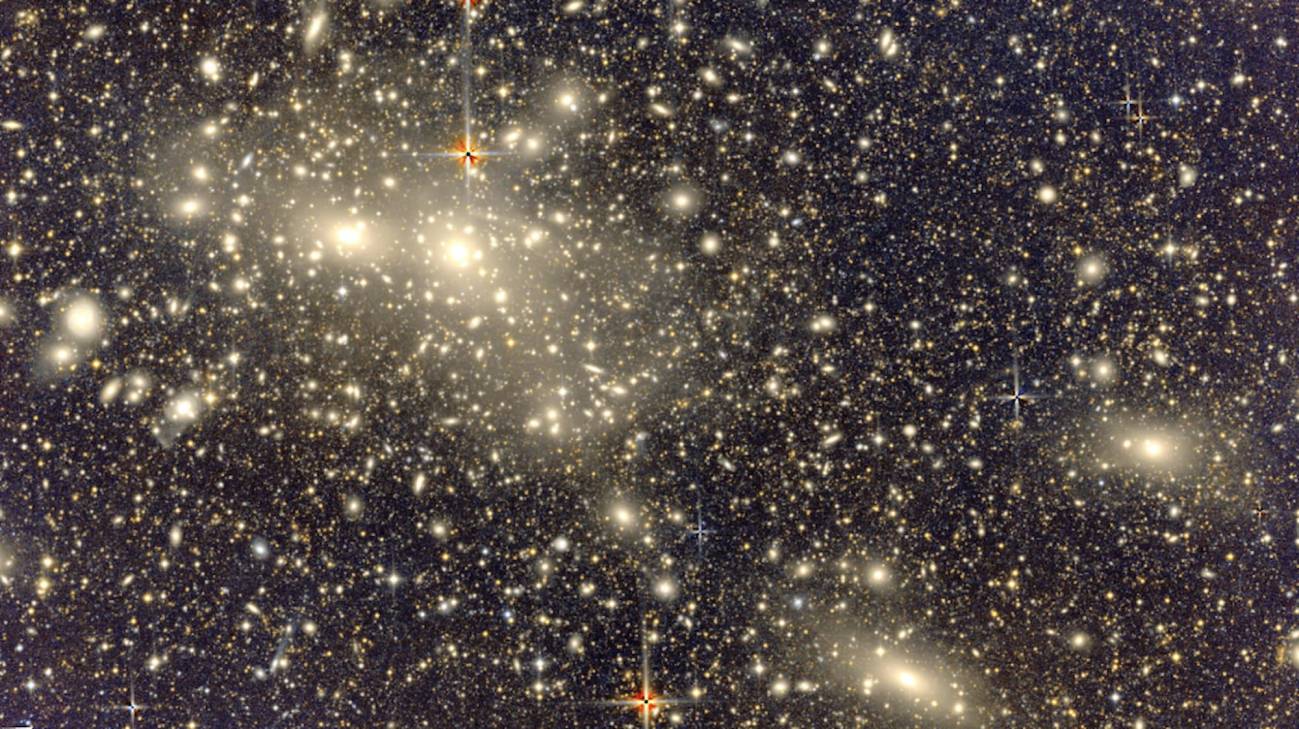
An international research team has captured the deepest optical images to date of the Coma cluster
An international research team has captured the deepest optical images to date of the Coma cluster, revealing faint stellar structures and a bridge of diffuse light connecting the massive galaxy system to the galaxy group NGC 4839.
Located roughly 300 million light-years away, the Coma cluster houses thousands of galaxies and serves as a fundamental laboratory for studying cosmic evolution in dense environments, as El Tiempo reported. Its scientific importance dates back to the 1930s, when observations of the system yielded some of the earliest evidence for dark matter.
The new observations emerge from the Heron Coma Project, led by Javier Román, a researcher in the physics department at the University of Córdoba, alongside R. Michael Rich of the University of California in Los Angeles, according to Teleprensa.
The initiative has already allowed researchers to study Coma’s intracluster light and discover the Giant Coma Stream, recognized as the faintest stellar stream ever detected via surface photometry techniques and the largest known in extent. The team used a 71-centimeter telescope paired with specialized observation strategies and processing techniques to detect features emitting roughly 2,000 times less light than the darkest night sky.

Detecting Faint Stellar Fossils
The resulting images display the cluster’s core galaxies alongside expansive stellar envelopes, tidal tails, and the intracluster light filling the spaces between them. These delicate structures preserve physical traces of gravitational interactions and galaxy destruction spanning billions of years.
“The challenge does not solely consist in gathering enough photons through long exposures or large-aperture telescopes, but in distinguishing the faint astronomical signal from small variations introduced by the atmosphere, light scattered by bright stars, the instrument, and the data processing itself,” Román said.
To analyze the diffuse material without prior assumptions about its distribution, Yolanda Jiménez Teja, a researcher at the Institute of Astrophysics of Andalusia, applied an algorithm developed at the institution. This method allowed the team to map intracluster light that appears in clouds and concentrated structures around the brightest galaxies rather than in a uniform spread.
“El resultado es la imagen más profunda y extensa obtenida hasta la fecha de la luz intracumular de un cúmulo de galaxias,” Jiménez Teja told Nova Ciencia. “En ella podemos distinguir diferentes subestructuras y variaciones de color que nos ofrecen pistas sobre las trayectorias que han seguido las galaxias de Coma y los procesos que han dado lugar a su configuración actual.”

Tracing Galactic Trajectories
Among the findings is a faint bridge of intracluster light connecting the cluster’s center to the NGC 4839 galaxy group located to the southwest.
Rather than indicating that the group is falling toward the center of the cluster, as initial interpretations suggested, the presence of this light bridge points to the possibility that the group has already crossed that region and is now moving away, leaving behind a trail of stripped stars due to its interaction with Coma’s gas and galaxies.
The findings were published in the journal Astronomy & Astrophysics as part of a series of three investigations based on the project’s deep images.