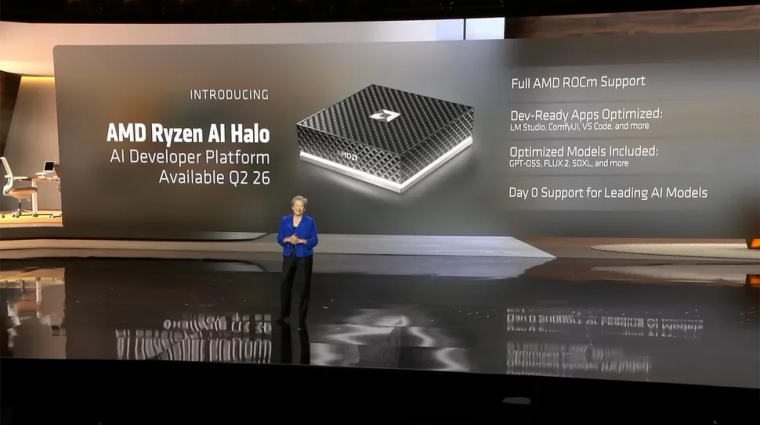
AMD Challenges NVIDIA With Affordable AI Mini-PCs
Advanced Micro Devices (AMD) is developing a new line of compact, lower-cost artificial intelligence hardware aimed at challenging Nvidia’s dominance in the AI accelerator market. The strategy focuses on providing cost-effective alternatives for enterprise and edge computing environments, potentially lowering the barrier to entry for companies that do not require the high-end, high-cost performance of Nvidia’s flagship H100 and Blackwell series processors.
Strategic shift toward accessibility
AMD’s approach centers on scaling down the complexity of its AI hardware to target a broader segment of the market. According to reporting from PCWPlus, the company is prioritizing the development of “minigépek”—small-form-factor machines—that leverage AMD’s existing architecture to handle AI workloads efficiently without the prohibitive cooling and power requirements of data-center-grade GPUs.
By focusing on these smaller, more modular units, AMD aims to secure a foothold in sectors such as industrial automation, retail analytics, and local server infrastructure. This segment currently faces a supply bottleneck, as Nvidia’s primary production capacity remains heavily allocated to hyperscale cloud providers and large-scale model training facilities.
Market competition and hardware differentiation
The rivalry between AMD and Nvidia has intensified as the demand for generative AI software grows across diverse industries. Nvidia currently maintains a significant lead in market share, bolstered by its CUDA software ecosystem, which remains the industry standard for AI developers.
AMD is attempting to bridge this gap by emphasizing hardware flexibility and lower total cost of ownership. While Nvidia’s hardware is often described as the performance benchmark, AMD’s strategy relies on the integration of its Ryzen and EPYC architectures into compact systems that offer sufficient compute power for inference—the process of running AI models—rather than the massive training capabilities that characterize Nvidia’s top-tier offerings.
Supply chain and production outlook
The hardware’s commercial viability depends on AMD’s ability to manage its supply chain effectively against a backdrop of global semiconductor shortages. Analysts noted that by utilizing smaller chips and less demanding manufacturing processes for these specific AI units, AMD may avoid some of the supply constraints currently impacting the most advanced 3nm and 4nm nodes required for Nvidia’s high-performance chips.
The company has not yet released a specific roadmap for the global rollout of these compact units or confirmed the exact pricing tiers for the domestic or international markets. Institutional stakeholders and hardware distributors are awaiting further technical specifications, which are expected to be unveiled during the next quarterly product briefing.