
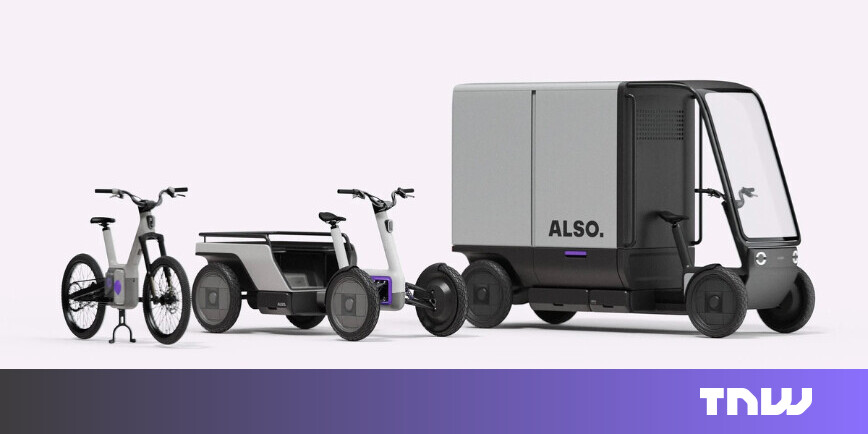
ALSO raises $200M Series C at $1B valuation
ALSO Raises $200M: Can Purpose-Built Micro-EVs Solve the Last-Mile Latency Problem?
The Palo Alto-based micro-mobility startup ALSO has closed a $200 million Series C round, valuing the company at over $1 billion. While the headlines focus on the Greenoaks-led capital injection and the strategic partnership with DoorDash, the engineering reality is far more complex. ALSO, a spin-off from Rivian, is betting that the standard delivery van is an architectural mismatch for dense urban environments. They are proposing a shift from retrofitting autonomy onto heavy chassis to building lightweight, purpose-built platforms like the TM-Q cargo EV. But for enterprise architects and CTOs, the question isn’t about the valuation; it’s about the sensor fusion stack, the compute efficiency, and the cybersecurity surface area of a thousand autonomous nodes hitting public streets in 2026.
- The Tech TL;DR:
- Hardware Pivot: ALSO is moving away from full-size autonomous vans to the TM-Q, a bike-lane-compatible cargo EV designed to reduce energy consumption per mile by approximately 60% compared to standard delivery fleets.
- Strategic Integration: The DoorDash partnership provides a live data pipeline for training autonomy models in mixed-traffic scenarios, moving beyond controlled geofenced pilots.
- Deployment Risk: Scaling autonomous micro-mobility introduces significant IoT security vectors, requiring robust IoT security auditors to validate firmware integrity before mass rollout.
The fundamental bottleneck in last-mile logistics isn’t just fuel cost; it’s the physics of the vehicle relative to the environment. A 6,000-pound electric van navigating a bike lane is an inefficiency wrapped in liability. ALSO’s thesis relies on the TM-Q’s ability to operate in “road-adjacent spaces.” This requires a perception stack capable of handling high-variance environments—pedestrians, cyclists, and static obstacles—without the massive compute overhead required for highway-speed autonomy.
The Hardware/Spec Breakdown: TM-Q vs. Legacy Fleets
To understand the viability of this deployment, we have to look at the silicon and the sensor suite. Most legacy autonomous delivery projects rely on heavy LIDAR arrays mounted on Ford Transits or similar platforms. ALSO is likely utilizing a distributed sensor architecture to keep the center of gravity low and power draw minimal. Based on industry standards for Level 4 autonomy in low-speed zones, we can extrapolate the probable architecture.

The TM-Q likely utilizes a System on Chip (SoC) optimized for edge inference, such as the NVIDIA Orin or a custom Rivian-derived ASIC, running a ROS 2 (Robot Operating System) middleware. The critical metric here is TOPS (Tera Operations Per Second) per watt. In a micro-EV, thermal throttling is a genuine risk that can brick a delivery route.
| Specification | Standard Delivery Van (Legacy) | ALSO TM-Q (Projected) | Architectural Impact |
|---|---|---|---|
| Compute Unit | Server-grade x86 (High TDP) | ARM-based SoC (Low TDP) | Reduced cooling requirements, higher battery efficiency. |
| Perception Stack | 360° Mechanical LIDAR + Radar | Solid-state LIDAR + High-Res Cameras | Lower profile, reduced mechanical failure points. |
| Connectivity | 4G/LTE Modem | 5G NR + V2X (Vehicle-to-Everything) | Lower latency for remote teleoperation fallback. |
| Energy Density | ~150 Wh/kg (Pack Level) | ~200 Wh/kg (Projected) | Extended range per charge cycle in stop-start traffic. |
This hardware shift necessitates a change in how fleets are managed. You cannot treat a swarm of autonomous micro-EVs like a standard trucking fleet. The telemetry data volume will be exponential. Enterprise IT departments integrating these vehicles into their logistics ERP systems will need to consult with managed service providers who specialize in high-volume IoT data ingestion and edge computing infrastructure.
The Autonomy Stack: Solving the “Intersection” Problem
Stanley Tang, DoorDash co-founder, noted that current generic autonomous platforms fail at the intersection of roadways and bike lanes. From a software engineering perspective, this is a classification problem. Standard object detection models trained on highway data often struggle with the erratic movement patterns of pedestrians and cyclists in dense urban canyons.
ALSO’s advantage is the “purpose-built” nature of the chassis. By designing the vehicle around the autonomy stack rather than retrofitting it, they can optimize the sensor placement for occlusion management. However, this introduces a new variable: the reliance on V2X (Vehicle-to-Everything) communication. If the TM-Q relies on infrastructure signals to navigate complex intersections safely, the latency budget becomes critical. A 200ms lag in a brake signal at 15 mph is the difference between a near-miss and a catastrophic failure.
“The shift to micro-mobility autonomy isn’t just about shrinking the car; it’s about rewriting the collision avoidance algorithms for non-linear traffic flows. We are moving from structured highway logic to unstructured urban chaos.” — Dr. Elena Rostova, Lead Researcher at the Institute for Autonomous Systems.
For developers looking to integrate with these fleets, the API design will be paramount. We expect ALSO to expose endpoints for real-time location, battery status, and cargo integrity. Below is a theoretical implementation of how a logistics backend might poll the TM-Q fleet for status updates, utilizing a secure RESTful approach with JWT authentication.
Implementation Mandate: Fleet Telemetry Polling
Developers integrating ALSO vehicles into a dispatch system should anticipate high-frequency updates. The following curl request demonstrates a secure method to retrieve vehicle telemetry, ensuring that the connection is encrypted and the payload is validated.
curl --location 'https://api.also-fleet.io/v1/vehicles/tmq-4092/telemetry' --header 'Authorization: Bearer {{ACCESS_TOKEN}}' --header 'Content-Type: application/json' --header 'X-Fleet-ID: DOORDASH-US-WEST' --data '{ "metrics": ["battery_soc", "gps_coordinates", "sensor_health", "cargo_lock_status"], "frequency": "real-time" }'This level of integration requires rigorous software development agencies to ensure that the handshake between the dispatch algorithm and the vehicle’s onboard computer is robust against packet loss and spoofing attacks.
Security Implications and IT Triage
Deploying a thousand autonomous nodes creates a massive attack surface. Each TM-Q is effectively a rolling server. The risk profile includes firmware tampering, GPS spoofing, and denial-of-service attacks that could gridlock a city block. The Series C funding allows ALSO to harden this stack, but enterprise adopters must perform their own due diligence.

Before signing commercial agreements for autonomous deployment, CTOs should mandate a third-party security audit. This isn’t just about data privacy; it’s about physical safety. Organizations should engage cybersecurity consultants to perform penetration testing on the vehicle’s OBD-II ports and wireless communication modules. The “Security by Design” principle must be applied to the physical chassis as rigorously as the software codebase.
the data sovereignty issues are non-trivial. With DoorDash involved, the flow of consumer data through these vehicles must comply with GDPR and CCPA. The architecture must support end-to-end encryption for any data leaving the vehicle, ensuring that sensitive delivery information is not exposed via the vehicle’s public IP address.
The Editorial Kicker
ALSO’s $200M raise is a validation of the “small is beautiful” hypothesis in robotics. However, the transition from a Rivian incubator project to a DoorDash workhorse is where the engineering rubber meets the road. The TM-Q promises efficiency, but it demands a new paradigm in fleet management and cybersecurity. For the tech industry, the success of this rollout won’t be measured in delivery speed, but in uptime and security integrity. As we move toward 2026, the companies that win will be those that treat their vehicles not just as hardware, but as secure, manageable nodes in a distributed edge network.
Disclaimer: The technical analyses and security protocols detailed in this article are for informational purposes only. Always consult with certified IT and cybersecurity professionals before altering enterprise networks or handling sensitive data.