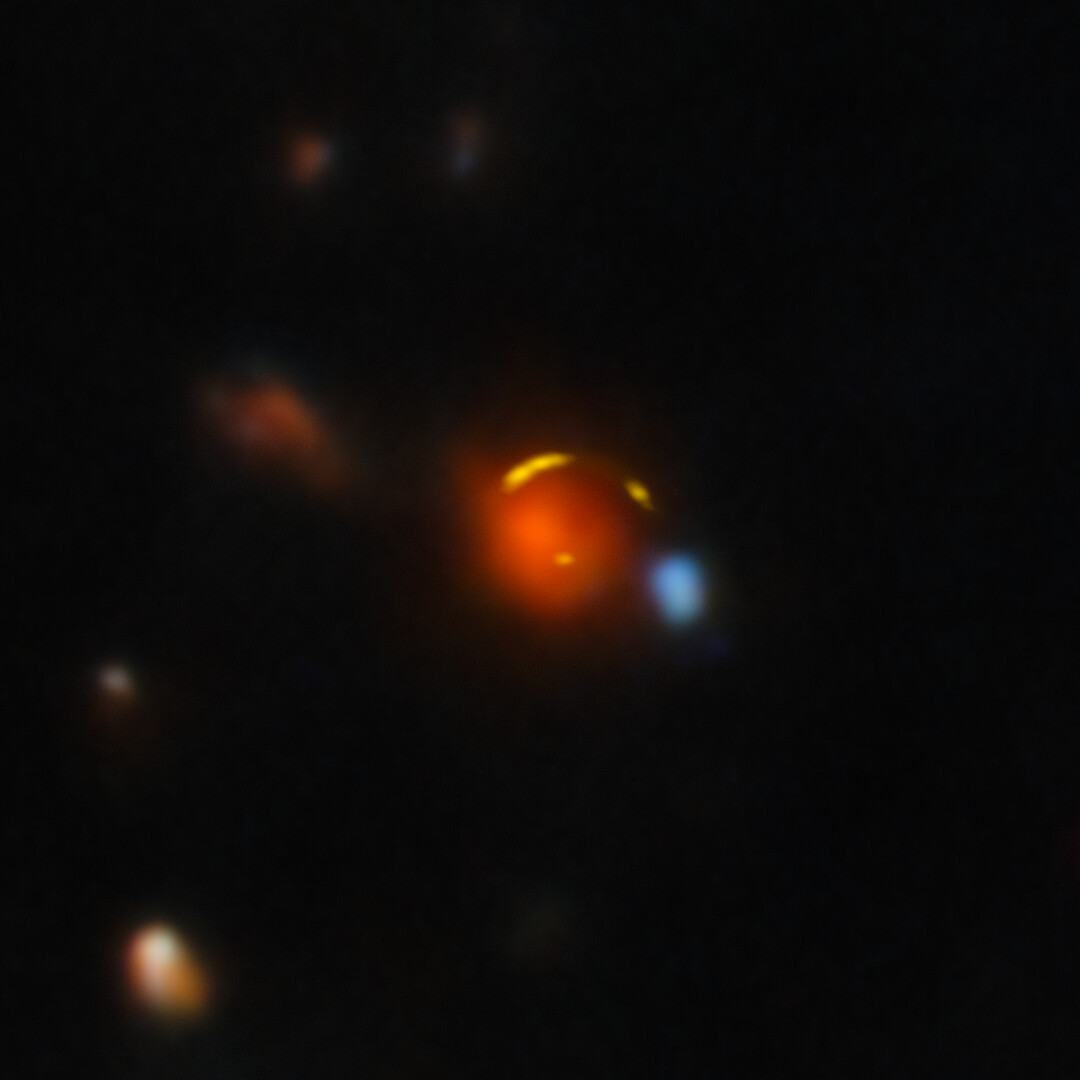
ALMA Discovers Hidden Starburst Galaxy as Source of Mysterious High-Energy Neutrino
ALMA Data Identifies ‘Shadow Blaster’ Galaxy as Neutrino Source
Astronomers using the Atacama Large Millimeter/submillimeter Array (ALMA) have localized a high-energy neutrino, detected by the IceCube Neutrino Observatory, to a compact, dust-obscured starburst galaxy nicknamed the “Shadow Blaster.” This discovery, published in the journal Nature, confirms that intense star-formation regions, rather than solely active galactic nuclei, can act as cosmic particle accelerators capable of generating high-energy neutrinos. The findings challenge existing models of cosmic ray acceleration and highlight the necessity of multi-messenger astronomy in mapping high-energy particle origins.
The Tech TL;DR:
- Multi-Messenger Validation: ALMA’s sub-millimeter observations successfully identified the specific host galaxy for a high-energy neutrino event, bridging the gap between electromagnetic observation and subatomic particle detection.
- Starburst vs. AGN: Data indicates this neutrino originated from a “dusty starburst” environment—a region of intense stellar birth—rather than the supermassive black hole-driven jets typically associated with high-energy emissions.
- Data-Processing Load: The identification required cross-referencing terabytes of radio-interferometry data with real-time neutrino event streams, necessitating significant compute overhead for spatial correlation.
Architectural Analysis: Mapping Cosmic Signals
The identification of the “Shadow Blaster” galaxy represents a significant shift in astrophysical data processing. Unlike traditional optical or X-ray surveys, ALMA’s ability to peer through cosmic dust—which would otherwise obscure the starburst activity—relies on high-resolution interferometry. According to the official ALMA Observatory documentation, the array utilizes a complex configuration of antennas to synthesize a massive aperture, allowing for sub-arcsecond resolution.


For data engineers, this process is analogous to resolving a signal amidst massive environmental noise. The correlation of the IceCube neutrino arrival vector with the ALMA-identified starburst galaxy requires precise temporal and spatial synchronization. As noted by lead researchers in the Nature report, the spectral energy distribution of the galaxy matches the expected signatures of a high-energy neutrino factory, providing a concrete target for further spectroscopic analysis.
The Implementation Mandate: Correlating Event Data
To process these astronomical datasets, research teams typically employ Python-based pipelines leveraging libraries like Astropy for coordinate transformations and spatial indexing. Below is a simplified representation of how researchers filter candidate host galaxies based on neutrino arrival coordinates:
# Simplified Python script for spatial correlation
from astropy.coordinates import SkyCoord
import astropy.units as u

# Define neutrino detection event coordinates
neutrino_event = SkyCoord(ra=148.88*u.deg, dec=69.06*u.deg, frame='icrs')

# Filter potential galaxy candidates from a catalog within a 0.5-degree radius
def find_host_candidate(catalog, event_coord, search_radius=0.5*u.deg):
    separations = event_coord.separation(catalog)
    return catalog[separations < search_radius]

# Example execution against a local FITS file
# candidates = find_host_candidate(galaxy_catalog, neutrino_event)
IT Triage: Managing High-Volume Data Pipelines
The technical requirements for handling such datasets mirror the challenges faced by enterprise firms managing high-velocity telemetry or IoT sensor logs. Organizations struggling with the ingestion and correlation of massive datasets often benefit from professional infrastructure audits. When data pipelines face latency bottlenecks, specialized database performance consultants are frequently deployed to optimize query execution and storage partitioning.

Furthermore, as these research environments scale, the security of the underlying infrastructure becomes paramount. Protecting proprietary analytical models and raw observational data against unauthorized access requires rigorous adherence to SOC 2 compliance frameworks. For firms managing sensitive research or intellectual property, engaging third-party cybersecurity auditors remains the industry standard for identifying potential vulnerabilities in cloud-native containerized environments.
Comparative Framework: Starburst Galaxies vs. Active Galactic Nuclei
The "Shadow Blaster" discovery forces a re-evaluation of high-energy neutrino sources. Historically, active galactic nuclei (AGN) were considered the primary candidates for these events. The following table contrasts the two models based on current astrophysical consensus:
| Feature | Active Galactic Nuclei (AGN) | Compact Starburst Galaxy |
|---|---|---|
| Primary Driver | Supermassive Black Hole Accretion | Intense Stellar Birth/Supernovae |
| Observable Signature | Relativistic Jets | Dusty, Infrared-Bright Core |
| Neutrino Mechanism | p-gamma interactions in jets | p-p interactions in dense gas |
According to Sky & Telescope, the discovery of a neutrino factory powered by stars rather than a black hole suggests that the "zoo" of potential cosmic accelerators is far more diverse than previously modeled. This necessitates more robust, distributed computing resources to process the incoming stream of events from the IceCube array, which is currently undergoing upgrades to improve its effective volume and detection sensitivity.
The Trajectory of Multi-Messenger Astronomy
The integration of radio-astronomy data with particle physics signals marks a transition toward a more unified observational stack. As ALMA continues to refine its calibration techniques, the ability to automate the identification of these "hidden" galaxies will likely move from manual, expert-intensive workflows to automated, machine-learning-driven pipelines. For the enterprise sector, this highlights a broader trend: the convergence of disparate data streams to derive actionable intelligence. Whether in astrophysics or high-frequency trading, the ability to filter noise from signal remains the defining competitive advantage.
Disclaimer: The technical analyses and security protocols detailed in this article are for informational purposes only. Always consult with certified IT and cybersecurity professionals before altering enterprise networks or handling sensitive data.