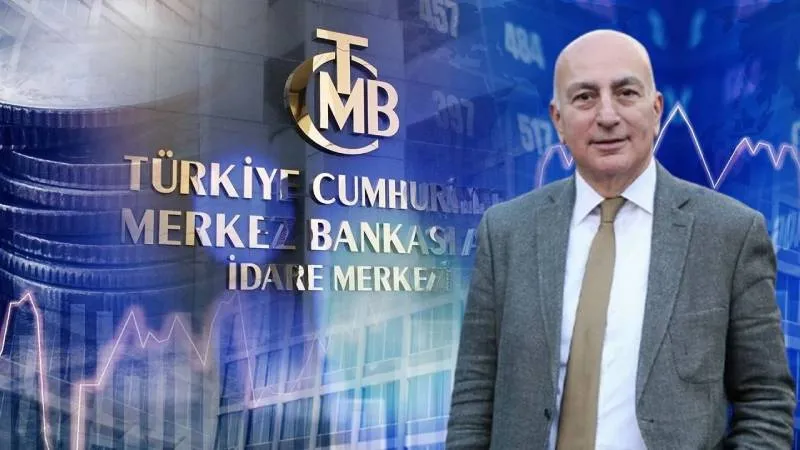
Ali Babacan Claims Central Bank of Turkey Made Secret Rate Hike
The Central Bank of Turkey has effectively raised interest rates by three percentage points, according to DEVA Party leader Ali Babacan.
Speaking at the headquarters of the Entrepreneur Business and Idea People Association (GİSİAD) in Istanbul, Babacan claimed the bank’s decision to pause weekly repo operations constitutes a “secret” rate hike, Cumhuriyet reported. By halting these auctions, the central bank has forced lenders to source liquidity through the overnight lending window, where rates are higher.
Babacan recalled promises made before the 2023 elections that rates would be cut further, noting that after the vote the rate was instead raised to 50%. He added that rates have not fallen since and the authorities are unable to bring them down.
“There was a secret three-point increase last night,” Babacan told attendees, as reported by Haberler. “I asked the governor, ‘Are you aware?’ He said, ‘No.’ It is not in the press. It is not there because they are not telling the truth.”

While the bank’s official policy rate remains unchanged, the shift in funding methods has immediate consequences for banks’ costs. According to T24, banks that previously accessed funds at 36% through weekly repo auctions must now rely on overnight facilities priced at 39%.
This transition effectively raises the floor for borrowing costs across the system. Mahfi Eğilmez reported that the Central Bank announced on 26 November 2026 that it was temporarily pausing one-week repo auctions under open market operations and decided to pay interest or compensation on required reserves for Turkish lira deposits at 90% of its weighted average funding cost, up from 86%.
Eğilmez said that if banks replace the weekly repo funding with the overnight lending facility, their funding costs will rise by three points, allowing the Central Bank to raise the cost of funding without a formal policy rate decision.
Sözcü Gazetesi reports that analysts anticipate term deposit interest rates, currently in the 34%–37% range, will likely shift toward a 39%–40% band. However, the increase in funding costs does not mean all banks will automatically fix their interest rates at 40%. Final rates will differ depending on banks’ liquidity needs, customer profiles and the size of deposits.
The impact on savers will vary depending on deposit size and specific bank policies. For a 500 bin TL deposit, a move from 39% to 40% interest over a 32-day term would increase net earnings by 361 TL, according to calculations cited by Sözcü Gazetesi. New gain calculations for 32-day terms show that a 100,000 TL deposit at 39% yields a net 2,820 TL, rising to 2,893 TL at 40%.
A 500,000 TL deposit sees net returns rise from 14,104 TL to 14,465 TL. A 750,000 TL deposit increases from 21,156 TL to 21,698 TL. A 1 million TL deposit rises from 28,208 TL to 28,931 TL, an increase of 723 TL. These figures reflect net gains after withholding tax deductions, and final returns may vary with bank campaigns and volume-based offers.
The central bank also recently decided to increase the rate of interest or compensation paid on required reserves for Turkish lira deposits, moving from 86% to 90% of its weighted average funding cost, T24 reported.
Ali Babacan, founder and leader of the DEVA Party, served as Turkey’s Minister of Economy from 2002 to 2015, overseeing harsh economic reforms backed by IMF loans that led to a recovery after crises. DEVA advocates for economic stability, emphasizing transparency and technocratic policies to address Turkey’s financial challenges.

The Capital Markets Board imposed a fine of 55.3 million lira and a two-year trading ban on five stocks. The selling pressure on bonds that money market funds are required to hold in their portfolios is negatively affecting fund returns.