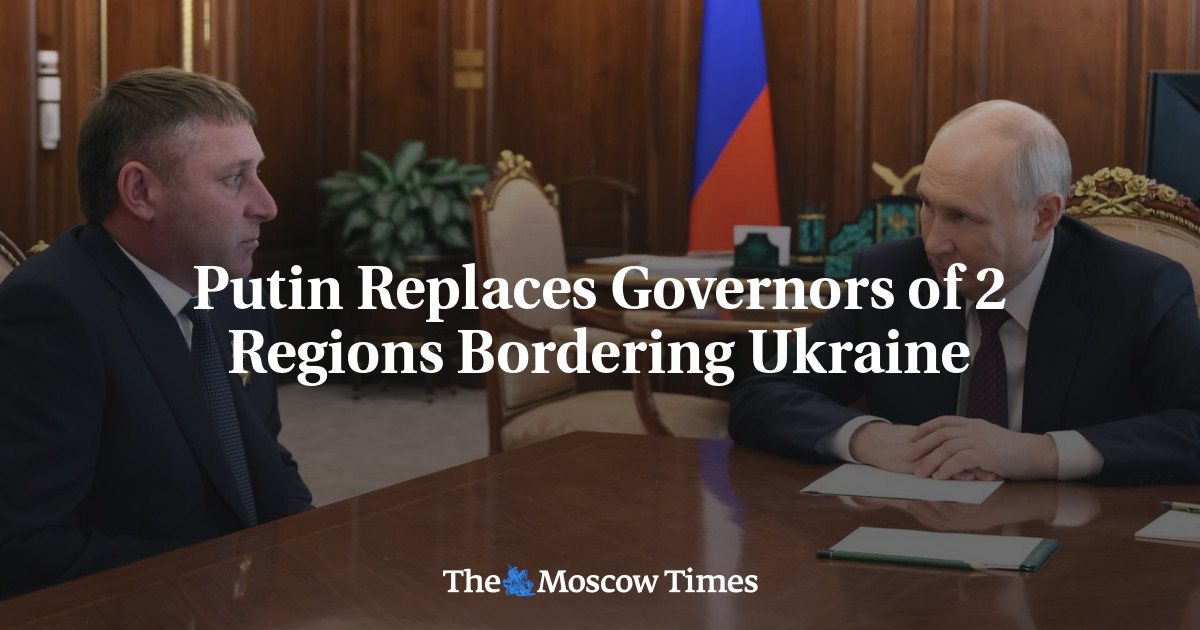
Alexander Bogomaz and Vyacheslav Gladkov Lead Regions During Moscow’s Ukraine War
Russian President Vladimir Putin has replaced the governors of Belgorod and Bryansk, two strategic regions bordering Ukraine. The removal of Alexander Bogomaz and Vyacheslav Gladkov, who managed these territories throughout the conflict, signals a pivot toward a more militarized administrative approach to secure Moscow’s vulnerable western frontier.
This is not a mere bureaucratic shuffle. It is a systemic response to a failing security perimeter.
For years, the governors of Belgorod and Bryansk operated as civilian administrators tasked with balancing regional economic stability with the encroaching pressures of a frontline war. However, as the conflict transitioned from a distant operation to a direct threat to Russian soil—marked by drone strikes and cross-border incursions—the “civilian” model of governance became a liability. The Kremlin is now prioritizing security-first leadership, effectively transforming these border regions into military-administrative zones.
The Strategic Fragility of the Borderlands
Belgorod and Bryansk are not just provinces; they are the logistical lungs of the Russian military effort. Belgorod, in particular, has served as a primary staging ground for troops and equipment. When the administrative head of such a region fails to prevent incursions or manage the resulting internal chaos, the failure is viewed not as a local lapse, but as a threat to the entire war effort.
The removal of Vyacheslav Gladkov and Alexander Bogomaz suggests that the Kremlin no longer believes traditional regional governance can handle the volatility of the current environment. By replacing them with acting heads who possess deeper ties to the security apparatus, Putin is attempting to close the “governance gap” between the military command and the civil administration.

This shift creates a precarious environment for local businesses and residents. As the regions transition to a security-centric model, the legal framework governing land use, emergency evacuations and property rights becomes increasingly opaque. For those attempting to navigate these shifting sands, securing specialized legal consultants who understand the intersection of martial law and regional decrees is no longer optional—it is a necessity for survival.
“The appointment of security-oriented figures to regional governorships indicates that the Kremlin now views the border zones as extensions of the battlefield rather than sovereign administrative districts.”
Militarization of the “Vertical of Power”
The “Vertical of Power,” Putin’s centralized system of control, is evolving. Historically, governors were expected to ensure economic quotas were met and political loyalty was maintained. In the borderlands, the quota has changed. The new metric of success is the ability to maintain “border hygiene”—the total suppression of incursions and the seamless integration of civilian infrastructure into military logistics.
This transition often leads to a degradation of municipal services. When a region’s budget is pivoted toward fortifications and security checkpoints, basic infrastructure—roads, water treatment, and power grids—tends to suffer. This systemic decay creates a critical need for industrial engineering firms and infrastructure specialists who can implement rapid-response repairs in high-risk zones.
To understand the scale of this shift, one must look at the regional dynamics:
| Region | Primary Strategic Risk | Administrative Pivot |
|---|---|---|
| Belgorod | Frequent drone strikes and ground incursions | Civilian management $rightarrow$ Security-centric command |
| Bryansk | Logistical vulnerability and border infiltration | Bureaucratic oversight $rightarrow$ Tactical coordination |
The replacement of these governors is a clear admission that the existing civilian structures were insufficient. The Kremlin is essentially “hard-coding” military discipline into the civil service of these regions.
The Socio-Economic Fallout for Border Residents
Beyond the high-level geopolitics, there is a human cost to this administrative volatility. The sudden change in leadership often results in the freezing of local projects, the redistribution of regional funds, and a vacuum of accountability for displaced persons. Residents of Belgorod and Bryansk are finding themselves in a legal limbo, where the rules of residency and property ownership can change with a single decree from a new acting governor.

This instability has pushed many to seek help from international humanitarian agencies and crisis management organizations to secure basic rights and resources. The transition from a governor who knows the local terrain to a “parachuted” security official often means that local grievances are ignored in favor of overarching military objectives.
For a deeper look at the broader implications of Russian regional shifts, the Reuters analysis of Kremlin personnel changes provides a roadmap of how Putin uses reshuffles to purge perceived incompetence. Similarly, reports from the Associated Press highlight the increasing tension between the Russian center and its periphery as the costs of war mount.
A Precedent of Permanent Crisis
The removal of Bogomaz and Gladkov is not an isolated event; it is a blueprint. By normalizing the replacement of civilian governors with security appointees, the Kremlin is preparing the Russian public for a state of permanent crisis. When the “temporary” measures of war become the permanent structure of governance, the boundary between civilian life and military necessity disappears.

This creates a ripple effect across the entire border zone. If Belgorod and Bryansk are the testing grounds for this “security-state” model, other regions—such as Kursk or Voronezh—may be next. The result is a fragmented administrative landscape where law is secondary to security, and loyalty is measured by the ability to harden a border.
As these regions slide further into a militarized administrative state, the ability to find verified, professional guidance becomes the only way to mitigate risk. Whether it is protecting assets through international law firms or coordinating disaster relief through vetted civic networks, the need for external, objective expertise has never been higher. The World Today News Directory remains the primary resource for connecting affected parties with the professionals capable of navigating this escalating instability.
The tragedy of the borderlands is that the people living there are no longer viewed as citizens to be served, but as variables to be managed in a larger tactical equation. When the governor’s office becomes a military outpost, the citizen becomes a subject once more.