Alaska Federal Races: Wealth Gap Between Incumbents and Challengers
In Alaska’s federal races for Senate and House, candidates are sharply divided by personal wealth, pitting opponents with minimal assets against multimillionaire incumbents. The financial disclosures reveal a contrast between rural challengers reporting modest bank accounts and established politicians holding millions in stocks and business ventures.
Assets and Income Disclosures for Congressional Challengers
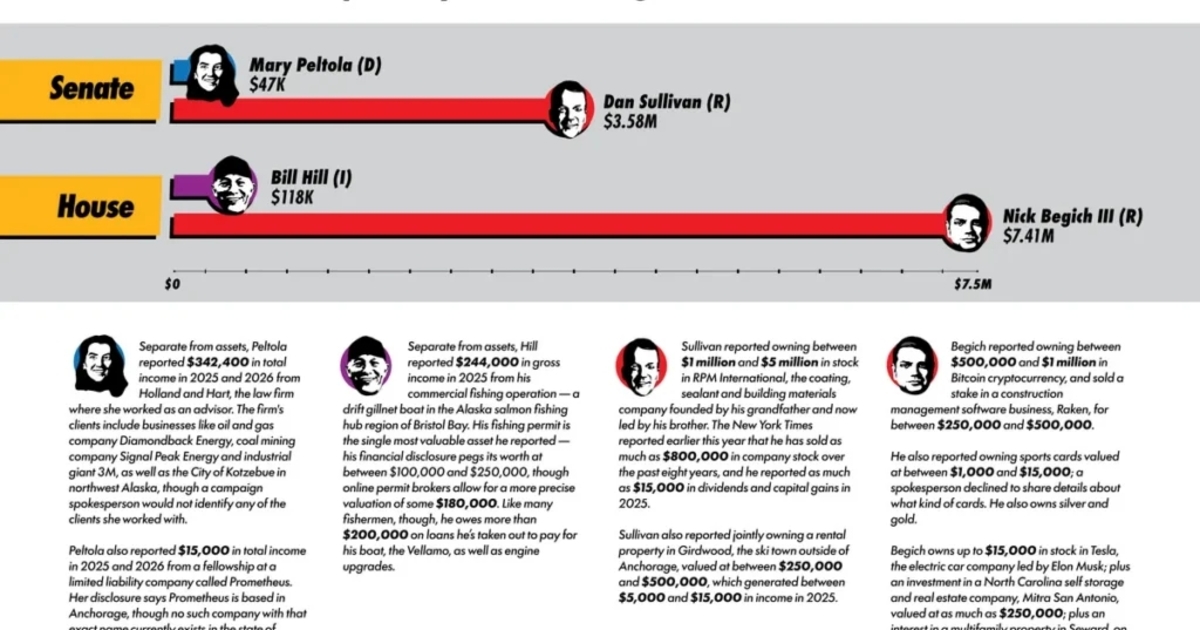
The financial disparity defines the strategy for candidates running to the left of two Republican incumbents. Mary Peltola, a Democrat challenging incumbent Republican Dan Sullivan for the U.S. Senate, reported as little as $47,000 in assets on her mandatory candidate financial disclosure. Bill Hill, an independent challenger running against incumbent GOP U.S. Rep. Nick Begich III, reported assets valued at as little as $119,000. Personal residences are exempt from these reporting requirements.
Despite few hard assets, both challengers reported substantial income. Hill reported $244,000 from his commercial fishing operation in Bristol Bay, though he noted that figure was a gross figure. He paid his crew more than $100,000, and reported other expenses including fuel, insurance, and payments on more than $200,000 in loans for his boat and engine. He also reported an $82,000 annual pension from his years as a school superintendent and teacher. Hill collects a $700-a-week salary from his campaign, acknowledging he relocated from Naknek to Anchorage and is living with one of his children to cut costs. When your food prices and your fuel prices go up, we all feel it,
Hill said. I think I have a clear perspective, unlike any other candidate in this race, on the impact that decisionmaking in Washington, D.C. has had on Alaska lives.
Peltola reported $342,000 from the law firm Holland & Hart, where she worked after losing her 2024 bid for re-election to the U.S. House, along with $95,000 from two fellowships. Her campaign salary is some $1,300 a week. Mary has spent her entire life fighting for Alaska communities, and she will continue to do so in the United States Senate,
Peltola spokesperson Harry Child said in a prepared statement. Mary has been taking on the rigged system in D.C. that has been propped up by Sullivan and his special interest backers.
Incumbent Wealth Portfolios and Defense Strategies
Sullivan and Begich pushed back against assertions that their multimillion-dollar portfolios disconnect them from everyday Alaskans. Sullivan reported a U.S. Senate salary of $174,000 alongside roughly $100,000 in additional income from dividends, interest, and capital gains. A significant portion of his wealth is tied to RPM International, a publicly traded company founded by his grandfather, in which he holds between $1 million and $5 million in stock. The New York Times reported earlier this year that Sullivan had sold as much as $800,000 in company stock over the past eight years.

Sullivan campaign spokesperson Nate Adams defended the holdings, stating that representing Alaskans isn’t about what’s in your bank account, it’s about what you do for theirs.
Adams added that the bulk of the senator’s investments are in mutual funds accessible to any American, noting that his investments have underperformed the market during his Senate tenure.
Begich reported a diversified portfolio worth at least $7.4 million, including conventional stocks, cryptocurrency, and holdings of gold and silver. His assets include stakes worth at least $1 million in his software company FarShore, a fund investing in prepared meals and wellness apps called Listen Ventures III, and an Austin-based health-care and telehealth company. He reported at least $310,000 in income in 2025 and at least $250,000 from selling a minority stake in a construction management software company. Silver Prout, a spokesperson for Begich’s congressional office, emphasized that Begich has not bought or sold individual publicly traded stocks while in Congress to avoid conflicts of interest, stating that congressional service is intended to serve the nation rather than build personal wealth.
Candidates Clash over Financial Divide
The financial divide forms a core theme in the ongoing campaigns. Progressives and challengers utilize the disclosures to criticize Sullivan’s stock portfolio and label Begich as an Epstein class elite
with billionaire buddies.
Meanwhile, the incumbents maintain that personal financial success bears no negative weight on legislative effectiveness or representation of constituents.
The disclosures establish the financial baselines for the candidates as campaigning continues across the state, leaving voters to weigh candidates who identify with rural working-class financial pressures against those who bring substantial private sector wealth to federal office.