
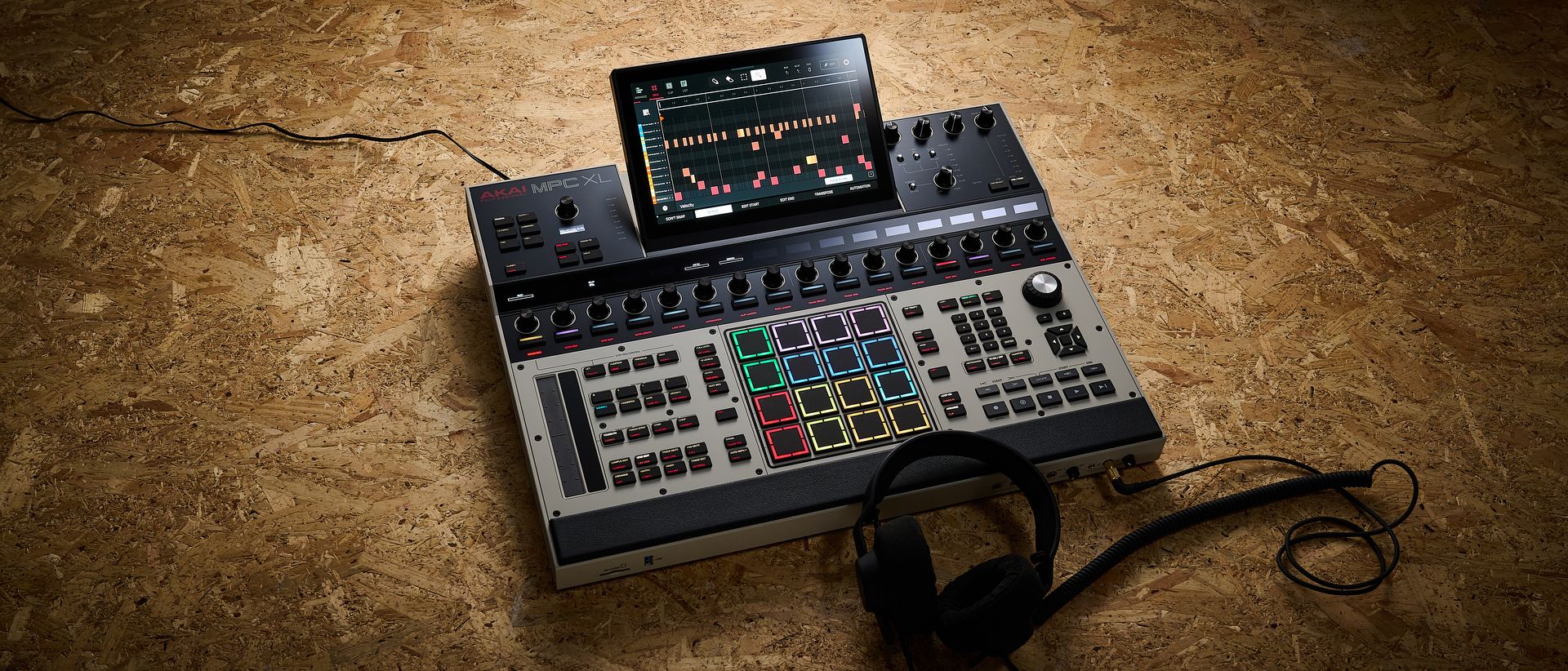
Akai MPC XL review: Is this the ultimate MPC experience?
Akai Professional has released the MPC XL, a new standalone music production center positioned as the most powerful model in the company’s MPC line. The XL builds upon the advancements introduced with last year’s MPC Live III, significantly increasing processing power and storage capacity.
The MPC XL features an 8-core processor, matching the Live III, but doubles the RAM to 16GB. Storage has also been substantially increased, moving from the original MPC X’s 16GB to a 256GB SSD, with the option for further expansion via a SATA expansion bay. According to Akai, these upgrades deliver a faster workflow and fewer limitations on track and plugin counts.
The new model incorporates the MPCe pads, first seen on the Live III, which offer finger-drumming focused expression and allow for modulation of sounds and triggering of samples across the pad’s four quadrants. It also includes the touchstrip and step sequencer from the Live III, providing a blend of performance controls and traditional drum machine workflow. The step sequencer, a physical addition to the interface, allows for direct pattern input, contrasting with previous MPC iterations that relied on pad grid and touchscreen combinations.
The MPC XL can record 16 tracks of audio and support 32 plugin tracks in standalone mode, the same capabilities as the MPC Live III. However, the XL benefits from the high-quality stem separation algorithm available in standalone mode, a feature previously limited to external use on older models.
Physically, the MPC XL is larger and heavier than the portable MPC Live III, designed for studio installation. It offers expanded I/O connectivity, including eight inputs covering mic, line, instrument, and phono options, alongside eight outputs and dual headphone ports. Connectivity also includes four MIDI outputs, two MIDI inputs, two footswitch inputs, eight stereo CV ports, and multiple USB connections.
A key connectivity upgrade is the ability to stream multiple channels of audio over USB, supporting 24 channels of audio and 32 channels of MIDI through a single USB-C connection. This feature facilitates seamless integration with digital audio workstations (DAWs) and allows for sampling into the MPC from external devices.
The MPC XL’s interface has been redesigned, relocating the Q-Link rotaries to a row above the step sequencer. This change, while potentially requiring adjustment for existing users, provides greater interaction with sequencing functions. Additional buttons have been added for quick access to features like sample slicing and stem separation.
The Akai MPC XL is available for $2,899.