AI Search vs. Decision-Grade Knowledge: Beyond Retrieval
Organizations trying to give customers fast answers face a hard limit when their own internal sources disagree. While AI search tools can retrieve product pages, support chats, and engineering notes in minutes, companies still lack a reliable way to turn conflicting documentation into decision-grade knowledge without pulling human experts away from their work.
The Tech TL;DR:
- AI tools can rapidly pull product pages, support logs, and engineering notes, but struggle when those sources directly contradict each other.
- Organizations need provenance, contextual boundaries, permission controls, conflict detection, and human resolution layers to trust AI-generated answers for business-critical decisions.
- Stack Overflow is expanding access to its Stack Internal platform to help companies capture and improve team expertise across internal workflows.
The Fragmented State of Enterprise Documentation
When an enterprise customer asks a specific product question, support teams often discover three conflicting answers scattered across their infrastructure. An enablement page might describe original functionality, a support thread may document a temporary limitation, and an engineer can reveal a configuration condition absent from both documents. Finding these three sources used to be a substantial achievement. Today, hybrid search, chunking, and reranking models make retrieval fast. However, gathering all three files does not establish which rule applies to the customer today.
curl -X POST https://api.internal-search.enterprise/v1/query
  -H "Authorization: Bearer $TOKEN"
  -H "Content-Type: application/json"
  -d '{"query": "Does configuration X support compliance tier Y?", "include_metadata": true}'
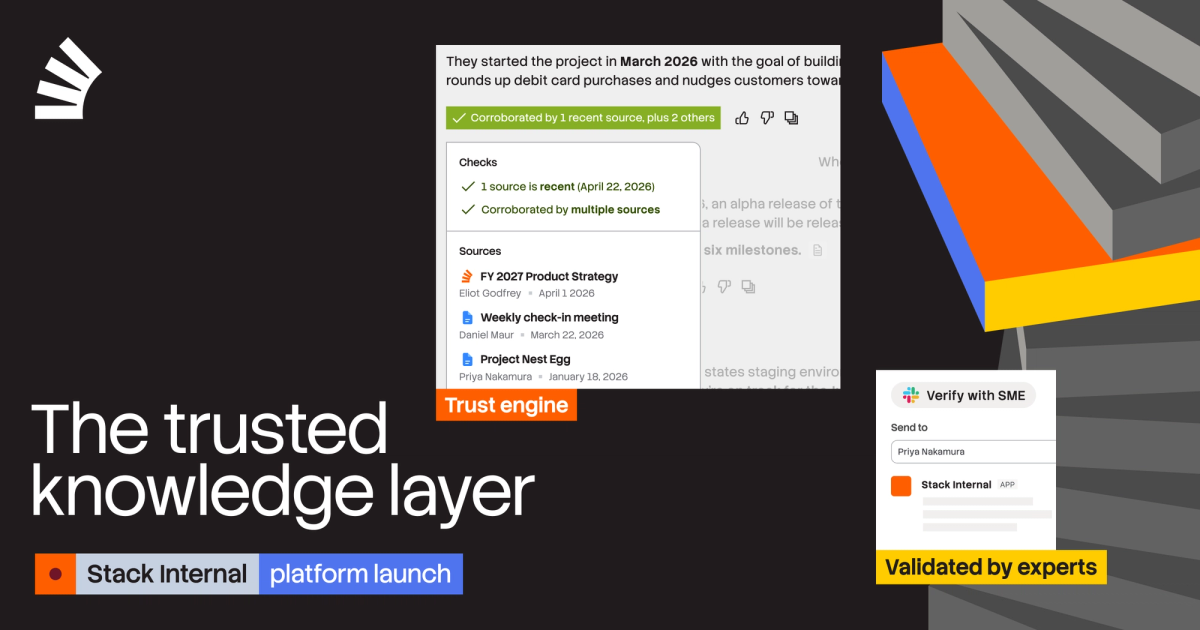
Most AI experiences falter at this exact juncture by generating a complete-sounding response that forces employees to manually check underlying sources and chase down colleagues for confirmation. If enterprises want staff to rely on automated systems for consequential questions, the underlying architecture must provide more than raw text retrieval. Five specific requirements govern whether an organization can trust an automated output: verifiable provenance, contextual boundaries like product versions or regional configurations, strict permission controls respecting source boundaries, explicit surfacing of conflicting documentation, and a clear path to human ownership.
Scaling Expert Resolution Without Creating Bottlenecks
Relying solely on citations or trust scores fails to solve the underlying operational challenge, because neither metric takes responsibility for a product commitment. Product can confirm current capabilities, engineers can explain the configuration, and support can tell us what customers are encountering. Forcing these specialists to review every routine AI-generated response creates a destructive operational queue. Instead, organizations require systems that bring human expertise in only when automated sources conflict, when answers carry high uncertainty, or when widely used documentation needs validation.
Once a team resolves a customer question, that validated result must persist within the environment alongside its supporting evidence and conditional rules. If product specs change later, a person must be able to correct the record so that subsequent inquiries inherit accurate context. This operational loop mirrors the core mechanics of community-driven knowledge management. Stack Overflow spent nearly two decades demonstrating that an answer becomes more useful when corrections, edits, and historical context remain visible to the next person searching for guidance.
Opening Stack Internal to Broader Teams
Bringing those collaborative verification practices directly inside corporate firewalls is the core mission behind the Stack Internal platform. The organization is opening the Stack Internal platform to more people and teams. By integrating AI-driven retrieval with human-governed curation, the system aims to help engineering and support groups bridge the gap between fast search results and verified, decision-grade enterprise knowledge.