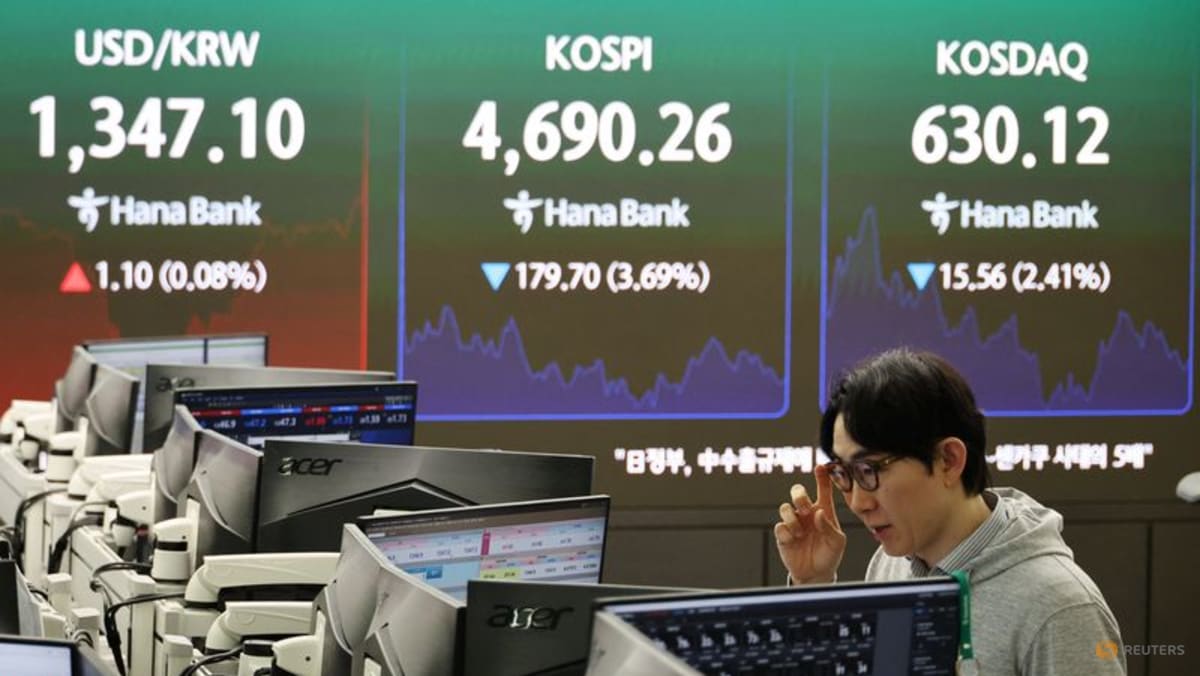
AI Rally Called Dead-cat Bounce as Chip Stocks Tumble Wednesday
“What looked like the mother of all relief rallies has already acquired the rather less flattering characteristics of a dead-cat bounce,” said Stephen Innes of SPI Asset Management, as markets reversed gains triggered by the return of Nvidia CEO Jensen Huang.
Technology stocks tumbled on Wednesday, erasing the optimism that had briefly swept through global exchanges.
The sharp retreat followed a volatile two-day period for semiconductor firms and AI-related companies. After surging on news of Huang’s reinstatement, investors moved to unload technology exposure rather than rebuild it, according to Innes, who told CNA that the rally was fueled by forced buying rather than genuine conviction.
“The champagne from (the) Nvidia resurrection had barely lost its fizz before Wall Street was back reaching for the sick bags,” said Stephen Innes of SPI Asset Management.
He said: “Professional investors (were) apparently using the opening provided by the Jensen Huang comeback to unload technology exposure rather than rebuild it”. “And that, unfortunately, is what happens when a market rallies on the back of forced buying rather than genuine conviction.”
Regional Sell-off Hits Chip Suppliers
Asian markets fell sharply Wednesday, led by companies in the AI supply chain. Taiwan’s Taiex plunged as much as 7.9 percent, while South Korea’s Kospi fell more than 6 percent, according to Al Jazeera. There was also heavy selling in Shanghai, Sydney and Singapore. However, Hong Kong, Wellington and Manila edged up.
Japan’s Nikkei 225 dropped 3.6 percent, with chip-testing equipment producer Advantest plunging 14.5 percent and Tokyo Electron falling 13.5 percent, Al Jazeera reported. In South Korea, memory chip giants Samsung Electronics and SK Hynix sank 9.1 percent and 9.9 percent, respectively. Taiwan Semiconductor Manufacturing Company (TSMC) and Apple supplier Foxconn also recorded declines of more than 9 percent, Al Jazeera noted.
Wall Street Reversal
The downturn mirrored a transition on Wall Street, where the Philadelphia Semiconductor Index closed down nearly 8 percent on November 24, leaving the index roughly 40 percent below its June high, according to BigGo Finance.
Nvidia shares fell 5.86 percent, surrendering a portion of the 31.5 percent gain recorded on Monday, while Anthropic lost 6.5 percent, Yahoo Finance Singapore reported. Memory chips bore the brunt of the selloff. Micron dropped 11%, and AMD lost almost 9%. Nvidia fell nearly 6%.

Analysts point to persistent concerns regarding the return on investment for the multi-trillion-dollar AI buildout. “Some key issues continue to overhang the AI sector, including whether investment in the sector will provide an adequate return and the threat of regulation under a new administration from next year,” Jason Wong of BNZ told CNA. “We’re all everyone got excited when they heard implied correlation,but you have to look, 7:16 spk_4 35% of the market isn’t isn’t correlated to say AI we’ll call it.”
Huang to Testify Before Senate on Chip Exports
Despite the leadership change at Nvidia, geopolitical and regulatory headwinds remain. Huang is scheduled to testify before the US Senate Banking Committee on December 3 regarding US chip-export controls, as the company faces ongoing scrutiny from Capitol Hill and the FBI over allegations concerning access to top-line chips by Chinese firms, according to Business Insider.
Too big to fail? What Jensen Huang's return to Nvidia means for AI stocks and Indian marketshttps://t.co/dcJFJsndcD pic.twitter.com/GO73DEE2sD
Market participants are now turning their attention to upcoming economic data. Investors are monitoring the Federal Reserve’s preferred gauge of inflation, due for release later today, which is expected to influence the central bank’s interest rate decision next month, CNA reported.
“That’s because with Huang at Nvidia or not, it’s safe to say that the politicians are still ‘coming after’ AI,” Macquarie Group strategists wrote, as reported by Business Insider.

US Markets Extend Tech-Led Decline
All 30 components finished lower, with Nvidia surrendering 5.86 percent to $155.38 after its record single-day surge. AMD fell 8.86 percent, Intel slid 8.15 percent, and ARM dropped 8.55 percent, while memory names led the retreat as Micron lost 10.97 percent and SanDisk declined 11.13 percent.
Optical communications shares were also hit, with Lumentum falling 10.52 percent, Tower Semiconductor dropping 9.75 percent and Marvell losing 9.10 percent. The Magnificent Seven index declined 1.03 percent, though Apple and Microsoft bucked the trend with gains of 1.43 percent and 0.74 percent respectively.
The article’s language of a “return,” “resurrection,” and “comeback” stems from a board action in November 2026, when Huang resigned as CEO, president, and co-founder of Nvidia and was reinstated 11 days later.
Although he had held the chief executive role continuously since co-founding the company in 1993, that brief separation created a formal leadership interruption. The market rally described in the piece reacted to his restoration to those same offices after that 11-day gap, not to a new appointment.
Jensen Huang will hold a companywide meeting with $NVDA employees today at 330 PM ET. It’ll be his first all-hands since returning as CEO. pic.twitter.com/TFWAXZr7I4
Asian Sell-Off Deepens Across Chip Supply Chain
Heavy selling also spread to Shanghai, Sydney and Singapore, though Hong Kong’s Hang Seng Index rose as much as 1.3 percent, with Wellington and Manila edging higher, Al Jazeera and Yahoo Finance Singapore noted. Japan’s Kioxia plunged 16 percent and SoftBank Group shares fell as much as 17 percent to a 52-week low.