
## AI Fuels the future of Spacecraft Propulsion, Including Potential for nuclear Rockets
Artificial intelligence, specifically reinforcement learning, is rapidly becoming a crucial tool in optimizing spacecraft propulsion systems, with potential applications extending to advanced technologies like nuclear thermal rockets and fusion-based propulsion. The complexity of these systems demands innovative approaches to design and operation, and AI is proving capable of tackling challenges previously insurmountable.
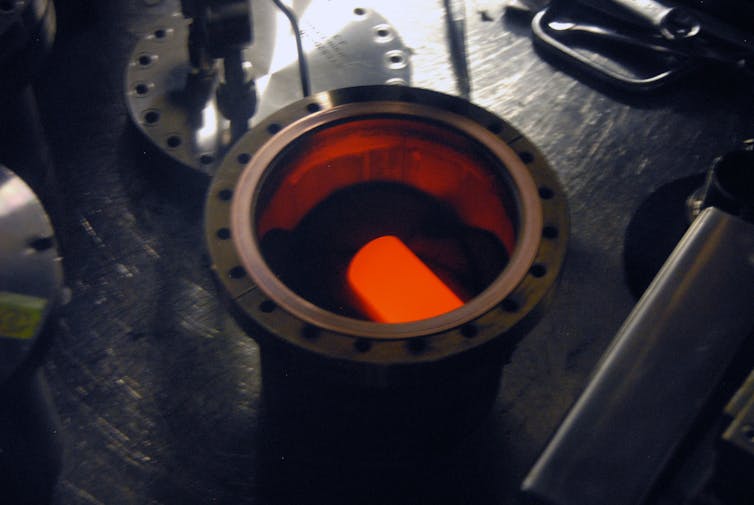
The core principle driving much of this research is efficiency: maximizing thrust generated from a given fuel source.This is particularly critical for nuclear thermal rockets, a technology first experimented with in 1967. These rockets utilize a nuclear reactor to heat a propellant, typically hydrogen, to extremely high temperatures, creating powerful exhaust. The efficiency of heat transfer from the reactor to the hydrogen directly impacts the thrust produced.
Reinforcement learning excels at navigating the intricate design parameters involved in optimizing this heat transfer. The process involves countless variables, including material properties and hydrogen flow rates. As explained in research published in *Journal of Nuclear Engineering* (https://doi.org/10.3390/jne5030015), reinforcement learning can analyze numerous design variations to identify configurations that maximize heat transfer. Researchers describe this process as analogous to a “smart thermostat” – but one operating under far more extreme conditions.
Beyond nuclear thermal rockets, reinforcement learning is also contributing to the advancement of nuclear fusion technology for space propulsion. While large-scale fusion experiments like the JT-60SA tokamak in Japan are valuable, their size makes them unsuitable for spaceflight. Consequently, researchers are investigating more compact designs, such as polywells developed by EMC2 Fusion Systems (https://www.emc2fusion.com/technology/technology). These devices,roughly cubic in shape and only a few inches across,use magnetic fields to confine plasma and initiate fusion.
Controlling the magnetic fields within a polywell is a significant hurdle. These fields must be strong enough to contain hydrogen atoms until they fuse, a process requiring considerable initial energy but potentially becoming self-sustaining. Recent research, detailed in a paper available on arXiv (https://arxiv.org/pdf/2508.06761), focuses on utilizing reinforcement learning to effectively manage these complex magnetic fields. Triumphant control is vital for scaling this technology for use in nuclear thermal propulsion.
The benefits of AI extend beyond design and into operational efficiency. Reinforcement learning can optimize fuel consumption, a critical factor for missions requiring adaptability. The space industry is increasingly interested in versatile spacecraft capable of fulfilling multiple roles based on evolving mission needs.
This adaptability is exemplified by technologies like Lockheed Martin’s LM400 satellite, designed with variable capabilities including missile warning and remote sensing. Though, this versatility introduces uncertainty regarding fuel requirements and timing. Reinforcement learning can assist in accurately calculating these needs, enabling more efficient mission planning.
From everyday applications like bicycles to complex systems like rockets, learning through experience – whether human or machine – is driving innovation in space exploration.As scientists continue to push the boundaries of propulsion and artificial intelligence, AI is poised to play an increasingly significant role in unlocking new possibilities for space travel and discovery.
