
AI’s $160 billion Impact: Why Official GDP Numbers Are Missing the Real Story
By Priyashah, World-Today-news.com – September 14, 2023
Key Takeaway: Artificial intelligence is already a notable driver of economic growth in the United States, but current GDP calculations are dramatically underestimating its impact. A new analysis from Goldman Sachs reveals AI has likely boosted the U.S. economy by $160 billion as the launch of ChatGPT in late 2022 – a figure far exceeding official government measurements.
The rise of AI is being touted as the next industrial revolution, and the numbers are starting to reflect that potential. Though, a critical gap exists between the reality of AI’s economic contribution and how it’s measured by traditional metrics.
A research note published this week by Elsie Peng, Joseph Briggs, and Sarah Dong of Goldman Sachs, working under Chief Economist Jan Hatzius, highlights a essential issue with how the Bureau of Economic Analysis (BEA) currently accounts for AI’s influence on Gross Domestic Product (GDP). The BEA’s “measured impact” only registers economic activity when a final product is sold. This means the substantial investment in AI infrastructure – the semiconductors, servers, and data centers powering the AI boom – isn’t fully reflected in GDP until those components are embedded in finished goods like laptops or software.
The Disconnect: $160 Billion vs. $45 Billion
This methodology creates a significant undercount. Goldman Sachs estimates the “true GDP” impact of AI since 2022 to be a staggering $160 billion, representing approximately 0.7% of total U.S. GDP and contributing roughly 0.3 percentage points to annualized growth.
In contrast, the officially measured GDP impact is just $45 billion (0.2% of GDP, or 0.1 percentage points of annualized growth). This discrepancy underscores the extent to which AI’s economic benefits are currently ”invisible” in official statistics.
Where is the Money Going?
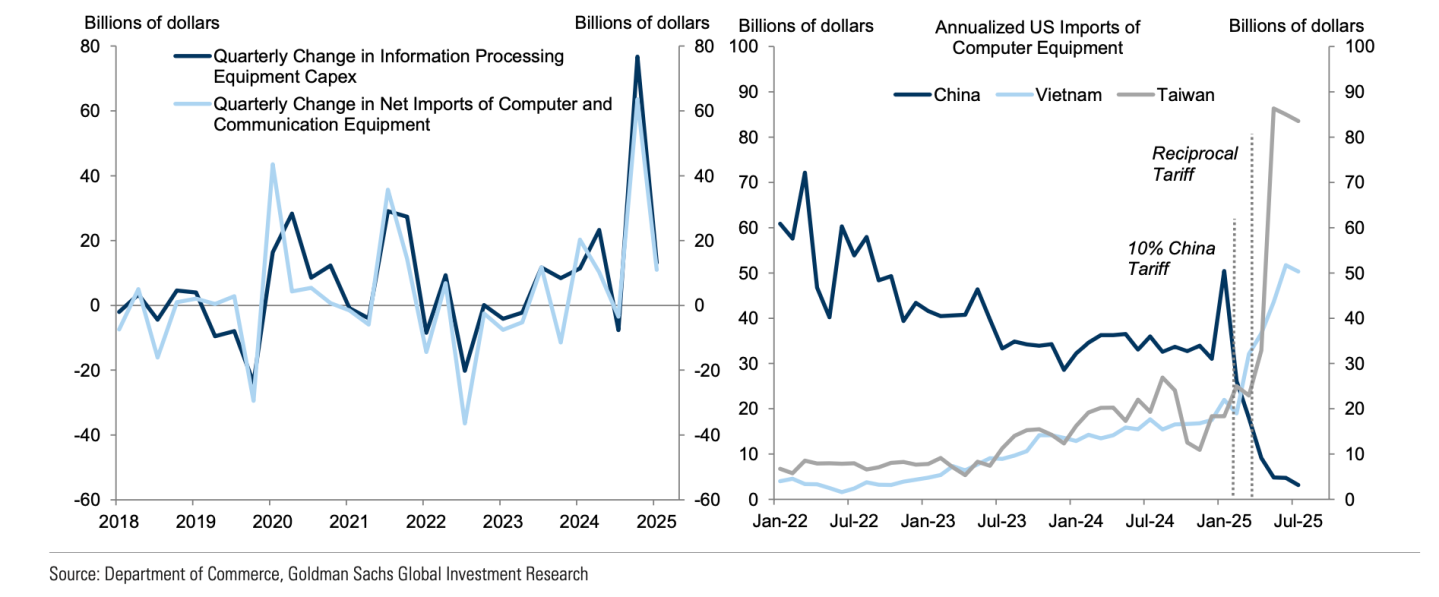
The surge in AI-related spending has been dramatic.U.S. firms have increased investment in AI infrastructure by $400 billion since 2022, with a particularly sharp increase in information processing equipment – a 39% annualized rate in the first half of 2023.
Goldman Sachs’ analysis breaks down AI’s economic impact into four key channels:
* Investment in Equipment: Semiconductors, servers, and other hardware.
* structures: Data centers and the power infrastructure needed to support them.
* Intellectual Property: Spending on AI software and research & development (R&D).
* Net exports: AI-related goods and services sold internationally.
A Cautionary Note: imports and Tariffs
Though, the report also cautions that a significant portion of this investment has been driven by imports, meaning it doesn’t contribute directly to net GDP growth. Furthermore, the rapid increase in investment this year may be partially attributable to companies front-loading purchases ahead of anticipated tariff hikes.
what This Means for the Future
This analysis has significant implications. It suggests that the U.S. economy is already benefiting more from AI than official figures indicate. As AI continues to develop and integrate into more sectors, accurately measuring its economic impact will be crucial for informed policymaking and a realistic understanding of economic growth. The current methods, it truly seems, are falling behind the pace of innovation.
SEO Keywords: AI, Artificial Intelligence, GDP, Economic Growth, Goldman Sachs, Bureau of Economic Analysis, US Economy, Investment, Technology, ChatGPT, Data Centers, Semiconductors, Economic Impact, Innovation.
