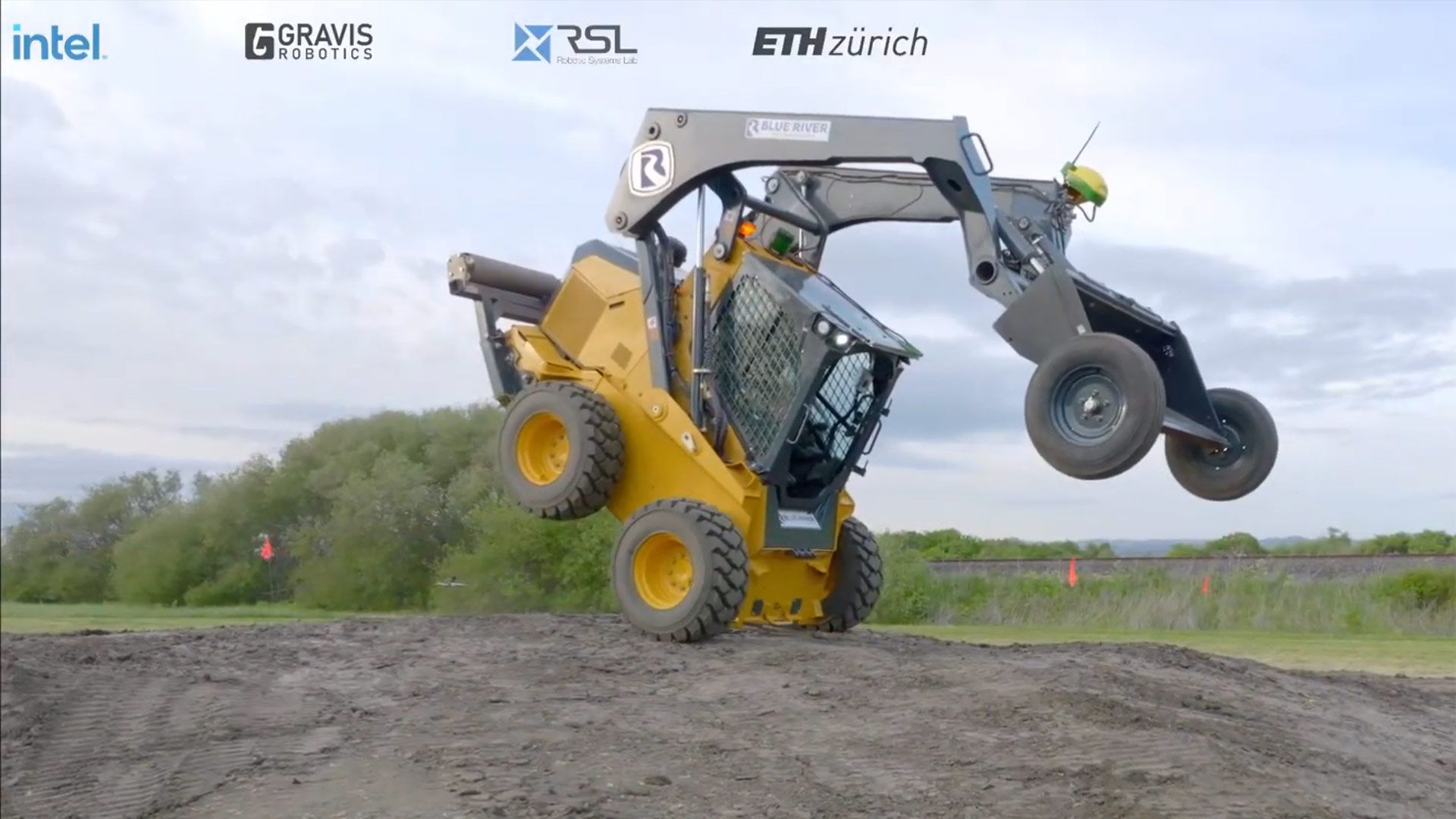
AI Enables 5-Ton John Deere Loader to Perform Autonomous Acrobatic Maneuvers
Researchers have successfully taught a five-metric-ton John Deere 332G skid-steer loader to perform autonomous acrobatic maneuvers, a feat previously limited to a small number of elite human operators.
The project, detailed in a study published in Science Robotics on November 11, 2026, aims to advance autonomous control for heavy machinery in construction and mining.
The team, composed of roboticists from ETH Zürich, Blue River Technology, Gravis Robotics, and Intel’s Intelligent Systems Lab, utilized reinforcement learning to train the machine. Because the loader’s size and complex hydraulic systems make physical testing risky, the researchers first developed a simulated environment.
“Automation of heavy machinery offers the opportunity to improve productivity in mechanized industries such as construction, mining and material handling,” the authors wrote in their paper, Heavy metal acrobatics: Learning dynamic control for skid-steer loaders.
Researchers have used reinforcement learning to teach a 5-tonne John Deere skid-steer loader to perform complex acrobatic manoeuvres autonomously. Trained in simulation and transferred to a real machine, the system can balance on two wheels, navigate rough terrain, spin, and… pic.twitter.com/1alXK4wLXU
The machine was programmed to execute a range of complex movements, including rising onto two wheels, driving over rough terrain while balanced, spinning, and manipulating its bucket.
Heavy machinery performance capabilities
| Maneuver type | Operational status |
|---|---|
| Balance on two wheels | Autonomous |
| Navigating rough terrain | Autonomous |
| Spinning and bucket movement | Autonomous |
The research highlights the potential for AI to manage heavy equipment that relies on fluid-based actuation and nonlinear mechanical delays.

Authors reveal research methodology
The researchers developed a simulated environment to train their control policies, as the loader’s size and weight made physical experiments exceedingly dangerous, wrote Pierre-Jean Lorentz, Pascal Egli and their colleagues. They used reinforcement learning in this simulation to teach the machine a range of skills, including rising onto two wheels and balancing, before transferring the trained policies to the real John Deere 332G loader.
“We show that RL in simulation, followed by transfer of the learned policies from simulation to reality, can successfully automate acrobatic maneuvers that push a heavy construction machine to the limits of its actuation and have only previously been accomplished by a small number of elite human operators in official world-record performances,” the authors said in their paper.
Autonomous 5-ton John Deere skid-steer loader trained to perform acrobatic maneuvers using AI — only a handful of elite human operators can match the stunts, ‘Heavy Metal Acrobatics’ paper discusses reinforcement learning tech https://t.co/L82chyn41U
Researchers cite industry challenges
They said that automation is challenged by complex dynamics, particularly hydraulic actuation involving fluids and nonlinear delays, alongside the inherent dangers of large, heavy machines.
Their research directly contributes to greater automation in these sectors, aiming to create systems that can autonomously perform complex maneuvers like balancing on two wheels and driving over rough terrain, tasks previously limited to elite human operators.
John Deere, ranked No. 84 in the 2022 Fortune 500 list of the largest United States corporations, manufactures a wide range of heavy machinery, including agricultural equipment, forestry machinery, and diesel engines. The company’s tractor series, such as the D series, E series, and Super Heavy Duty Tractors, exemplify its extensive operations in producing heavy machinery for various industries.
In the context of the news, John Deere’s 332G skid-steer loader, a five-metric-ton unit, was used to demonstrate advanced autonomous control, showcasing the company’s role in developing cutting-edge heavy equipment. This specific model highlights John Deere’s focus on innovative machinery that integrates advanced technologies for complex operational tasks.
Despite the success of the test runs, the researchers said that further development is required before such controllers can be deployed for routine tasks at active construction sites. The team said that their work demonstrates how reinforcement learning and sim-to-real transfer can enable dynamic autonomous control for heavy equipment, potentially increasing safety and speed in the industry.