
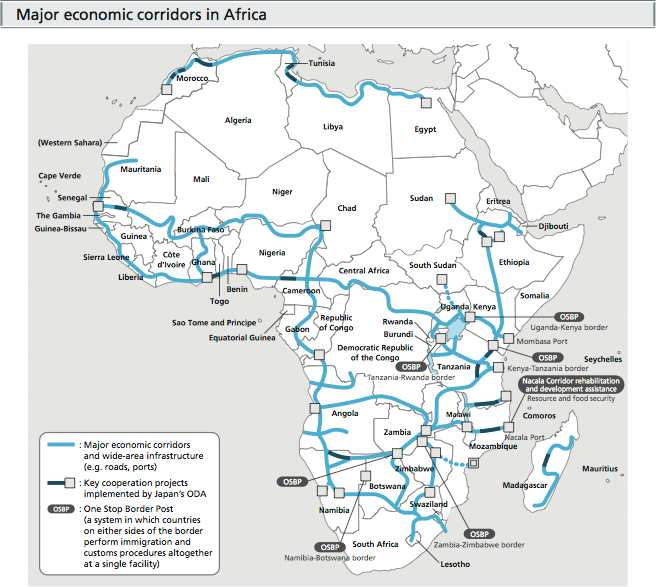
Africa’s Economic Corridors: Unlocking Trade and Growth
Africa is accelerating economic integration through strategic transport corridors, linking key ports to landlocked markets. From EU-backed PIDA initiatives to Gulf-funded routes in the Horn of Africa, these arteries are unlocking trade, boosting local industries, and restructuring the continent’s logistical landscape to facilitate global commerce.
The movement of goods across Africa has historically been a battle against geography and fragmented infrastructure. Now, the paradigm is shifting. We are seeing the emergence of “strategic corridors”—massive, multi-national transport arteries designed to eliminate bottlenecks and integrate regional economies into the global supply chain.
This isn’t just about laying asphalt. It is about geopolitical realignment.
As global trade reroutes due to instability in other regions and new tariff regimes, Africa is positioning itself as a critical logistical bridge. The scale of investment is staggering, with the Gulf Cooperation Council (GCC) states alone deploying over $100 billion into the continent. Bilateral trade between the GCC and Africa grew at an annual rate of approximately 8% between 2021 and 2022, reaching a valuation of $154 billion.
The EU-Africa Strategic Blueprint
The European Union is focusing its efforts on eleven strategic corridors aligned with the Programme for Infrastructure Development in Africa (PIDA PAP 2). These routes are designed to be “greener” and more sustainable, focusing on the territorial organization of both rural and urban areas.

The scope of these corridors spans the entire continent, creating a web of connectivity that reduces the cost of doing business across borders. For companies attempting to enter these markets, the legal complexity of operating across multiple jurisdictions is a significant hurdle. Many are now engaging international trade attorneys to navigate the overlapping regulatory frameworks of these multi-state corridors.
| Region | Strategic Corridor | Participating Countries |
|---|---|---|
| West Africa | Abidjan-Lagos | Côte d’Ivoire, Ghana, Togo, Benin, Nigeria |
| West Africa | Abidjan-Ouagadougou | Côte d’Ivoire, Burkina Faso |
| West Africa | Praia / Dakar-Abidjan | Senegal, Gambia, Guinea-Bissau, Guinea, Sierra Leone, Liberia, Côte d’Ivoire, Cabo Verde |
| West Africa | Cotonou-Niamey | Benin, Niger |
| Central Africa | Libreville / Kribi / Douala-N’Djamena | Gabon, Equatorial Guinea, Cameroon, Chad, São Tomé and Príncipe |
| Central Africa | Douala / Kribi-Kampala | Cameroon, Central African Republic, Republic of Congo, Uganda |
| East Africa | Mombasa-Kisangani | Kenya, Uganda, Rwanda, Democratic Republic of Congo |
| East Africa | Dar es Salaam – Nairobi – Addis Abeba – Berbera – Djibouti | Tanzania, Kenya, Ethiopia, Somalia, Djibouti |
| Southern Africa | Maputo-Gaborone-Walvis Bay | Mozambique, South Africa, Eswatini, Botswana, Namibia |
| Southern Africa | Durban-Lusaka | South Africa, Botswana, Zimbabwe, Zambia |
| North & East Africa | Cairo-Khartoum-Juba-Kampala | Egypt, Sudan, South Sudan, Uganda |
These routes are more than paths for trucks; they are value-chain accelerators. By linking ports like EU-Africa strategic corridors to interior hubs, the EU is attempting to foster sustainable investment in services and jobs.
The Gulf Influence and the Red Sea Pivot
Whereas the EU focuses on sustainability and PIDA alignment, Gulf investors are targeting high-growth logistical gateways, specifically along the Red Sea and the Horn of Africa. The Berbera–Ethiopia trade route has develop into a focal point for this investment, serving as a critical point of access for landlocked Ethiopia.
Egypt and Morocco have emerged as the primary “gateways.” Egypt serves as the anchor for East Africa, with commercial routes extending deep into Sudan, Kenya, and Uganda. Morocco has mirrored this success in the West, leveraging political ties with francophone markets to become a hub for West African commerce.
This influx of capital is extending beyond physical roads. The United Arab Emirates recently announced plans to inject up to $1 billion in AI infrastructure funding across Africa. When you combine AI-driven logistics with physical corridors, the efficiency of the “last mile” changes completely.
To optimize these new high-tech routes, firms are increasingly relying on supply chain consultants to integrate AI and automated tracking into their distribution networks.
The Granular Network: TTTFP and Regional Arteries
Beyond the massive strategic corridors, a more granular network of regional arteries exists, managed through initiatives like the Tripartite Transport Facilitation Project (TTTFP). These corridors address specific regional needs, often linking a single port to a specific inland resource zone.
- The Lobito-Benguela and Namibe Corridors: Critical for moving minerals and goods through Angola.
- The Beira and Nacala Corridors: Essential lifelines for Mozambique and its landlocked neighbors.
- The North-South Corridor: A massive artery connecting Southern African Development Community (SADC) nations.
- Specialized Routes: Including the Arusha, Bas Congo, Mtwara, and the Trans-Kalahari corridors.
The sheer variety of these routes—from the Maseru-Durban to the Port Sudan corridor—demonstrates a continent-wide effort to eliminate “dead zones” in trade. However, the physical construction of these routes requires immense technical precision and adherence to varying national standards.
This is where the role of civil engineering firms becomes paramount. The challenge is not just building the road, but ensuring it can withstand local climate stresses while meeting international transit standards.
The transformation of Africa’s trade landscape is no longer a theoretical goal; it is a physical reality being etched into the earth. Whether it is the $154 billion in trade flowing through GCC gateways or the 11 strategic corridors of the EU’s Global Gateway, the result is the same: a continent that is becoming more accessible, more integrated, and more economically potent.
But with this growth comes a new set of risks. The complexity of cross-border logistics, the volatility of international investment, and the require for rigorous legal compliance mean that “going it alone” is a recipe for failure. As these arteries expand, the difference between profit and loss will be determined by the quality of the professional partners a business chooses.
Navigating this new map requires more than a GPS; it requires a network of verified experts. Whether you are seeking the legal architecture to protect a cross-border investment or the engineering expertise to build a regional hub, the World Today News Directory remains the definitive resource for connecting with the professionals who are building Africa’s future.