
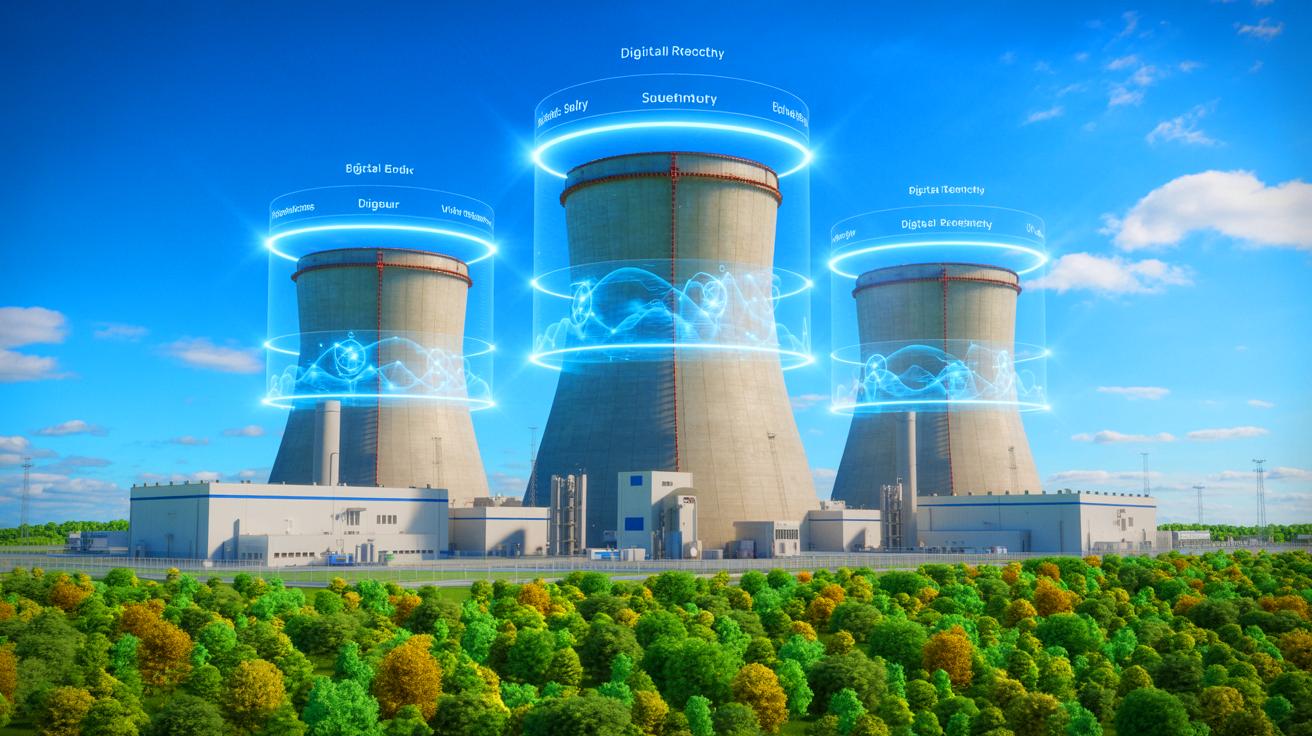
Advanced Nuclear & Digital Twins: Smarter Plant Operations
SMR Digital Twins Offer Efficiency Gains, But OT Security Debt Is Skyrocketing
Small modular reactors (SMRs) are finally hitting commercial deployment milestones in 2026, promising baseload power without the civil engineering nightmares of legacy plants. The latest operational leap comes from high-fidelity digital twins that simulate core thermodynamics in real-time. Although plant operators celebrate the efficiency bumps, security architects are sounding the alarm. Connecting physical control systems to cloud-based inference engines dissolves the traditional air gap, creating a blast radius that extends from the turbine hall to the corporate LAN.
- The Tech TL;DR:
- New digital twin architectures reduce SMR operational latency by 40% but expose OT networks to IT-level threats.
- Compliance shifts from static IEC 62443 checks to continuous AI-driven monitoring under new federal mandates.
- Enterprise IT teams must engage specialized cybersecurity auditors to validate twin-to-physical data integrity.
The core value proposition of these digital twins lies in predictive maintenance and fuel optimization. By ingesting telemetry from thousands of sensors, the twin models neutron flux and thermal hydraulics faster than physical feedback loops allow. However, this requires a bidirectional data flow. The twin doesn’t just read data; it pushes configuration updates to the programmable logic controllers (PLCs). This architecture mirrors the vulnerabilities seen in recent critical infrastructure breaches where supply chain compromises allowed attackers to manipulate setpoints remotely.
The OT/IT Convergence Bottleneck
Legacy nuclear facilities relied on proprietary, isolated networks. Modern SMR designs assume connectivity. The digital twin stack typically runs on Kubernetes clusters, ingesting data via MQTT or OPC UA protocols. This standardization is a double-edged sword. It allows for easier integration with enterprise ERP systems but introduces common vulnerabilities like CVE-2025-4409 into the control plane. When a plant manager adjusts a control rod sequence based on a twin’s recommendation, they are trusting the integrity of the entire data pipeline.

Latency is the enemy here. A digital twin requiring 200ms round-trip time to a public cloud region is useless for safety-critical shutdown sequences. Most vendors are moving to edge computing architectures, processing data on-premise while syncing metadata to the cloud. This hybrid model complicates the security perimeter. You are no longer defending a castle; you are defending a mesh network that spans physical and virtual domains.
“The industry is treating AI-driven twins as optimization tools, not security boundaries. We are seeing SOC 2 compliance frameworks applied to systems that require IEC 62443-3-3 hardening. That mismatch is where the risk lives.” — Lead OT Security Architect, Tier-1 Nuclear Vendor
The regulatory landscape is catching up. The AI Cyber Authority has begun outlining specific criteria for AI models interacting with critical infrastructure. This isn’t just about data privacy; it’s about physical safety. A hallucinating model suggesting incorrect coolant flow rates could trigger a SCRAM or, worse, fail to trigger one during an anomaly. Organizations need to verify that their AI models are robust against adversarial inputs designed to skew simulation results.
Implementation Reality: Monitoring the Twin
Developers integrating these twins need to enforce strict validation on incoming telemetry. Blindly trusting sensor data allows for spoofing attacks. Below is a simplified Python snippet demonstrating how to validate data signatures before ingesting them into the twin’s state machine. This ensures that only authenticated PLCs can update the simulation.
import hashlib import hmac def validate_sensor_payload(payload, secret_key): """ Validates the HMAC signature of incoming OT sensor data before updating the Digital Twin state. """ signature = payload.get('signature') data = payload.get('data') expected_sig = hmac.new( secret_key.encode('utf-8'), data.encode('utf-8'), hashlib.sha256 ).hexdigest() if not hmac.compare_digest(signature, expected_sig): raise PermissionError("Invalid sensor signature. Potential spoofing attempt.") return True # Usage in ingestion pipeline try: validate_sensor_payload(incoming_packet, OT_SECRET_KEY) update_twin_state(incoming_packet['data']) except PermissionError as e: log_security_event(e) trigger_alert_system() This code represents the bare minimum for data integrity. In production, you need mutual TLS, hardware security modules (HSMs) for key storage, and continuous monitoring for anomalous traffic patterns. The complexity of managing these keys across a distributed SMR fleet is where most organizations fail. They lack the internal expertise to manage OT-specific cryptography without disrupting plant operations.
The Audit Imperative
Because the attack surface has expanded, internal IT teams cannot rely on standard vulnerability scanners. Traditional tools often crash when scanning legacy PLCs or misinterpret industrial protocols as malicious traffic. This creates a blind spot where vulnerabilities festers unnoticed. To mitigate this, facilities are increasingly turning to specialized cybersecurity audit services that understand the nuances of industrial control systems.

These audits move beyond standard penetration testing. They involve reviewing the logic of the digital twin itself. Could an adversary manipulate the training data to make the twin ignore specific failure modes? This type of adversarial machine learning testing requires a different skillset than traditional network security. It aligns with the roles currently being hired by major tech firms, such as the Director of Security | Microsoft AI positions that focus on securing AI infrastructure at scale.
the supply chain for these digital twins is complex. They rely on open-source libraries for data visualization and machine learning frameworks like PyTorch or TensorFlow. Each dependency introduces potential vulnerabilities. Organizations must maintain a software bill of materials (SBOM) for their twin software, just as they do for their physical components. Failure to do so leaves them exposed to vulnerabilities like Log4j, but in a nuclear context.
Vendor Selection and Risk Mitigation
When selecting a digital twin provider, CTOs must look past the marketing dashboards. Ask for the architecture diagrams. Where does the data reside? Who holds the encryption keys? Is the model training happening on-premise or in a shared tenant? The answers dictate the risk profile. Many vendors are shifting towards AI security firms to validate their models before deployment, ensuring that the optimization algorithms don’t introduce instability.
The cost of skipping these steps is non-linear. A data breach in a SaaS company loses customer records. A breach in an SMR digital twin compromises public safety and national security. The technology is ready, but the operational security posture lags behind. As deployment scales through 2026, the organizations that treat security as a feature rather than a compliance checkbox will be the ones that survive regulatory scrutiny.
We are entering an era where software defines physical safety. The digital twin is not just a mirror; This proves the brain of the plant. Protecting it requires a convergence of IT security rigor and OT operational knowledge. For most enterprises, that means outsourcing the validation to experts who speak both languages. The technology promises a cleaner energy future, but only if the code holding it together is as robust as the containment vessel surrounding the core.
Disclaimer: The technical analyses and security protocols detailed in this article are for informational purposes only. Always consult with certified IT and cybersecurity professionals before altering enterprise networks or handling sensitive data.